Tomar's Festa dos Tabuleiros: An Honest Guide
Once every four years, Tomar fills with young women balancing towers of 30 loaves on their heads and streets carpeted in handmade flowers. An honest guide to seeing the Festa dos Tabuleiros without ending up sleeping in Abrantes.
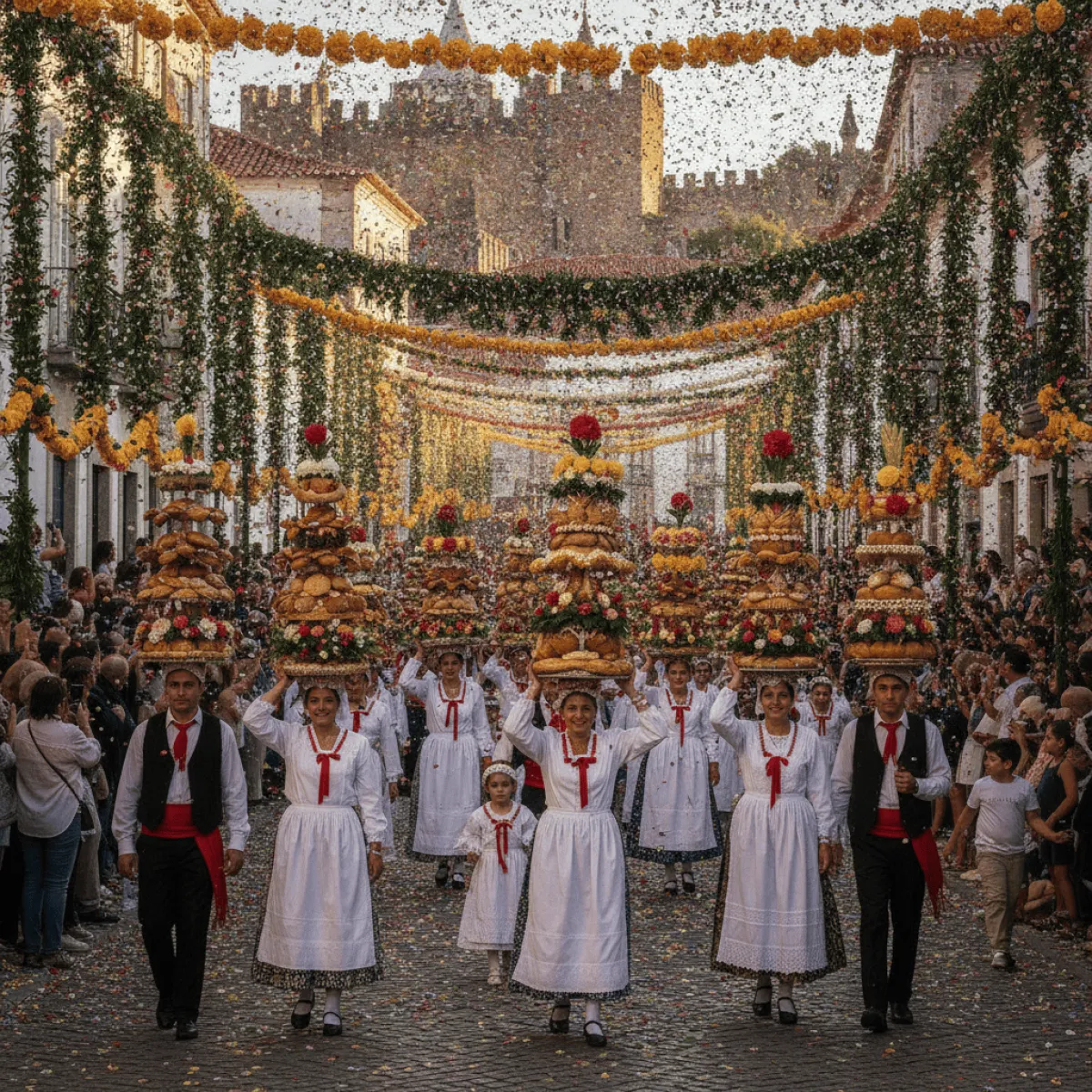
Once every four years, Tomar turns itself into what is probably the most visually improbable festival in Portugal: hundreds of young women dressed in white walking through the streets with 15 kilo trays balanced on their heads, each tray a tower of 30 loaves of bread skewered onto canes, decorated with paper flowers and crowned by a dove or a cross. The tray has to match the height of the woman carrying it. That is not a metaphor. It is an actual rule of the procession, and any local will tell you of more than one young woman who trained for months and still had to be steadied halfway down Rua Serpa Pinto.
The Festa dos Tabuleiros, also known as the Festa do Espírito Santo, takes place in July, every four years, although the periodicity has shifted over the centuries. The next confirmed edition, if it has not happened already, check locally, since the Tomar council has been adjusting the calendar for logistical reasons and even pandemics. What does not change is the essential: the city fills up, accommodation prices triple, and anyone showing up without a reservation ends up sleeping in Abrantes or Torres Novas.
Why bother coming
Let me be blunt: if you are after a Portuguese popular festival in the São João do Porto style, with grilled sardines, basil pots and plastic hammers, look elsewhere. The Tabuleiros are a different beast, more ceremonial, much older, stranger in the best sense of the word. The roots reach back to the 14th century, tied to the cult of the Holy Spirit brought to Portugal by Queen Saint Isabel, and the ritual structure, the procession, the blessing of bread and wine, the pezada (communal meal) and the cattle distribution, has survived almost intact.
What you see in the old town during the main week is something that has no real equivalent anywhere else in the country. The streets are carpeted with hand made flower patterns: paper petals, eucalyptus leaves, dyed salt, geometric drawings that cover entire blocks. Each parish adopts a street and neighbourhoods compete in silence to see whose carpet looks best. Locals work on them through the night, and by sunrise Rua Direita looks like a cathedral with the roof torn off.
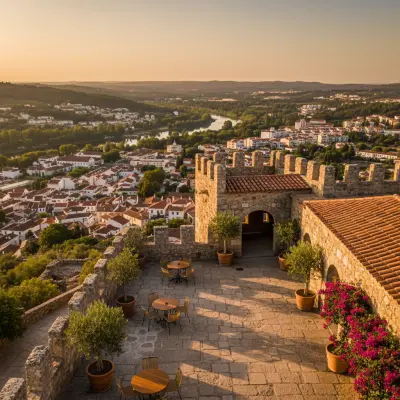
For an overview before the main procession, climb up to the Miradouro do Castelo de Tomar in the late afternoon. From there you see the whole city getting ready: flags hanging from balconies, the Convento de Cristo carved against the setting sun, and the Nabão river cutting everything in half. It is also the best spot to grasp the scale of the festival before you plunge into it.
The procession, in practical terms
The main Tabuleiros procession traditionally takes place on the Sunday. It leaves from the square in front of the Igreja de São João Baptista, winds through the decorated streets and ends near the Convento de Cristo. Allow two to three hours if you want to see the whole thing, although what really matters is the first 40 minutes: that is when the pairs go past (each girl is accompanied by a young man in white shirt, black tie, jacket draped over the shoulder) and the choreography of balancing is most visible.
One practical tip: do not stand near Praça da República, it is always packed and the trays pass in a flash. Position yourself halfway down Rua Serpa Pinto or on Rua Infantaria 15, where buildings give some shade and the procession moves more slowly. Bring water. Bring a hat. In July, in Tomar, at midday, the thermometer hits 38 Celsius without ceremony.
There are other processions during the week: the boys', where young men carry baskets of bread, the Blessing of the Pezada, and the Cattle Distribution, which typically takes place on the following Monday and sees livestock handed out to the poor of the city, a gesture that preserves the original social function of the festival. This last ceremony is the most authentic and the least touristy. If you can stay one more day, stay.
Where to sleep (the hard part)
Tomar has a modest hotel stock and the Festa dos Tabuleiros sells out everything within 30 kilometres six months in advance. If you are reading this less than three months before the festival, prepare to stay further out or to pay a premium. That said, there are three options I recommend without hesitation for travellers who want to avoid the chaos of the centre but still sleep relatively close.
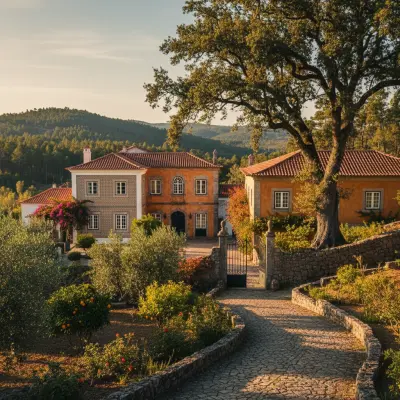
The Quinta do Troviscal is probably the most elegant choice: a country estate by the Zêzere river, with a pool, mature gardens and rooms with character. It is about 20 minutes by car from the centre, which during the festival is a blessing: you arrive at night, dive into the pool, and forget about the traffic. The kind of place couples return to for anniversaries.
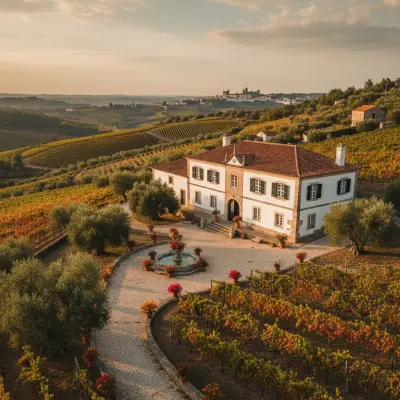
The Quinta São José dos Montes plays in another league, more rural, more quiet retreat, with broad views and a breakfast where the cheese and the bread are genuinely local. If you are coming as a couple or small family and want to pair the festival with two or three days of decompression afterwards, this is the safe bet.
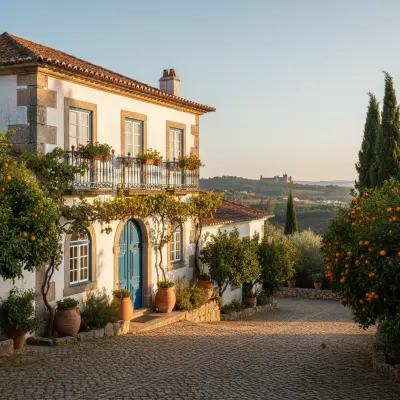
For travellers wanting something more affordable and family run, without sacrificing warmth, the Quinta da Ti Júlia is one of the best value options in the area. Genuine hospitality, home cooked food if you book ahead, and zero pretension.
What to eat and where (without inventing things)
Tomar sits in the Ribatejo culinary world, which means: lamprey rice in season, eel stew, honest salt cod with cream, and the famous Fatia de Tomar, a dessert made only with egg yolks, steamed in dedicated moulds, with a texture that feels like sweet butter and that you will not find anywhere else in the country. Eat it whenever you can. It costs almost nothing. No decent restaurant in Tomar fails to carry it.
During the festival, many restaurants run fixed menus with long queues. My suggestion is simple: either eat early (12:30) or late (15:00), never between 13:00 and 14:30. For dinner, book. No exceptions. The neighbourhood association stalls on the decorated streets serve caldo verde, bifanas and wine by the glass at civilised prices, and sometimes that is exactly what you want between processions.
The context that gives the festival meaning
The Festa dos Tabuleiros is one of three major religious festivals in central Portugal that, together, tell a story about how popular Catholicism worked itself into daily life. The other two have dedicated guides worth reading before or after: the Fátima pilgrimage on May 13th, probably the best known religious event in the country, and the Queima das Fitas in Coimbra, which despite being a student festival shares with the Tabuleiros the same procession structure, hierarchy and chromatic symbolism.
If you are planning a longer trip, it is worth combining Tomar with a few other stops in the Centre region. There is everything from short, well marked walks, see the walking trails around Caldas da Rainha, to more active experiences such as cycling the Ecopista do Dão if you want to pedal 49 flat, traffic free kilometres on a former rail line.
Seeing Tomar from above (if you are brave)
For travellers with an extra day and a taste for a genuinely different angle on the Ribatejo, I recommend paragliding in Tomar. It is a tandem flight with an instructor, no previous experience needed, and the view over the Convento de Cristo, the castle and the Nabão valley is worth the trip on its own. On festival day, with the decorated streets seen from above, it must be close to surreal. It costs from 80 to 120 euros depending on the season, and typically lasts 20 to 40 minutes in the air.
Getting there and getting around
Tomar is well served by train. The Linha do Norte has a direct connection, with a regional branch from Entroncamento, and the journey from Lisbon takes about 2 hours. By car, it is around an hour and a half via the A1 and A23. During the festival, traffic is closed off in the old town, usually starting the week before, and parking inside the centre becomes a fantasy. Use the car park near the station or the signposted ones on the outskirts, and walk. Tomar is small and made for it, and there is always a patch of shade nearby.
What to pack and what to expect
- Hat, water, sunscreen. July in Tomar does not forgive.
- Comfortable shoes. You will walk much more than you think, especially between processions and flower carpets.
- Some cash in small notes, for the neighbourhood stalls and for the churches, where candles and small tokens are sold.
- Patience with crowds. At peak procession, more than 50,000 people fill the streets. That is double the population of Tomar.
- Willingness to talk. This is a festival where locals want to explain what is happening. Ask. You will hear stories about grandmothers who carried trays in 1955.
In short
The Festa dos Tabuleiros is not just another summer party. It is a ceremony that has survived seven centuries because the community decided, every four years, to stop everything and do it again. There is no tourist trickery, no fake reconstruction. The young women carrying the trays are daughters, granddaughters and great granddaughters of women who did the same. The flower carpets are made by the same families who made them in 1971. This is rare. In Portugal, in 2026, it is increasingly rare. Show up. Book early. Climb the castle at sunset. And eat a Fatia de Tomar. Go home knowing you saw something that may exist for another century. Or may not.