Tomar Beyond the Convent: The Templar City Nobody Finishes
The Convent of Christ is just the beginning. From the Church of Santa Maria do Olival, where Gualdim Pais has been buried since 1195, to the medieval synagogue on Rua Dr. Joaquim Jacinto and the 180 arches of the Pegões Aqueduct, Tomar hides an entire Templar town below the hill.
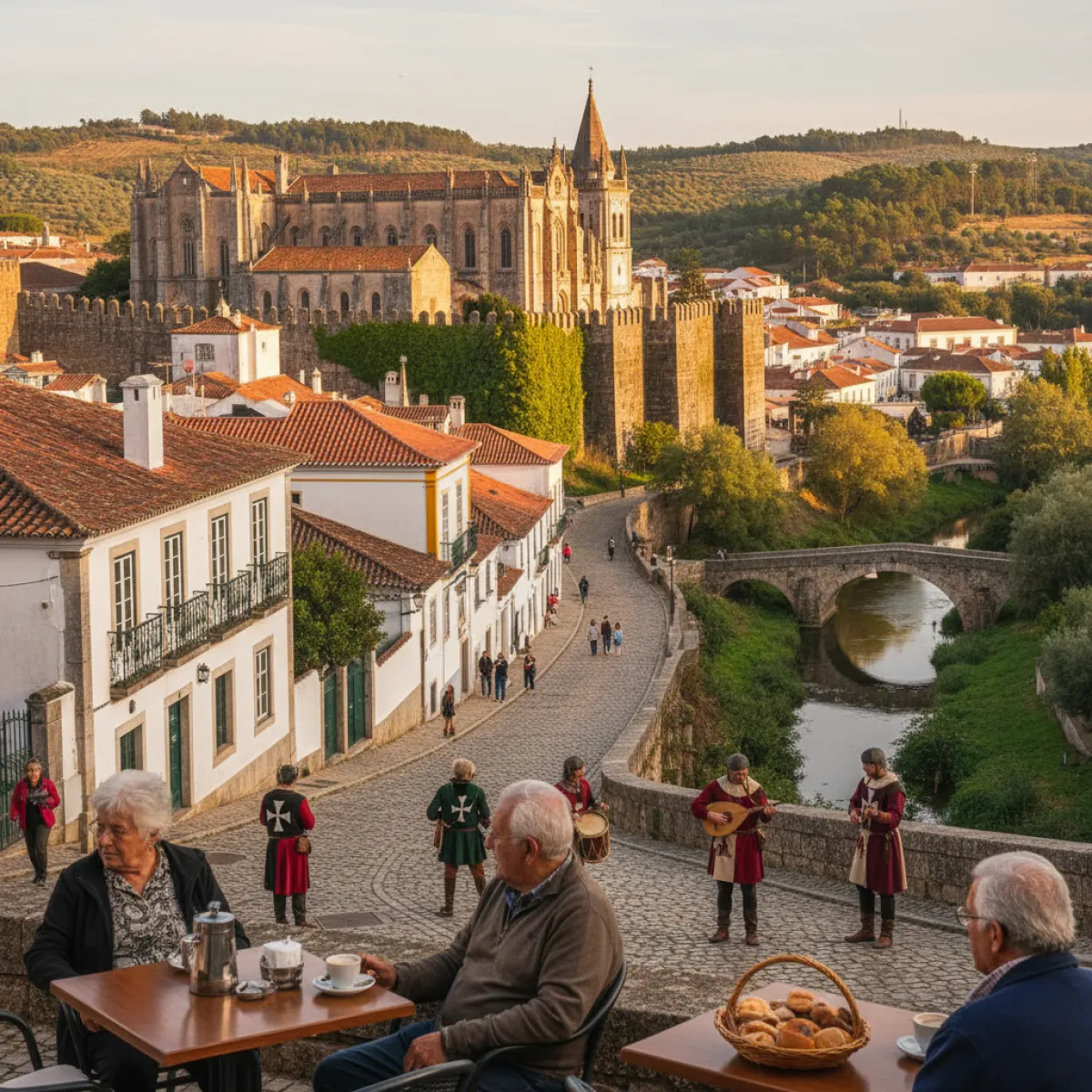
Most visitors arrive in Tomar, climb to the Convent of Christ, photograph the Manueline window, and leave. It is a spectacular mistake. Not because the Convent isn't worth the trip (it absolutely is), but because the town below, stretched along the Nabão River, holds the most telling traces of the Templar presence in Portugal. And almost nobody pays them any attention.
The church that came before the Convent
Start where the Templars started: the Church of Santa Maria do Olival, on the left bank of the river, slightly removed from the historic centre. It was rebuilt by Gualdim Pais in 1160, over the ruins of a Benedictine monastery, and served as the burial place of the Templar Grand Masters. This is where Gualdim Pais himself was interred when he died in 1195, not up at the Convent. The original funerary inscription survives, though of the many knight tombs that once filled the church, only four escaped a botched renovation campaign in the sixteenth century.
The church is Gothic, unadorned, and worth at least half an hour. Notice the rose window on the main facade, which became a model for churches across the Portuguese empire, and the grave slabs set into the nave floor. If you catch the space empty, which is easy outside August, the late-morning light through the side windows is reason enough for the detour.
The Synagogue and Tomar's other story
From Santa Maria do Olival, walk into the old town and find Rua Dr. Joaquim Jacinto. The Synagogue of Tomar, built in 1438, is one of the best-preserved medieval synagogues on the Iberian Peninsula. From outside, it says nothing: a plain limestone facade with no ornament. Inside, four elegant columns support the prayer hall, representing, according to tradition, the four matriarchs of Israel: Sarah, Rebecca, Rachel, and Leah.
The Jewish community thrived in Tomar until 1496, when King Manuel I ordered forced conversion and scattered everything. Today it functions as the Abraão Zacuto Luso-Hebrew Museum. Entry is free, and the visit takes about twenty minutes but changes how you see the town. Tomar was not only a Templar stronghold: it was a meeting point of cultures that history pulled apart.
The Mata dos Sete Montes: 39 hectares of quiet
If the Convent of Christ is the monumental face of the hill, the Mata dos Sete Montes is its green shadow. Thirty-nine hectares of parkland wrap around the castle walls, with centuries-old olive trees, pines, and oaks. Tradition has it that Templar initiation rituals took place here. True or not, this is one of the best places in Tomar to escape the Ribatejo heat, which between June and September is relentless.
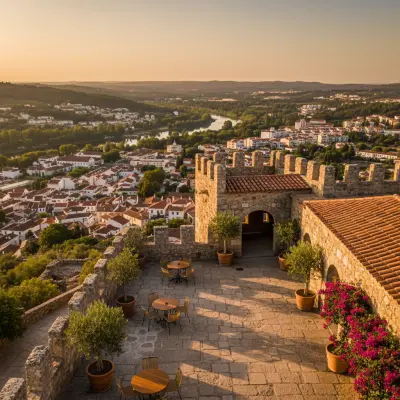
Entry is free, and you can combine your visit to the Convent with a descent through the forest rather than doubling back the same way. There are marked trails, and if you go early in the morning you will cross paths with more squirrels than people. From the Miradouro do Castelo de Tomar, you get an open view over the Nabão valley and the town, which at sunrise looks like a scale model far below.
The Pegões Aqueduct: engineering nobody visits
About two kilometres from the centre, the Pegões Aqueduct is probably the most impressive monument in Tomar that almost no tourist sees. Built from 1593 onward, during the period of Spanish rule, to supply the Convent of Christ with water from four separate springs, it stretches roughly six kilometres with 180 arches. Where it crosses the deepest valleys, the arches stack in two tiers, and the scale is genuinely startling.
You can walk along parts of the aqueduct. There is no ticket office, no guide, just the structure and the countryside around it. Access is via the road to Leiria (N113). With a car, it costs nothing; without one, a local taxi from the centre should run 5 to 7 euros.
The Mouchão and the river that holds it all together
Parque do Mouchão is Tomar's living room. Set on a small island in the middle of the Nabão, reachable by pedestrian bridges, it is where locals read the paper, walk the dog, or simply watch the waterwheel turn. The wheel is decorative but photogenic, and the park is the ideal starting point for a walk along the riverbanks toward the Ponte Velha, the sixteenth-century crossing that links the historic centre to the south side of town.
Halfway across the bridge, stop. On one side, the tight rooftops of the old town; on the other, the silhouette of the Convent of Christ on its hilltop. It is perhaps the best view in Tomar for zero physical effort. If you prefer aerial perspectives and something altogether more exhilarating, the paragliding experience over Tomar puts it all at an entirely different scale.
Eating in Tomar: keep it simple
Tomar's cuisine is Ribatejo through and through: direct, generous, unpretentious. Look for fatias de Tomar in the cafés around the centre: a conventual egg-and-almond sweet that deserves wider fame. At restaurants, order roast kid (cabrito assado) if it is in season, or miga de bacalhau. The beija-me-depressa, a local sausage preparation, appears in some of the more traditional tascas. I will not name specific restaurants because quality shifts, but the advice is straightforward: avoid anything with menus in six languages near the Convent and head for the streets between Praça da República and the river.
At Praça da República itself, the Church of São João Baptista has a Manueline portal that rivals the detail of much in the Convent. Sit at a terrace on the square, order a coffee and a fatia de Tomar, and look at the portal without hurrying. There is no rush.
The Festa dos Tabuleiros: if you hit the right year
The Festa dos Tabuleiros happens every four years and transforms Tomar completely. Women parade through town carrying tabuleiros on their heads: structures of cane, bread loaves, and paper flowers crowned by the Cross of Christ or the Dove of the Holy Spirit. The procession covers about five kilometres through the town streets. The origins are debated: some trace them to the cult of the Holy Spirit promoted by Queen Saint Isabel, others see pagan roots.
What matters is that in the right year, Tomar fills up like at no other time. If you plan to visit during the festival, book accommodation well in advance. If you miss the cycle, at least you know there is this festive layer beneath the Templar surface.
How Tomar fits into an itinerary
Tomar is about ninety minutes from Lisbon via the A1 and A23 motorways. By train, the connection from Lisbon-Santa Apolónia takes around two hours, with a change at Entroncamento. A one-way ticket costs roughly 10 to 12 euros; check CP timetables for current schedules.
One full day is the reasonable minimum: morning at the Convent and the Mata dos Sete Montes, lunch in the centre, afternoon at the Synagogue, Santa Maria do Olival, and a walk through the Mouchão. With two days, add the Pegões Aqueduct and an aimless late-afternoon wander through the streets as the heat fades.
Tomar fits naturally into a week-long itinerary through central Portugal, paired with a stop in Coimbra, where the street art murals reshaping the Alta neighbourhood are another surprise few expect, or a detour down the coast to Caldas da Rainha, which has some excellent walking trails worth exploring.
But above all, Tomar asks that you not rush. The town is not large, the monuments not many, and the river runs slowly. The temptation to tick everything off in a morning is strong. Resist it. The Templars stayed here for centuries. Give them at least a full day.