The Vertical Harvest: Elevated Perspectives in Pinhão
Explore the most exclusive terraces and viewpoints in Pinhão, where schist and river converge. A detailed guide to the classic elegance of Quinta do Bomfim and the contemporary dining at Quinta de la Rosa.
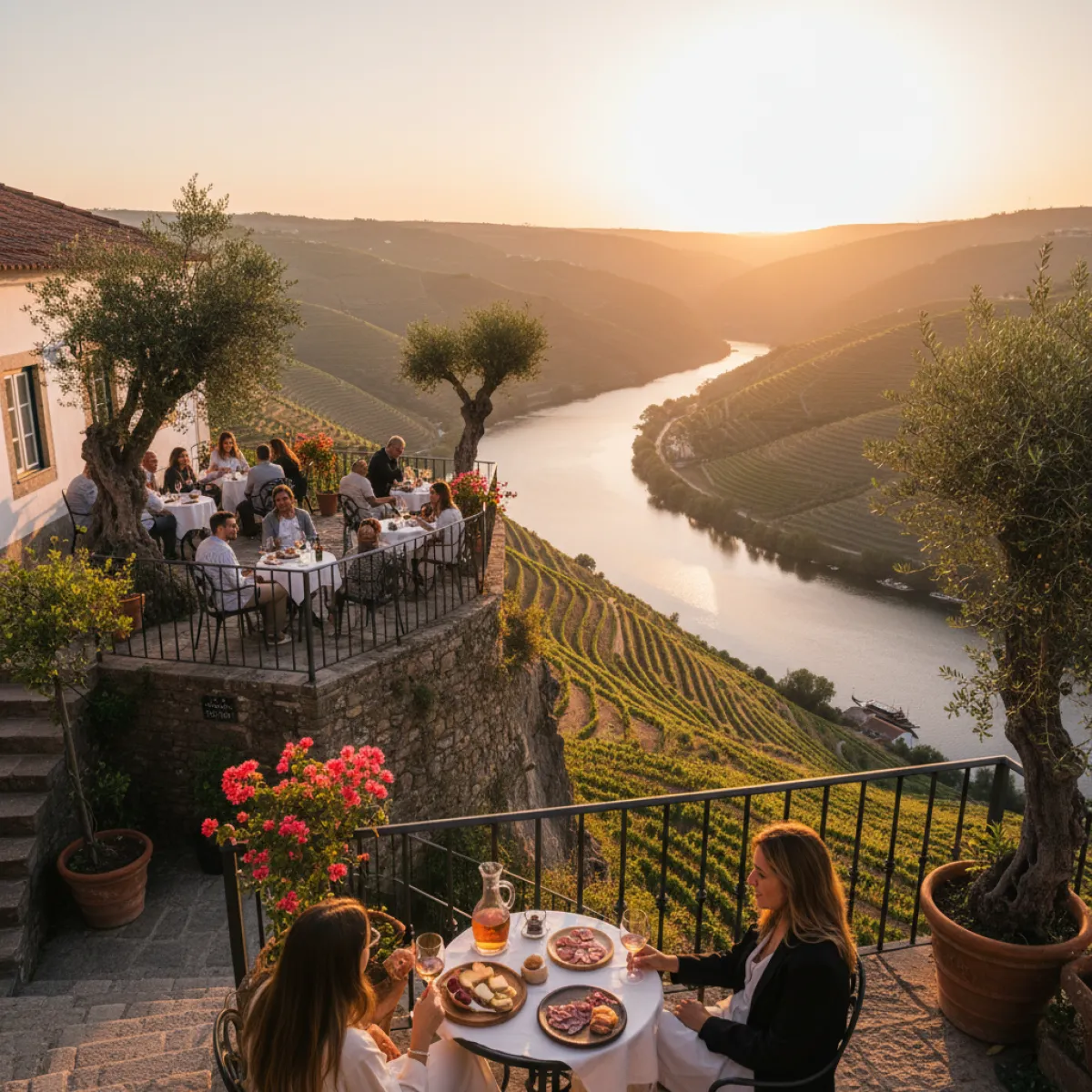
The Schistous Amphitheater
Arriving in Pinhão by rail is one of the few remaining functional romanticisms of European travel. As the train pulls into the station, decorated with its twenty-four iconic azulejo panels, the traveler is immediately confronted by the sheer scale of the Douro. Here, the river isn't just a body of water; it’s the central axis for a vertical amphitheater of schist and vine. In Pinhão, life happens on a gradient. It is a geography that demands effort to understand, but rewards those who seek higher ground with a visual clarity that the riverbanks, however charming, can never replicate.
Quinta do Bomfim: Industrial Elegance
A stone's throw from the railway platform, Quinta do Bomfim represents the most polished face of the region’s viticulture. Owned by the Symington family, the terrace of the visitor center is an exercise in restraint and quiet luxury. There is no attempt to overshadow the landscape with modern gimmicks; the focus is entirely on the river bend and the Eiffel-designed bridge that anchors the town to the horizon. It is the ideal spot to observe the rhythmic movement of the boats, a flow that recalls centuries of fluvial logistics, today celebrated in experiences like the Rabelo Boat Workshop: Learning Ancient Navigation on the Douro, where one learns that the beauty of these waters was built upon the sweat of commercial navigation.
On the Bomfim terrace, order a White Port & Tonic. The mix must be precise: dry White Port, plenty of ice, high-quality tonic, and a slice of lemon. For those seeking something more structured, the wine flights allow you to journey through the family’s history via 20-year-old Tawnies that, in the afternoon sun, take on an amber hue echoing the surrounding slopes. Budget: Expect to spend between €25 and €45 per person for a comprehensive tasting experience paired with local snacks like roasted Douro almonds.
Quinta de la Rosa: Where the River Meets the Table
While Bomfim offers classic elegance, Quinta de la Rosa, a ten-minute walk along the river road, proves that the Douro can be contemporary without losing its soul. The terrace of their restaurant, Cozinha da Clara, is arguably one of the most privileged vantage points in the valley. Here, the proximity to the water is so intimate you can almost hear the dialogue between the current and the river stones. The architecture leverages the natural slope, creating tiered levels that ensure no table loses the sightline to the opposite bank.
What makes this spot exceptional is the curation of what lands on your plate. Eschew the obvious and go for the octopus with cabbage migas or the roasted kid goat, paired with the estate's terroir-driven reds. The atmosphere is one of unpretentious luxury, where service is attentive but never intrusive. It is the perfect venue for a long afternoon, watching the shadows of the vines stretch across the Douro's surface. This sense of suspended time defines our perspective in The Inland Coast: River Escapes and the Luxury of Stillness in Lamego, a guide that explores the necessity of slowing down to observe what is truly essential.
The Ascent to Casal de Loivos
For those who aren't satisfied with river-level views, the drive up to Casal de Loivos is non-negotiable. This isn't a hotel terrace but a public viewpoint offering the region’s most famous perspective: the perfect 'S' curve the river carves at Pinhão's feet. From here, the village looks like a toy forgotten among the mountains. It is a place that demands silence. The schist geology, which absorbs heat all day, seems to radiate a specific energy at twilight. It is the antithesis of the urban density of Lamego, where the dominant stone is different. While in Pinhão the schist is mutable and shimmering, in Lamego, it is the granite that dictates the rules, as detailed in Lamego in Winter: The Geometry of Comfort and the Silence of Granite.
The Sonic Duality of the Valley
Sitting on a terrace in Pinhão is also an auditory experience. The sound of the wind moving through the vines, the occasional whistle of the train, the distant thrum of a boat engine. It is a soundscape that contrasts with the deeper, more melancholic tradition found just a few kilometers away. In Pinhão, the sound is of labor and water; in Lamego, the sound is of history and granite. This distinction is vital to understanding the region’s identity, a topic we explore in The Resonance of Granite: Fado and the Sonic Identity of Lamego, where music and architecture converge.
Practical Information
- When to go: Pinhão reaches its aesthetic peak in September during the harvest. However, for those seeking tranquility, May and June offer milder temperatures and a palette of vibrant greens. Avoid August, when temperatures can easily exceed 40°C (104°F), turning the terraces into heat traps.
- Getting there: The Douro Line train from Porto’s São Bento station is the most scenic route. The journey takes about 2h15m and costs approximately €11. If driving, the N222 road between Peso da Régua and Pinhão is widely considered one of the world's most beautiful drives.
- What to order: Beyond Port, do not overlook the high-altitude DOC Douro whites. They are fresh, mineral-heavy, and ideal for pairing with local cured sheep’s cheese.
- Insider tip: Always book your spot at terraces like Quinta do Bomfim or de la Rosa at least 48 hours in advance, especially for lunch or dinner on weekends.
Pinhão is not a destination to be consumed in haste. it is a place that requires you to sit, order a bottle, and watch the light change. On its terraces, suspended between schist and river, one understands that the true sophistication of the Douro lies in its ability to be simultaneously raw and delicate.
