The Islamic Trail: Mértola as Portugal's Open-Air Museum of Al-Andalus Heritage
Mértola, in the lower Alentejo, preserves nearly five centuries of Islamic heritage with an archaeological clarity unmatched anywhere in Portugal. From the mosque inside the church to the excavated Islamic quarter, a complete guide to this open-air museum.
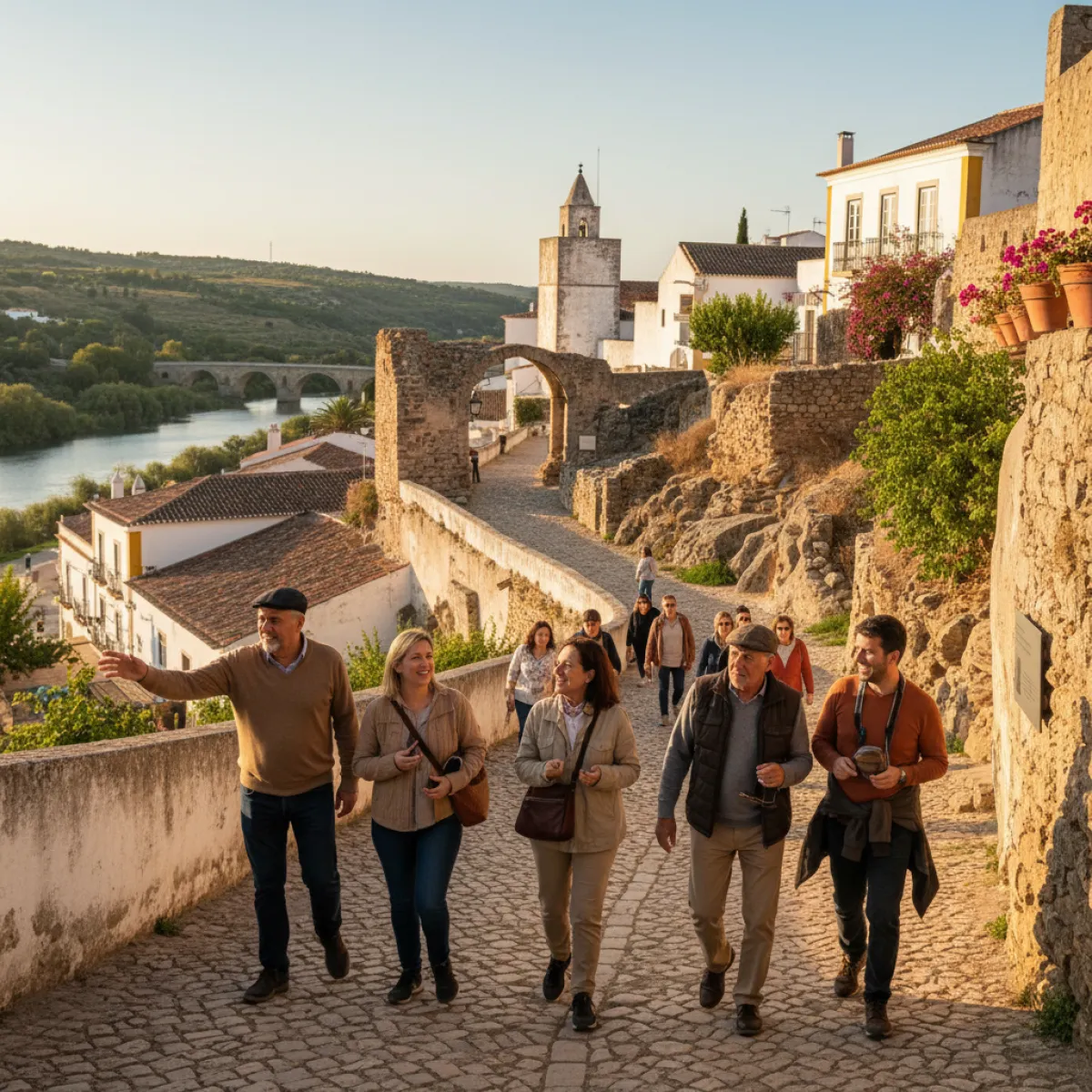
A Town That Refused to Forget
You approach Mértola from the north, driving through the rolling emptiness of the lower Alentejo, and then the town appears, white-walled, vertical, perched above the Guadiana River like a watchtower that never stood down from its post. For nearly five hundred years, between the eighth century and the Christian reconquest of 1238, this place was called Mārtulah, and it served as one of the most important commercial and cultural centres in the gharb al-Andalus, the westernmost frontier of the Islamic world.
Today, Mértola is a town of barely two thousand residents, quiet outside of summer, its narrow streets smelling of whitewash and wild rosemary. But beneath that provincial calm lies a heritage that makes it singular in all of Portugal, and, I would argue, across the entire Iberian Peninsula. No other settlement of this size has managed to preserve, excavate, and present its layers of Islamic occupation with such clarity and conviction.
The Museum That Is the Town Itself
The phrase "open-air museum" gets thrown around carelessly in tourism marketing. In Mértola, the designation has genuine archaeological and institutional weight. Since the 1970s, when Cláudio Torres, the archaeologist who devoted his life to this cause, began systematic excavations, every square metre of the historic centre has yielded evidence that tells a coherent and remarkable story.
Mértola's museum system is distributed across several nuclei scattered throughout the town, each dedicated to a different aspect of its history. The Museum of Islamic Art, housed beside the town walls, is the essential starting point. Its collection of Islamic ceramics, pieces dating from the ninth to the thirteenth century, is considered the most important in Portugal and among the most significant on the Iberian Peninsula. Plates, jugs, oil lamps, and tiles bearing geometric and epigraphic decoration reveal an artistic sophistication that most visitors do not expect to find at this latitude.
Tickets for the complete museum circuit cost €5 (€2.50 for students and seniors) and cover all nuclei. First practical note: buy the combined ticket and block out at least half a day. Anyone who tries to see Mértola in two hours misses what matters.
The Mosque Inside the Church
Mértola's parish church is probably the most eloquent building in the entire town. From outside, it looks like any number of Gothic churches across the Alentejo, whitewashed walls, a simple portal, a modest bell tower. Step inside. The mihrab, the prayer niche oriented toward Mecca, is right there, preserved in the southeast wall, a secret the building refused to surrender. The four horseshoe arches, the nearly square floor plan, and the orientation of the space unmistakably reveal the mosque that existed before the Christian conversion. It is exceptionally rare in Portugal and one of the few examples on the Iberian Peninsula where a mosque's original structures remain visible within a church.
Entry to the church is free, but I recommend combining it with the Early Christian Basilica museum nucleus, steps away, where remains of a Christian temple predating the mosque itself demonstrate that this site was sacred to successive civilisations.
Reading the Territory: What the Archaeology Reveals
One of Mértola's distinctions is how its archaeology refuses to stay behind glass. The Alcáçova, the highest point of the town beside the castle, is an active archaeological site where visitors can observe an excavated Islamic quarter, houses, streets, drainage systems, even latrines, that reveal daily life in twelfth-century Mārtulah. The dwellings follow the classic Mediterranean Islamic house model: a central courtyard, rooms arranged around it, minimal openings to the street. It is an urbanism of intimacy and function, sharply different from the extroverted Roman cities that preceded it.
The Castle of Mértola, crowning the town, was rebuilt on Islamic and Roman foundations. The keep, at 27 metres, offers a panoramic view across the Guadiana and the undulating landscape of the lower Alentejo that justifies the climb on its own. Entry is €2.
The River as Road
You cannot understand Mértola without understanding the Guadiana. During the Islamic period, the river was navigable this far inland, Mértola functioned as the most interior port of the western al-Andalus, connecting the Mediterranean to the heart of the Alentejo. Trade in wheat, olive oil, ore, and ceramics passed through this quay. Today the river runs slower and lower, but the recently renovated Cais de Mértola is a place for contemplation, where you can imagine the flat-bottomed boats that once arrived heavy with goods a thousand years ago.
For those who want a more active encounter with the river, the municipal council organises boat trips during the summer months (typically June to September), with late-afternoon departures that catch the sunset over the Guadiana's banks. Expect to pay around €15 per person.
Where to Eat: The Alentejo on a Plate
Mértola's food is Alentejano at its core, with its own local inflections. Restaurante Tamuje, by the riverbank, is the local benchmark, order the lamb stew, prepared here with wild herbs from the surrounding hills and Alentejo wheat bread, and pair it with a red from the nearby Vidigueira sub-region. A full meal with wine runs between €18 and €25 per person.
For something less formal, Churrasqueira O Guadiana serves honest, unfussy grills at prices that feel like a time warp, lunch for under €10 is entirely possible. The café on Largo Vasco da Gama makes the best pastries in town and an espresso that would hold its own in Lisbon.
A note on timing: Mértola is not Lisbon. Many restaurants close between 3pm and 7pm, and Sunday evenings offer slim pickings. Plan accordingly.
The Islamic Festival: When Mértola Remembers Out Loud
Every two years (even-numbered years), Mértola stages the Mértola Islamic Festival, an event that transforms the town into an open-air souk for four days in May. Artisans, musicians, and cooks from North Africa and the Middle East set up along the streets, the scent of spices and grilled meat mingles with the sound of the oud, and thousands of visitors fill a town built for hundreds. It is the only festival of its kind in Portugal and one of the most authentic in Europe.
If your visit coincides with the festival, book accommodation at least two months ahead, Mértola's hotel capacity is limited and fills fast. If you prefer to avoid the crowds, the week before the festival is ideal: the town is already in preparation mode, with some preliminary activities, but without the full capacity.
Where to Sleep
Accommodation in Mértola has improved substantially over the past decade but remains modest in scale. Hotel Museu, in the historic centre, is the most polished option, doubles from €65 in low season, with river views. For those who prefer rural tourism, Monte da Serralheira, a few kilometres outside town, offers the absolute quiet of the Alentejo countryside at similar rates.
Budget travellers should note Pensão Beira Rio: simple, clean rooms with Guadiana views for around €35 per night.
The Connection to Évora and the Deep Alentejo
Mértola sits roughly two hours by car from Évora, the Alentejo's capital, and the two cities complement each other remarkably well. Where Mértola tells the Islamic story of the south, Évora reveals the slow pulse of an Alentejo that absorbed Romans, Visigoths, Moors, and Christians into a singular cultural synthesis. Visit the Roman Temple in Évora and then drive south to stand before the mihrab in Mértola, and you physically understand what history textbooks try to explain in the abstract.
For those planning a longer Alentejo itinerary, I recommend dedicating at least a full day to Évora. A well-structured day in the Alentejo capital can cover the essentials, from the Chapel of Bones to the university, from the aqueducts to the city walls, without the haste that ruins so many visits.
And there is something Évora shares with Mértola: stone and silence as the raw materials of an experience measured not in attractions ticked off but in layers of time understood.
Getting There and When to Go
Mértola is 260 km from Lisbon (roughly 2 hours 45 minutes via the A2 motorway and then the IC27) and 70 km from Beja. There is no direct rail connection, a car is essentially non-negotiable. The road from Beja to Mértola along the IC27 is one of the most beautiful drives in the Alentejo, cutting through a landscape of cork-oak montado and steppe that, in March and April, erupts in wildflowers.
The best time to visit is spring (March to May) or early autumn (September and October). Summer in the lower Alentejo is brutally hot, temperatures above 40°C are routine in July and August, and many of the outdoor visits become unpleasant. If you do visit in summer, start early, retreat indoors between 1pm and 5pm (as the locals do), and save outdoor activities for the late afternoon.
What Mértola Teaches
In a Europe that debates identity and belonging with mounting anxiety, Mértola offers a quiet lesson. Here, Islamic heritage was neither erased nor exoticised, it was woven into the town's narrative with the ease of people who recognise that identity is always plural. The mihrab coexists with the Christian altar. The Arabic calligraphy on the museum's ceramics tells a story that is as Portuguese as any other.
Mértola is not an al-Andalus theme park. It is a real town, with real people, living and working atop layers of history that other places would prefer to forget. That honesty, archaeological, cultural, human, is what makes Mértola one of the most important and least understood places in Portugal.
Give it two days. Bring comfortable shoes and curiosity. Leave your phone in your pocket as you walk the whitewashed streets. And when you stand before the mihrab in the parish church, with late-afternoon light filtering through the arrow slits, allow yourself the rare luxury of not photographing, just looking.
