The Granite Memory: Deciphering the Jewish Legacy of Belmonte
Belmonte is a testament to cultural survival, where a community preserved its faith in silence for 500 years. We explore the granite streets of the Jewish Quarter and the legacy of the Sephardim.
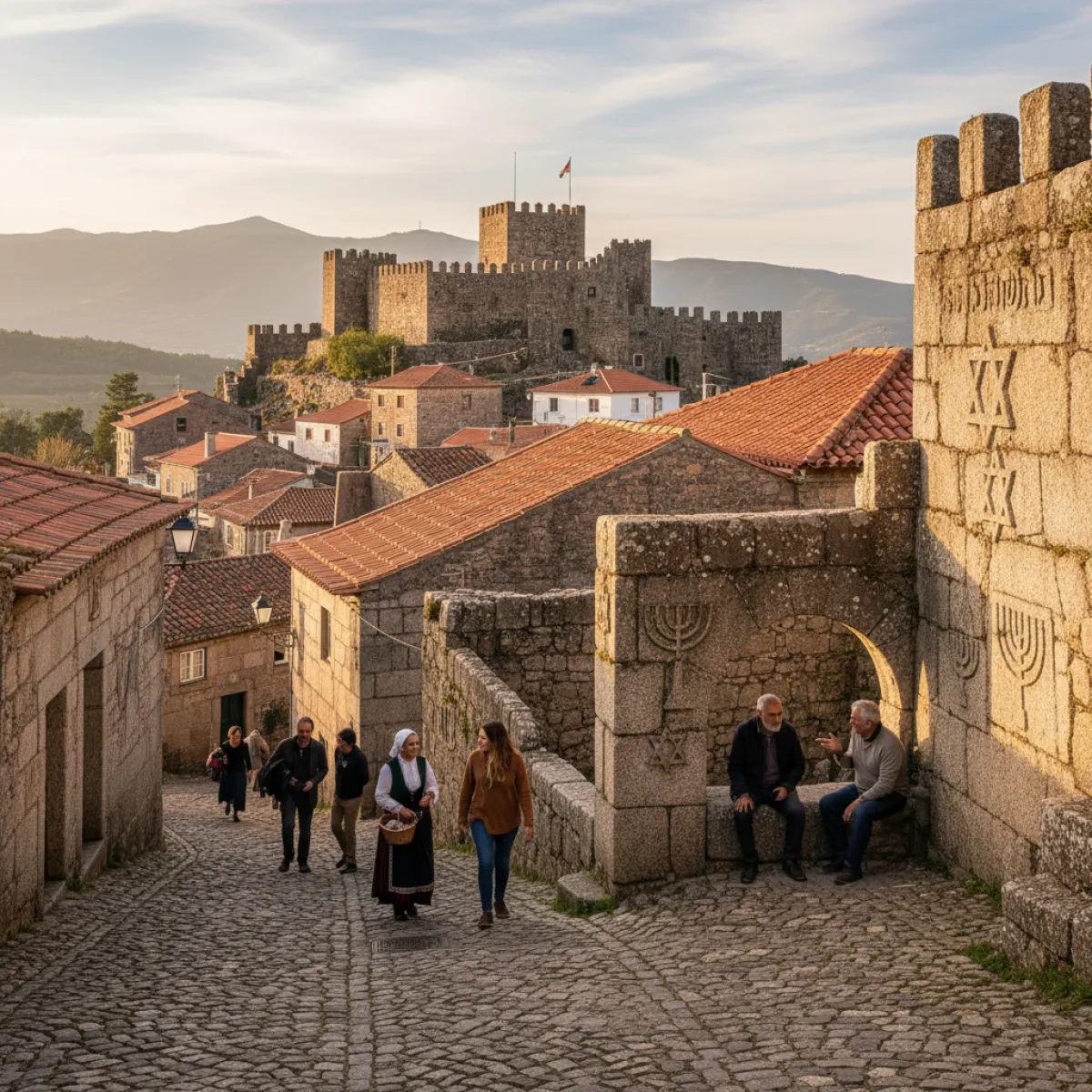
The Weight of Silence in the High Beira
Belmonte rises on a granite spur, commanding the Cova da Beira landscape with a sobriety that commands respect. This is not merely another of Portugal’s twelve Historic Villages; it is a repository of cultural and spiritual resistance that challenges linear narratives of European history. Here, the wind sweeping off the slopes of the Serra da Estrela seems to carry echoes of prayers uttered in whispers for five centuries. To understand Belmonte, one must first understand the nature of silence, a strategic, curated silence maintained by a community that refused to vanish in the face of the Inquisition’s threats.
The Saga of the Crypto-Jews and the 1496 Edict
The Sephardic history of Portugal changed irrevocably in 1496, when King Manuel I, under pressure from the Catholic Monarchs of Spain, signed the edict of expulsion. Unlike the neighboring kingdom, Portugal’s policy was one of forced conversion. Thousands of Jews were forcibly baptized, becoming "New Christians" in the eyes of the law, while remaining faithful to their ancestral rites in the intimacy of their granite homes. Belmonte became the epicenter of this defiance. While Jewish identity in other cities was diluted or eradicated by the close surveillance of the Holy Office, the geography and social cohesion here allowed Crypto-Judaism to survive.
The preservation of faith in Belmonte was a feat of social engineering. In the absence of rabbis and synagogues, women took on the central role in transmitting tradition. It was they who kept the lunar calendar, who hid Shabbat candles inside clay jars to prevent the light from being seen from the street, and who adapted recipes to comply with dietary laws without raising suspicion. For those seeking to peel back the layers of this subterranean narrative, The Hidden History of the Sephardic Community: A Private Tour of Belmonte provides the requisite access to oral traditions that rarely appear in conventional history books.
The 1917 Encounter: Samuel Schwarz
The existence of Belmonte's Jewish community remained an absolute secret to the outside world until 1917. Samuel Schwarz, a Polish mining engineer working in the region's tin mines, suspected the existence of Jewish rites among local families. His encounter with the community is worthy of an espionage novel. Initially met with deep suspicion, after all, the fear of the Inquisition had left generational scars, Schwarz only managed to prove his Jewish identity by uttering the word "Adonai" during a prayer session. The recognition of this sacred word broke a secular isolation and revealed to the world that the Sephardic legacy was alive in the Beiras.
Architecture of Resilience: The Bairro de Marrocos
Walking through the Bairro de Marrocos, the old Jewish Quarter of Belmonte, is an exercise in technical observation. The streets are narrow, designed for defense and privacy. On the granite doorframes, the attentive traveler will find small engraved crosses. Often misinterpreted as simple symbols of Christian faith, these crosses were, in fact, marks of protection and camouflage, proof that the house belonged to converts who maintained external appearances. Granite, the omnipresent material in the Beira region, serves here as a protective skin, keeping temperatures constant through both harsh winters and scorching summers, and guarding secrets that are only now being fully shared.
The Jewish Museum and the Bet Eliahu Synagogue
The Jewish Museum of Belmonte, the first of its kind in Portugal, is not a collection of dusty artifacts. It is a memorial to endurance. Through sober museography, visitors explore the daily life of Crypto-Jews, their rites of passage, and the persecution they endured. A few meters away, the Bet Eliahu Synagogue represents the culmination of this emergence from the shadows. Inaugurated in 1996, exactly 500 years after the edict of expulsion, the synagogue is a modern building that integrates seamlessly into the granite urban fabric, symbolizing the recovered freedom of worship.
Regional Context: From the Mountains to the Valley
Visiting Belmonte requires looking beyond its walls. The Beira Interior region is a territory of fascinating architectural and natural contrasts. If Belmonte represents medieval tradition and religious heritage, nearby Seia offers a compelling aesthetic counterpoint. Exploring Modernism in the Mountains: The Architectural Legacy of Cottinelli Telmo in Seia allows one to understand how the Estado Novo attempted to reinterpret national identity through monumental architecture in the heart of the mountains.
Seasonality also plays a crucial role in the traveler's experience. If your visit coincides with the early spring thaw, a detour south is mandatory. Consulting The Ephemeral Bloom: A Guide to Seeing Cherry Blossoms in Fundão will help you plan a trip through the orchards that paint the valley white, offering a visual spectacle that contrasts with the austerity of Belmonte's granite.
Gastronomy and Tradition: The Taste of the Beira
The table in Belmonte reflects its dual history. Beira Baixa olive oil, dense and fruity, is the foundation of every dish. One should seek out the locally produced kosher wine, one of the few in Europe with full rabbinical certification, utilizing grapes from the sunny slopes of the Cova da Beira. Regarding food, Jewish influence is visible in the generous use of aromatic herbs, heather honey, and the historical absence of pork in traditional dishes that were adapted to maintain appearances, such as the famous alheira, which, though common across Portugal today, had its genesis in the need to simulate the consumption of pork sausages.
Practical Information and Planning
For the traveler who values rigor and comfort, the Pousada de Belmonte, housed in the former Convento da Nossa Senhora da Esperança, is the logical choice. A budget for a two-day stay should account for approximately 300 to 450 euros per couple, covering high-end accommodation, meals, and guided tours.
The best time to visit is between March and May, when the light is clearest and temperatures allow for long walks without the oppressive summer heat. If your itinerary includes the Portuguese coast during this same period, our Surfing Portugal in March: The Best Beaches and Conditions provides the necessary technical details for those wishing to balance the cultural introspection of the interior with the Atlantic energy of the coast.
A Destination for Reflection
Belmonte does not reveal itself in a hurry. It is a destination for the traveler who prefers depth over surface, who is interested in the sociology of small communities and how memory shapes territory. It is, above all, a lesson in continuity. In a world of constant change, the stones of Belmonte remain as a testament that some identities are, like the granite that supports them, impossible to erase.
