The Granite Foundation: Guimarães Between Medieval Majesty and Minho Modernity
Explore Guimarães, the birthplace of Portugal, where medieval granite meets modern sophistication. An editorial guide to the castle, the Palace of the Dukes, and the city's vibrant culinary scene.
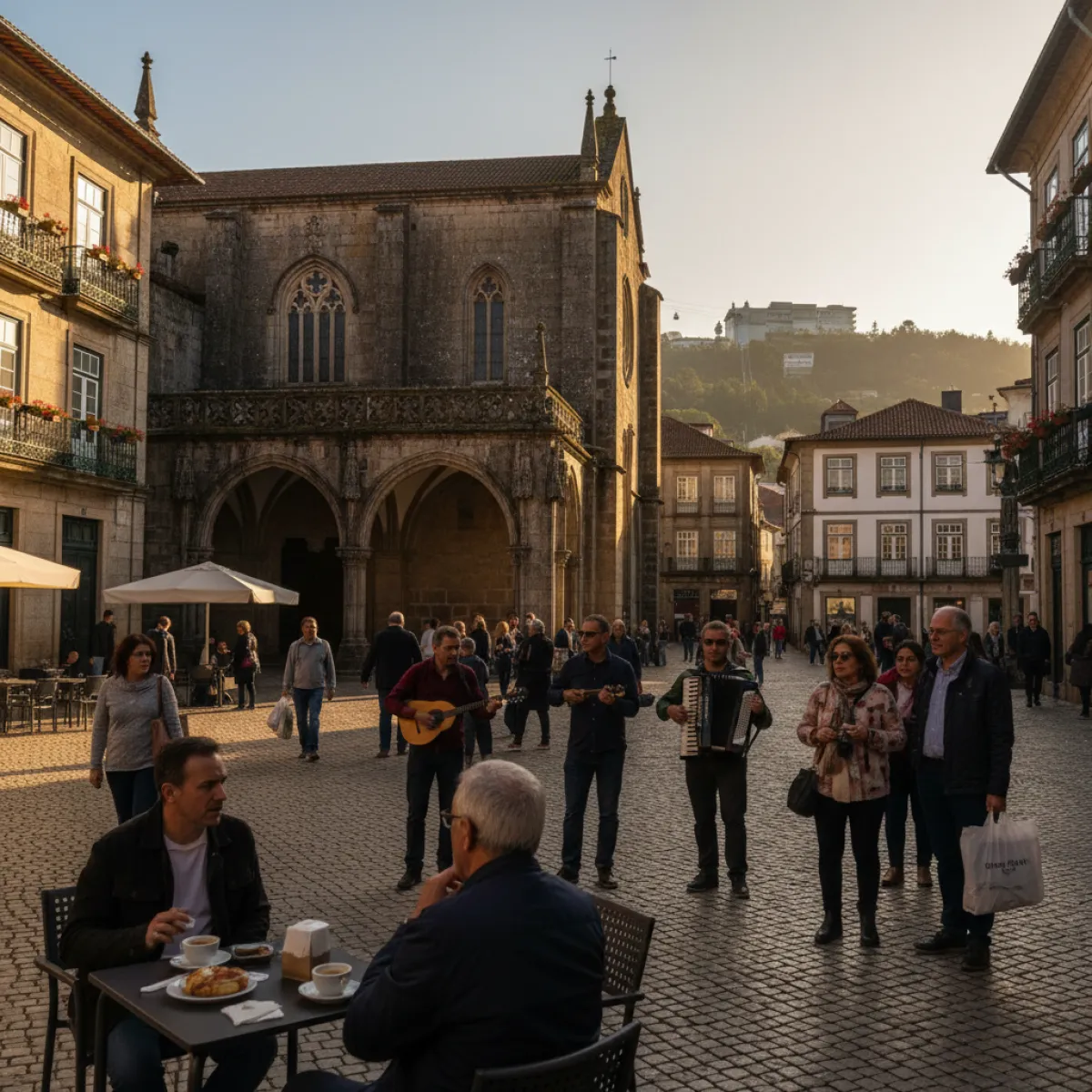
The Gravity of the Birthplace
There is a specific density to the air in Guimarães that is found nowhere else in Portugal. It is not merely the persistent Minho humidity or the scent of woodsmoke escaping historical center chimneys during the winter months; it is the literal weight of history. When one approaches the ramparts bearing the iconic phrase "Aqui Nasceu Portugal" (Portugal Was Born Here), it does not feel like a tourism marketing slogan, but rather an ontological statement. Guimarães is ground zero, the place where Lusitanian identity was forged in granite and blood, and where today, that same identity reinvents itself with a quiet sophistication that eludes the noise of the masses.
Walking through Guimarães is an exercise in urban archaeology. The historical center, a UNESCO World Heritage site since 2001, is one of the best-preserved examples of medieval urbanism in Europe. Unlike other European cities that have become open-air museums, Guimarães maintains an authentic pulse. Laundry still dries on wooden balconies, neighbors converse from window to window, and traditional commerce persists alongside new design and gastronomy concepts that bring the city into the 21st century without trampling its past.
For those arriving from the south or the coast, this city is often framed as one of the best day trips from Porto, but reducing Guimarães to a brief stop is a strategic error. The city demands time to be absorbed, for the shifting light on the stones of Praça de São Tiago to be felt, and for the complexity of its foundation to be understood.
The Sentinel of Afonso Henriques: The Castle
Atop the Sacred Hill, the Castle of Guimarães imposes itself as an austere silhouette against the Minho sky. Originally built in the 10th century by Countess Mumadona Dias to protect the monastery from Moorish and Norman raids, the castle we see today is the result of successive expansions and restorations. It is a building of brutalist simplicity, stripped of ornament, where beauty resides in the function and proportion of its towers.
Tradition holds that D. Afonso Henriques, the first King of Portugal, was born here. While the historical accuracy of this claim is debated, the symbolic value of the site is unquestionable. Walking the wall's ramparts, the view over the city and the Penha mountain reveals the strategic importance of this location. It is the perfect place to grasp the essence of A Guide to Guimarães: The City Where Portugal Learned to Be Itself, as geography and history merge here into a narrative of resistance and ambition.
The Palace of the Dukes: Burgundian Ambition in Minho Soil
A few steps from the castle, the scenery shifts radically. The Palace of the Dukes of Braganza, built in the 15th century by D. Afonso, the first Duke of Braganza, is a unique specimen in the Iberian Peninsula. With its numerous cylindrical brick chimneys and its Burgundian-influenced architecture, the palace transports us to a Europe of refined courts and palace intrigues.
The interior is a testament to the opulence of the House of Braganza. Vast rooms are decorated with copies of the famous Pastrana tapestries, which narrate Portuguese conquests in North Africa. The light filtering through the pointed windows illuminates wooden ceilings shaped like inverted ship hulls, a technique that would later be replicated throughout the empire. It is a space that demands silence and careful observation, far from the haste of tour groups who limit themselves to photographing the facade.
The Geometry of the Squares: Oliveira and São Tiago
Descending from the Sacred Hill, one enters the labyrinth of narrow streets leading to the heart of the lower city. Largo da Oliveira and Praça de São Tiago are arguably the most photogenic public spaces in Portugal. Here, Guimarães architecture reveals itself in all its glory: granite ground floors, solid and impenetrable, supporting timber-framed upper structures that often overhang the street to gain vital living space within the walls.
In Largo da Oliveira, the Padrão do Salado, a unique Gothic monument commemorating the victory at the Battle of Salado in 1340, serves as a meeting point. Around it, terraces invite a long coffee. This is where the Vimaranense rhythm is felt. Unlike the atmosphere in A Guide to Braga: Portugal's Quietly Radical Northern City, where the energy is more clerical and Baroque, Guimarães is medieval, telluric, and proud of its human scale.
The Couros Zone: Industrial Heritage
Recently integrated into the UNESCO-protected area, the Couros Zone offers a different perspective on the city. Here, history is not made of kings and castles, but of workers and tanneries. The stone tanks where hides were treated remain like scars in the ground, witnessing an industry that was, for centuries, the region's economic engine. It is a melancholic but essential walk to understand the working-class Guimarães, which today reinvents itself through the University of Minho campus and innovation centers occupying the old factories.
Gastronomy: The Minho on a Plate
Eating in Guimarães is a serious matter. Local gastronomy is a celebration of Minho abundance, but with a touch of elegance that reflects the city's urban history. At A Cozinha por António Loureiro, a Michelin-starred establishment, the chef interprets local traditions with contemporary precision. It is the place to taste cod or goat in a new light, within a space that is itself an exercise in modern design in the historical center.
For a more traditional experience, Histórico by Papaboa offers classic dishes in an environment that lives up to its name. Do not leave the city without trying the Tortas de Guimarães and Toucinho do Céu, conventual sweets that are the sugary legacy of the Santa Clara nuns. The secret lies in the thin puff pastry and the filling of spaghetti squash and eggs, a combination that defies any diet.
Where to Stay: From Convent to Boutique Hotel
To fully experience Guimarães, the stay must be as historical as the walk. The Pousada Mosteiro de Guimarães, located in the former Monastery of Santa Marinha da Costa, is one of the most impressive units in the Pousadas de Portugal network. Set on the slopes of Penha, it offers panoramic views over the city and gardens that invite contemplation. The cloisters and 18th-century tiles provide the perfect setting for those seeking a luxury monastic experience.
In the center, Hotel da Oliveira is a sophisticated boutique option, with interiors designed by Paulo Lobo that blend modern comfort with local historical references. For something bolder, the Emaj Guimarães Boutique Hotel, housed in a former bank, preserves its classic facade but offers rooms with mid-century design that would delight any Monocle reader.
Practical Advice for the Traveler
Guimarães is best visited during spring or early autumn, when the light is softer and temperatures allow for walking without the stifling heat of the Minho summer. Avoid Mondays, as many museums and monuments are closed. In terms of budget, the city is surprisingly accessible for the quality it offers; a high-level lunch can cost between 25 to 40 euros per person, while a Michelin dinner will require an investment upwards of 100 euros.
For those traveling from Porto, the train is a charming and efficient option, departing from São Bento station and arriving in central Guimarães in just over an hour. However, having a car allows for exploring the surroundings, such as Citânia de Briteiros, one of the most important proto-historic settlements in the Iberian Peninsula, located about 15 kilometers from the city.
In summary, Guimarães is not just a history lesson; it is a lesson in how a city can age with dignity, remaining relevant and vibrant. It is the place where Portugal learned to be itself, and where we, as travelers, learn to value the permanence of granite in a world that seems increasingly ephemeral.
