The Douro Reimagined: Contemporary Design and the Architecture of Silence in Pinhão
Explore Pinhão through the lens of contemporary design and signature architecture. From Siza Vieira’s minimalist wineries to the functional engineering of Rabelo boats, discover the new aesthetic language of the Douro valley.
The Valley Redefined: Beyond the Illustrated Postcard
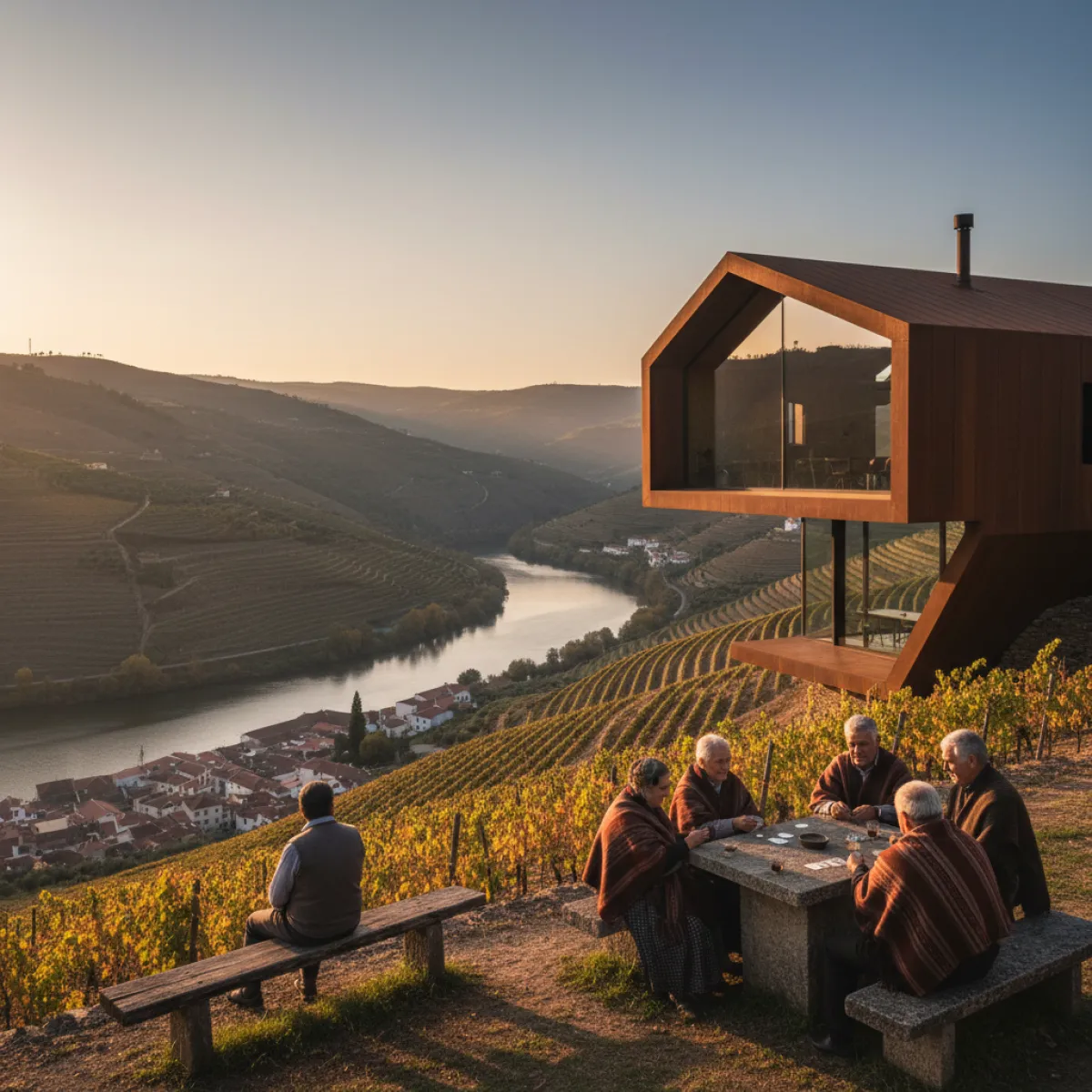
Pinhão has, for decades, been consumed by the tourist gaze as a mere logistical hub for the Port wine industry. A mandatory stop, yes, but often reduced to the bucolic iconography of terraced slopes and railway romanticism. However, those who traverse the Alto Douro Vinhateiro with an eye trained for contemporary aesthetics realize that something deeper is unfolding. The region is undergoing a metamorphosis where functional design, signature architecture, and rigorous preservation of tradition merge into a language we might call Douro Modernism.
This evolution does not manifest through noisy gestures or buildings attempting to dominate the landscape. On the contrary, design in Pinhão and its surroundings is an exercise in subtraction. It is the intelligence of knowing how white concrete can dialogue with black schist, and how the brutal summer light can be filtered by structures that respect the orography. In exploring this facet, we discover that luxury here lies not in opulence, but in the precision of the line and the quality of the silence.
Pinhão Station: Where Graphic Design Meets Engineering
Any serious analysis of the village's aesthetics must begin with its railway station. Opened in the late 19th century, it is ground zero for local visual identity. The 24 tile panels, produced by the Aleluia Factory in Aveiro in 1937, are more than decoration; they are an ethnographic catalog in blue and white that dictates the visual rhythm of the town. Observe Jarl's technical composition: the way human movement is captured in the harvests and the transport of wine reveals a concern for visual narrative that anticipates much of what modern graphic design would later systematize.
For the traveler arriving by rail, the station serves as an introduction to the valley's geometry. The parallel lines of the tracks mirror the horizontality of the terraces, creating a symmetry that is almost hypnotic. It is this geometric rigor that informs the new wave of architects who have chosen the Douro as their canvas. It is not just about building a winery; it is about designing a journey where the visitor is guided by light and temperature, much like wine in its aging process.
Siza’s Influence and Signature Architecture
Not far from the center of Pinhão, the presence of Álvaro Siza Vieira and Souto de Moura is tangibly felt. The Quinta do Portal winery, designed by Siza, is perhaps the most radical example of how contemporary design can inhabit a World Heritage region. Here, the Porto-born architect used schist and cork, native materials, to create a volume that seems to emerge from the earth. It is a building that demands time to be understood, where shadows are as important as walls.
This minimalist approach extends to other spaces. In Pinhão, the renovation of old estates has followed a strict protocol: preserving the outer stone shell and introducing stripped-back interiors, where Portuguese design furniture, often in oak or walnut, takes center stage. It is this contrast between the ruggedness of the exterior and the tactile sophistication of the interior that defines the region's new hospitality. The conceptual framework of The Inland Coast: River Escapes and the Luxury of Stillness in Lamego applies perfectly here: the luxury of being still, of watching the light change on the slopes, in an environment designed not to interfere with that contemplation.
Nautical Engineering as an Art Form
Design in Pinhão is not limited to what is fixed to the ground. The Douro River is the axis around which the region's entire aesthetic orbits, and the Rabelo boats are its most iconic design pieces. Originally built to navigate fast and treacherous waters, their shape is a triumph of function over purely ornamental aesthetics. The long mast, flat bottom, and square sail are not artistic choices but engineering solutions to a specific problem.
Today, there is a movement to recover this nautical intelligence. Participating in the Rabelo Boat Workshop: Learning Ancient Navigation on the Douro allows one to understand the mathematics behind wooden construction and the physics of river navigation. It is a unique opportunity to see how traditional craftsmanship possesses a design sophistication that we often overlook in our digital age. The way the wood is shaped to withstand water pressure is, in itself, a lesson in organic industrial design.
The Pinhão-Lamego Axis: A Journey of Materials
The aesthetic experience of Pinhão is incomplete without the ascent towards Lamego. If Pinhão is the land of schist, Lamego is the realm of granite. This geological transition is fundamental to understanding the region's architecture. While schist allows for laminar constructions integrated into the hillsides, the granite of Lamego provides an austere and cold monumentality that has influenced centuries of ecclesiastical and civil design.
Exploring The Inland Coast and its surrounding territory, one notices how contemporary Portuguese architecture has repurposed these granitic structures. Many of the new accommodations and cultural spaces in Lamego utilize granite as an element of thermal and acoustic insulation, creating havens of modernity within historical shells. The very sonority of the region changes with the material; sound reverberates differently in the narrow streets of Lamego compared to the acoustic openness of the Pinhão valley. This sonic identity is explored in depth in The Resonance of Granite: Fado and the Sonic Identity of Lamego, which traces the link between stone and cultural expression. For those visiting during the colder months, Lamego in Winter: The Geometry of Comfort and the Silence of Granite offers a masterclass in how architecture manages the elements.
Practical Guide for the Aesthetic Traveler
For those visiting Pinhão with the goal of absorbing its design scene, here are specific recommendations that avoid the obvious:
- When to go: Late October offers the best light for architectural photography. The vineyard colors turn ochre and red, creating a dramatic contrast with the blue of the river and the grey of modern constructions.
- Where to eat: Seek out Cozinha da Clara at Quinta de la Rosa. The interior design is a lesson in how rustic can be elegant, and the view over the river through large glass windows is an ever-changing painting. Order the grilled octopus or the duck rice, but pay attention to the curation of the ceramic pieces the food is served on.
- Logistics: Rent an electric car to drive the N222. The engine's silence allows for total immersion in the landscape, turning the car journey into a sensory performance.
- Budget: A trip focused on design and signature experiences in the Douro requires significant investment. Expect to spend between €250 and €450 per day, considering luxury estate stays, meals at top-tier restaurants, and private visits to architect-designed wineries.
Pinhão is ceasing to be a place that just produces wine to become a place that produces aesthetic thought. It is a destination for those who appreciate the detail of a hand-designed door handle, the texture of a local linen fabric, or the way a steel pergola casts perfect shadows onto a schist terrace. In the Alto Douro, the future is being built with absolute respect for the past, proving that the most effective modernity is the one that knows where its roots belong.
