Portalegre Tapestries: The Intersection of High Art and Industrial Heritage
Discover the fascinating world of Portalegre Tapestries, where industrial heritage meets contemporary art. A deep dive into the unique Portalegre Stitch and the sophisticated soul of Northern Alentejo.
The Weight of the Thread in Northern Alentejo
There is a specific kind of silence in Portalegre that differs from the sun-drenched stillness of the southern plains. Here, on the slopes of the São Mamede mountains, the air carries a sharper edge, the landscape is more fractured, and history is written not just in granite but in wool. Portalegre was, for centuries, a hub of industrial textile production, but in the mid-20th century, something happened that moved beyond mere utility. The Portalegre Tapestries are not rugs; they are woven murals of such technical density that they challenge the eye, where painting and weaving merge in a dialogue that has seduced the greatest masters of modern art.
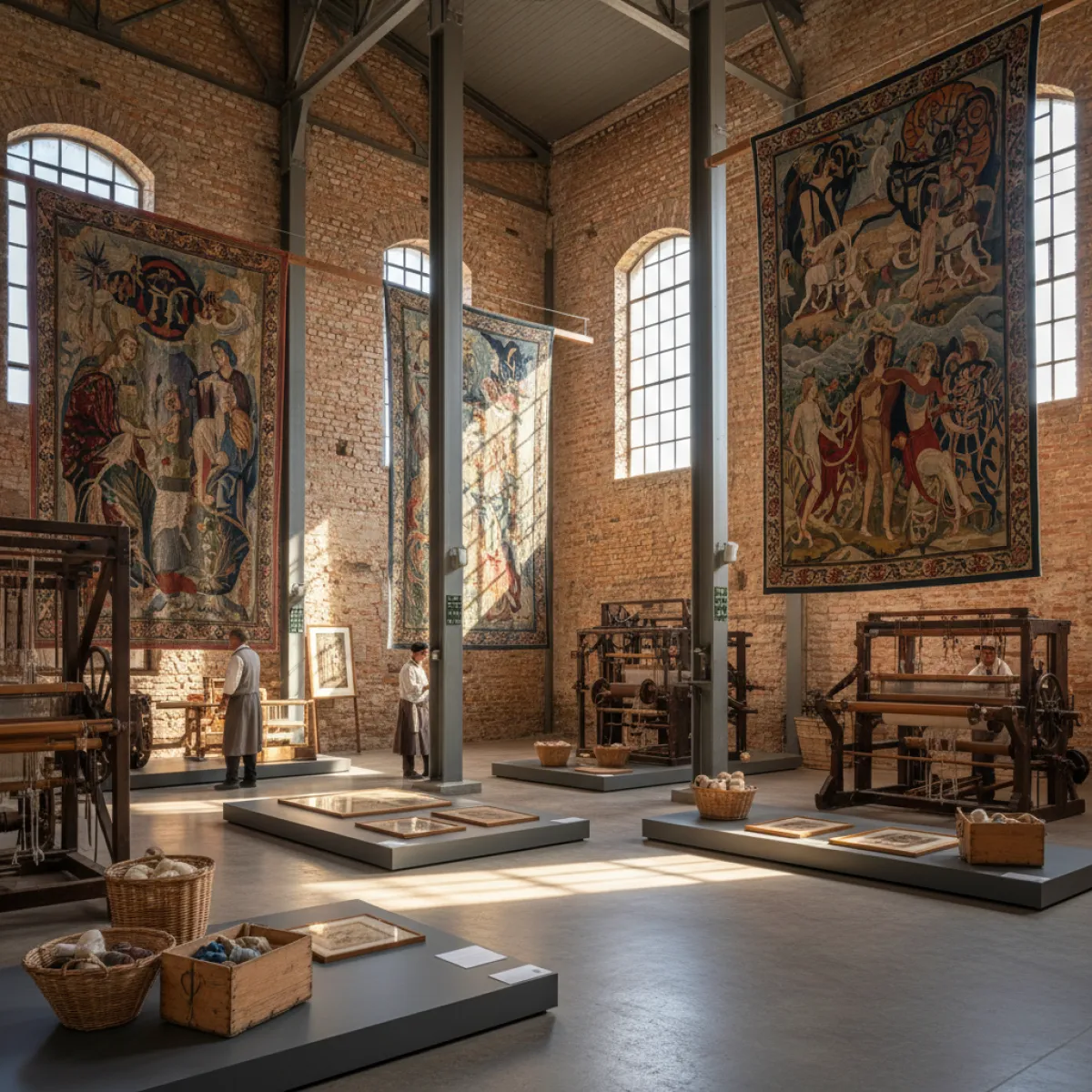
To enter the Manufactura de Tapeçarias de Portalegre is to step into a temporal pocket where speed is considered a manufacturing defect. Housed in the former Jesuit College of São Sebastião, this institution is the custodian of a technique unique in the world. Unlike the tapestries of Aubusson or Gobelins, the Portalegre Stitch allows for absolute fidelity to the original artwork, the "cartoon", thanks to a knot density that permits chromatic gradations impossible elsewhere. It is an exercise in absolute patience, transforming pure wool threads into masterpieces that now hang in institutional headquarters and private collections from Geneva to Tokyo.
The Genesis of a Textile Revolution
The story of this technique began with Guy Fino and Manuel do Carmo in the 1940s. At a time when the traditional textile industry was flagging, these two visionaries decided that survival lay in excellence. The Portalegre Stitch, an evolution of the Arraiolos stitch but executed on a vertical manual loom, allows for such definition that, from a distance, the texture of the wool disappears, giving way to the vibration of color. It is no coincidence that Jean Lurçat, the French master who revitalized modern tapestry, was stunned by the technical superiority of the Alentejo weavers.
For the traveler seeking to understand the deeper soul of the region, Portalegre offers a fascinating counterpoint. While other parts of the Alentejo celebrate the rustic and the raw, here, sophistication is the baseline. After absorbing the complexity of these looms, one might feel the urge to contrast this density with the monumentality of other Alentejo landmarks. If Portalegre is a city of minute detail, Stone and Silence: A Sentimental Guide to Évora offers a different meditation on how time shapes Portuguese heritage, focusing on the permanence of mineral rather than the delicacy of textile.
The Guy Fino Museum: A Pilgrimage for the Senses
The Portalegre Tapestry Museum - Guy Fino, located in a restored Baroque palace, is where the scale of this ambition becomes clear. The rooms display works by Almada Negreiros, Vieira da Silva, Júlio Pomar, and Menez. Seeing an Almada sketch transposed to three meters of wool is a physical experience. There is a gravity to the pieces, an acoustic weight that wool grants to a space, making it more intimate yet more imposing.
The museum's curation doesn't just show the final product; it decodes the process. The role of the "cartoonist-draughtsman" is vital: they translate the original painting into a code the weavers can follow. Every color is numbered, every transition mapped. It is an analog binary system of staggering complexity. The cost of one of these pieces reflects this dedication: we are talking about months, sometimes years, of labor for a single work. For those wanting to understand how this slow cadence defines the region, the guide Évora: The Slow Pulse of the Alentejo serves as an ideal companion, expanding the notion that in Alentejo, haste is a form of rudeness.
The Portalegre Stitch: Deciphering the Technique
- The Density: The Portalegre stitch uses between 2,500 and 10,000 points per square decimeter.
- The Raw Material: Pure sheep's wool, dyed in thousands of shades to ensure smooth transitions.
- The Loom: Unlike low-warp weaving, here the work is vertical, allowing weavers to constantly monitor the evolution of the piece.
Navigating the Baroque City
Portalegre does not surrender easily to the casual tourist. You must walk the narrow streets of the Castle district, observe the coats of arms on the facades of Baroque mansions, and feel the mountain humidity. The city possesses an old industrial bourgeoisie reflected in the quality of its shops and the sobriety of its people. Do not expect Algarvian exuberance; here, luxury is time and authenticity.
When planning a visit, reserve the morning for the Manufactura (by appointment) and the afternoon for the Museum. The contrast between the rhythmic clacking of the looms and the silence of the galleries is essential for appreciating the work. If your itinerary is tight and you need to optimize your time in the region, consult One Day in Évora: A Precision Itinerary for the Alentejo Capital to ensure that even with limited hours, you don't miss the essence of what makes this corner of Portugal unique.
Practicalities: Logistics and Flavors
Where to Eat
Portalegre’s cuisine is rich and often influenced by convent traditions. Solar do Caldeirão is a local institution where the 'migas' (bread-based crumbs) with black pork reach a level of technical perfection comparable to the tapestries. For something more contemporary, Tombalobos offers a reinterpretation of São Mamede flavors without pretentious ticks. Order the 'sarapatel' soup in winter or the game 'empadas'.
Timing and Budget
Spring and autumn are the ideal seasons. Summer in Portalegre can be unforgiving despite the altitude, and winter is often marked by a persistent rain that, while necessary for the greenery, makes walking difficult. Regarding budget, museum entry is modest (around €5), but the real investment is time. If you wish to purchase a small piece from the Manufactura, be prepared for prices starting in the hundreds of euros, reflecting the exclusivity of the craftsmanship.
How to Get There
From Lisbon, it’s about a two-and-a-half-hour drive via the A6 and A245. The journey is a geography lesson, crossing the Ribatejo marshlands before hitting the first elevations of the Alto Alentejo. There is no rush. Let the landscape change its hues, much like the wools on the looms, and prepare to discover a Portugal that prides itself on being, above all, well-made.
