Nazaré on a Plate: Caldeirada, Dried Fish, and Real Tradition
Forget the giant waves for a moment. In Nazaré, the real show happens in backstreet kitchens and seaside fish-drying racks, where the seven-skirts tradition still dictates what hits the table.
Salt on the Skin, Fish on the Plate
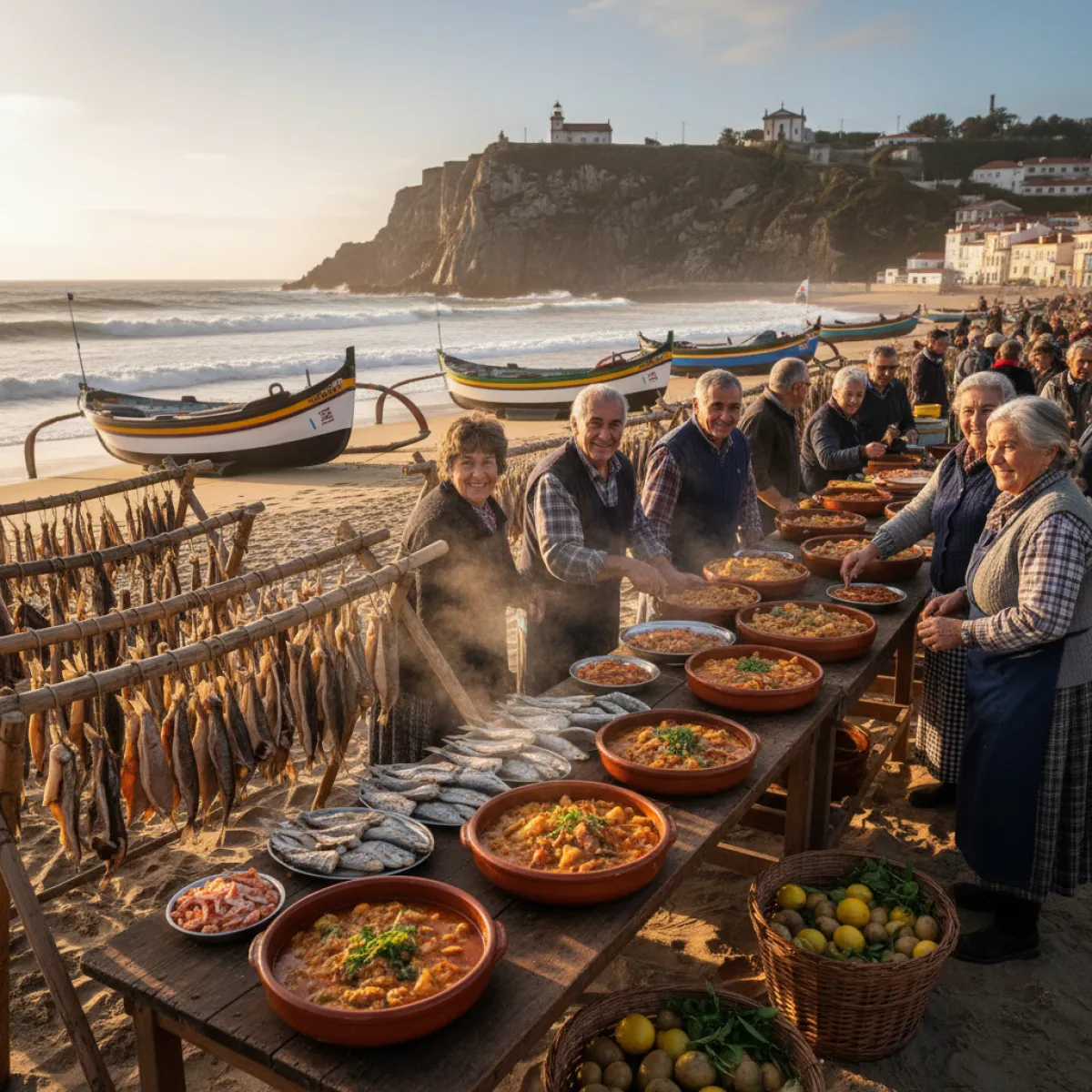
Arriving in Nazaré and talking only about the giant waves of Praia do Norte is like entering a museum and staring only at the fire extinguisher. Yes, the waves are staggering, a display of brute force that put this town on the world surfing map, but the true pulse of Nazaré isn't out at sea. It's on the sandy ground where fish dries in the sun and in the cramped kitchens where the fat of a caldeirada (fish stew) glints at the bottom of the plate. Forget the surf jet-set glamour for a moment. What brings us here is the scent of sea spray mixed with charcoal smoke and the gravelly voices of the women who, even today, hold the keys to the town's pantry.
Nazaré is divided into three: the Sítio, high up on the cliff where the views are breathtaking and the legends are ancient; the Pederneira, the historical cradle; and the Praia (the Beach), where the action happens. It's in the latter that gastronomy takes its most visceral form. If you want to understand what you're eating, you first have to understand who is serving you. The experience Nazaré's Seven Skirts Tradition with Alma Nazaré Tours is the perfect starting point. It's not folklore for tourists to gawk at; it's the explanation of a social structure where women ruled the land while men faced a sea that didn't always bring them back. The seven skirts are used to count the waves, to shield from the cold, and to maintain dignity in a trade that forgives no mistakes.
The Dried Fish Ritual: A Fisherman's Snack
Walk along the seawall toward the south. You'll find the "estendedouro", the fish drying racks. To the untrained eye, it looks like an odd art installation; to a Nazarene, it's the traditional refrigerator. Horse mackerel, sardines, octopus, and rays are split open, washed in salt water, and left to dry in the sun and wind. It's a preservation technique dating back to times of scarcity, but it has become a pillar of the local palate.
Don't be afraid. Approach the stalls where women with headscarves sell small plastic bags of dried fish. The "carapau enjoado", a local term for fish that hasn't dried completely and retains some moisture, is a delicacy. It's salty, intense, and demands a cold beer to accompany it. If you're looking for a gourmet snack, go elsewhere. Here, you eat with your fingers, feeling the firm texture and concentrated flavor of the Atlantic. This is Nazaré in its purest state: rugged, honest, and addictive.
Caldeirada Nazarena: The Hierarchy of the Pot
If there's one dish that defines the identity of this coast, it's the Caldeirada à Nazarena. But beware: do not accept tourist-menu imitations with frozen potatoes and anonymous fish. A serious caldeirada demands respect and a specific variety of fish. In Nazaré, the stew is made with whatever the sea provided in the last 24 hours, but it never lacks ray, conger eel, and dogfish. The secret? The onion and tomato base cannot be rushed, and the potato must absorb the broth until it's nearly falling apart.
My recommendation is to avoid the first-line beachfront restaurants, where the view pays for half the bill and the flavor often falls short. Go up one or two streets. Look for A Tasquinha on Rua Adrião Batalha. It's a small space, often with a line at the door, but where the caldeirada is treated as an affair of state. The service is fast, sometimes brisk, but the food is unassailable. If you prefer something even more local, Rosa dos Ventos is where retired fishermen go for their glass of wine. Order the grilled fish if the caldeirada has already run out, but arrive early. By 12:30 PM, the best catches already have owners.
The Municipal Market: Where the Morning Comes Alive
At 8 AM, the Nazaré Municipal Market is the center of the universe. Forget aseptic supermarkets. Here, the fruit still has soil on it, the flowers smell like the countryside, and the fish is still twitching. It's the best place to observe the dynamic of the seven skirts in full sales action. Buy a bag of lupin beans, watch the aggressive but fair negotiation between sellers and customers, and feel the town's pulse.
If you're planning a larger trip through the region, Nazaré is the perfect knot. You can easily include this stop in a Portugal Itinerary: A Week in the Heart of the Country, balancing the maritime intensity here with the serenity of the Alcobaça or Batalha monasteries, just a short drive away. Nazaré isn't an island; it's the gateway to a Portugal that still tastes of salt and tradition.
Seafood Rice and Fish Pasta
If caldeirada is the queen, Seafood Rice (Arroz de Marisco) is the crown prince. In Nazaré, it doesn't come dry like a paella; it's "malandrinho", swimming in a rich broth of tomato, cilantro, and the juices from shrimp heads. Another dish that often escapes tourists' notice is Fish Pasta (Massa de Peixe). It's comfort food, originally made on the boats using scraps of fish that had no commercial value but plenty of flavor. It's a dense dish that warms the body after a morning spent fighting the north wind at the Sítio viewpoint.
For those traveling north or south, perhaps following The Measured Pace: A Seven-Day Passage from Lisbon to Porto via the Ria, Nazaré offers that necessary jolt of reality between the more monumental stops of Lisbon or Porto. This is where you realize that Portuguese gastronomy isn't made of foams or reductions, but of fresh product and hands that know exactly what to do with it.
Traditional Sweets: The Final Note
You don't leave Nazaré without trying Táamares. These are small cakes made of almonds, eggs, and sugar, with a moist texture and a name that evokes times when Moorish influence still lingered in these sands. Look for them in the local bakeries in the Praia area. Another option is Sweet Sardines (Sardinhas Doces), a visual joke using communion wafers, chocolate, and almonds to recreate the town's most famous fish. Is it kitsch? Maybe. Is it delicious? Absolutely.
Practical Tips for the Traveler
- Parking: In summer and on weekends, parking at the Beach is a nightmare. Leave the car at the Sítio and take the funicular down. The trip costs about 4 euros (round trip) and saves you an hour of frustration behind the wheel.
- Hours: Traditional shops and the market close early. If you want to see the action, be at the market before 10 AM.
- Reservations: At the mentioned restaurants, reservations are nearly impossible. It's first-come, first-served. If you see a line, join it. It's worth it.
- Prices: A fresh fish meal for two, with house wine, should cost between 40 and 60 euros. Caldeiradas for two are usually served in generous portions that would feed three.
Nazaré may have changed with the arrival of big-wave surfers, but the foundations of its kitchen remain intact. It's a silent resistance made of clay pots and drying nets. If you're looking for authenticity, you won't find it at the crest of a 100-foot wave; you'll find it at the bottom of a bowl of fish soup, in a street where the sun barely enters and where time is marked by the tides. And if after this maritime immersion you miss a bit of academic history and carved stone, know that Coimbra: The Grammar of Time in Portugal’s Intellectual Capital is less than an hour and a half away, offering the perfect contrast between beach salt and the dust of ancient libraries.
At the end of the day, Nazaré is this: an unlikely blend of archaic tradition and radical modernity. But when it comes to eating, the advice is simple: follow the smell of grilled fish, look for the seven skirts, and never, ever, refuse a plate of caldeirada.
