Monchique: The Real Festival Calendar of the Serra
Monchique runs on two calendars: the official one and the one whispered over beers at Bar Travessa. From the April Sausage Fair to the November Magusto, here's the serra's festive year explained by people who live it, without posters or flourishes.
There's something nobody tells you about Monchique until it's too late: the town runs on two calendars. There's the official one, with round dates and posters in the cafés around Largo dos Chorões. And there's the other one, the one locals murmur about over a cold beer, the one that decides whether you'll catch the right procession, the medronho coming out of the still at the right moment, or whether you'll show up a week early and miss everything. This guide is about the second calendar.
Monchique is not the Algarve of glossy itineraries. It sits at 458 metres altitude, has cool air in August, and its cultural year doesn't follow the rhythm of the beach. Here, festivals follow the chestnut tree, the medronho, the black pig of the serra, and the saint of the day. Show up in July expecting DJ sets at sunset and you've gone to the wrong side of the mountain. Show up in October looking for a wild boar and chestnut lunch with three grandmothers arguing about the harvest, and you've come home.
January to March: the silence before the serra wakes up
Winter in Monchique is serious business. It rains. It rains a lot. Clouds descend on Fóia and stay there as if they've signed a lease. It's the worst time to come if you're chasing parties, and the best if you want the town to yourself.
The big moment of this season is Carnival, usually in February. Forget Brazil. Forget Torres Vedras. Monchique's Carnival is small, with locals dressed in absurd costumes, kids throwing confetti at shop windows, and a short parade that invariably ends at Bar Travessa mid-afternoon. It's not Instagram. It's better than that.
By March, the serra starts waking up. Mimosas explode in yellow on the slopes (yes, they're an invasive species, but nobody resists the photo) and the cultural programme begins to fill out. Check locally for dates of the first producers' fairs, usually tied to Father's Day or the equinox.
April and May: the Sausage Festival and the season starts in earnest
This is where Monchique catches you off guard. The Feira dos Enchidos Tradicionais da Serra de Monchique typically happens in March or April, at the fairground. It's not a tourist event, it's the most important gastronomic moment on the local calendar. You come, you eat morcela, paio, mountain ham, you drink medronho, you listen to an Alentejan choral group (yes, Alentejan: the cultural border is more permeable than geography suggests), and you understand why these people talk about the pig slaughter the way other people talk about football.
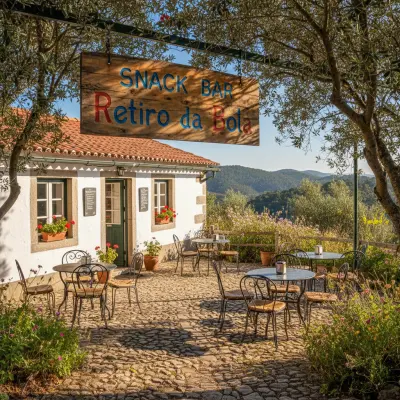
Practical tip: go on a Saturday, for lunch. Sundays fill up with day-trippers from Porto and Lisbon who eat poorly and leave early. On Saturday, you'll find producers still willing to explain the difference between a meat chouriço and a blood chouriço. Book a night, sleep in Monchique, and on Monday have a late lunch at Snack Bar Retiro da Bola, where the soup of the day costs less than a coffee in Lisbon and the main course arrives the way it should: without ceremony.
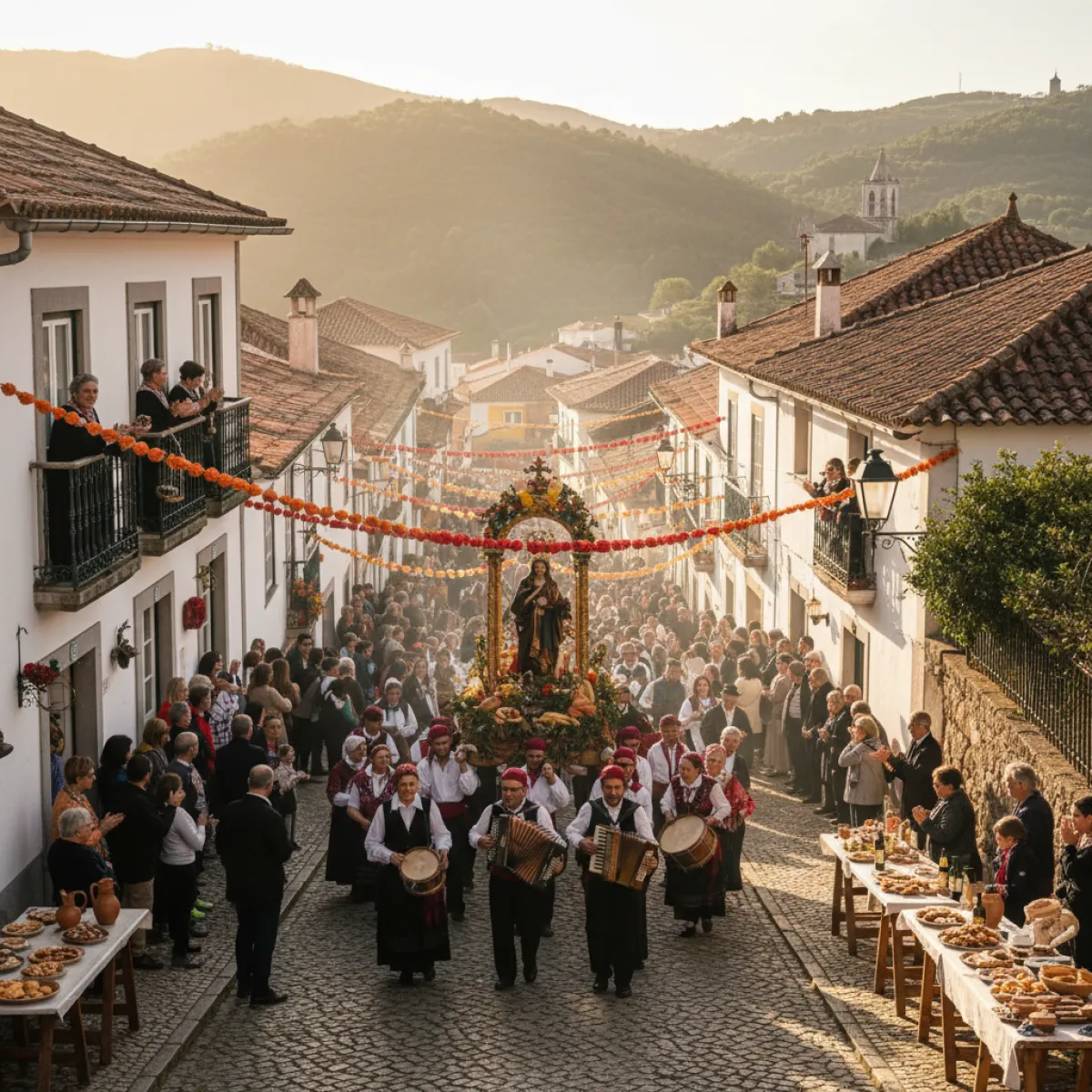
In May, there's the Festa de Nossa Senhora do Desterro, tied to the ruined convent that gives the area its name. It's a small pilgrimage, with mass, procession, and a small fair. There's no sophisticated cultural programming. There's house wine, there's grilled sardines when it's the right season, and there's a night when half the town goes to mass just because, and the other half stays at the café.
June: the popular saints (the serra way)
Yes, there are Santos Populares in Monchique. No, it's not Lisbon. There's no mass sardine grilling on big avenues. What there is: small neighbourhood arraiais, São João bonfires that people still leap over without irony, and improvised dinners on narrow streets where the neighbourhood drags tables outside.
São Pedro, on June 29th, is the saint of fishermen. Up here in Monchique, a hundred and something metres from the sea, it makes less sense, but the tradition holds in the parishes of the council. In Alferce, especially, São Pedro is taken seriously. If you want to combine this with a more immersive experience, it's worth pairing with the cooking class in Alferce where you knead bread the old-fashioned way: you start to understand that these people's relationship with the wood-fired oven isn't folklore, it's infrastructure.
June is also when the heat starts to mean business. Anyone arriving from outside notices that Monchique at 35°C is a blessing compared to Lagos at 35°C. At 458 metres, there's still cool shade, there's still a breeze, you can still sleep.
July and August: the big festa and the concerts
The big summer event is the Festa em Honra de Nossa Senhora do Desterro or, depending on the year, the summer fair. There's music, small concerts, stalls with farturas, and tasquinhas run by local associations selling plates at prices that still make sense (verify locally, but expect 8 to 12 euros for a generous portion of meat).
It's also the season of the Noites de Verão, the municipal cultural programme that usually includes outdoor cinema, concerts at Largo dos Chorões, and fado sessions. Quality varies. Some years the lineup is a quiet gem, with Algarvian musicians who deserve more attention than they get. Some years it feels filled out under duress. Ask at the café. The locals know how to tell the difference.
A counterintuitive piece of advice: if August has you craving the sea, don't head to the nearest beach (Portimão, Carvoeiro, Lagos: heaving). Drive an hour to the west coast and go to Arrifana. In fact, if you're staying a week in Monchique, this is the smartest detour you can make. The Atlantic coast in Aljezur is everything the southern Algarve has stopped being. To make it more serious, you can try surfing at Praia da Arrifana with lessons designed for those staying in Monchique: a morning in the water, an octopus lunch at a tasca, back to the serra by late afternoon, and you still make it in time for an arraial.
September and October: the medronho and the pig
This, not the summer, is when Monchique shows its best face. Temperatures drop into the low twenties, there's golden light by five in the afternoon, and the calendar fills up with harvest festivals.
Medronho is harvested in October and November. The stills start running and the smell takes over parts of the council. The Feira do Medronho or similar events tend to happen in autumn, celebrating the spirit that defines the region. Tasting authentic artisanal medronho, away from a shop counter, is a different experience from leaving with an airport bottle. Take the chance.
October also marks the start of the hunting season and, with it, the season of wild boar, hare, partridge. Restaurants in Monchique and around start putting seasonal dishes on the menu. Don't expect them to be written on the board: ask. "Got any wild boar this week?" is the right question.
November: the Chestnut Festival and the black pig
The big autumn gastronomic event is the Feira da Castanha or the council's Magusto, usually around São Martinho (November 11th). Roast chestnuts are shared with new wine (água-pé or jeropiga, depending on who pours), you learn that there are more chestnut varieties than you thought, and you realise the serra still partly lives off its forestry production.
Monchique chestnut has a designation and is taken seriously. Market prices vary between 4 and 7 euros per kilo, depending on size and timing. If you come to a magusto, bring a coat. At 458 metres, in November, at night, with no bonfire nearby, you'll regret showing up in a t-shirt.
It's also the right moment to understand the domestic rhythm of the serra. Private slaughters still happen (regulated, but happening), and the sausages you'll eat at the March fair start here, in cold Novembers. If you want to go deeper into the relationship between local culture and Algarvian gastronomy further east, it's worth reading about local culture in Faro and the traditions of the authentic Algarve: you start to understand the differences between the serra Algarve and the coastal Algarve, which are almost two different countries.
December: the small Christmas and the nativity scenes
Christmas in Monchique is intimate. There's modest lighting in the centre, Christmas concerts in the parish churches and chapels, and one or two small Christmas markets selling honey, cheese, conventual sweets, and sausages. It's not Strasbourg. It's better: it's quiet.
The missa do galo (midnight mass) still fills the Igreja Matriz, and there are people who go just to step out for a coffee afterwards. December 25th is family day, and the town shuts itself in. December 26th, everything reopens, and restaurants offer special menus with bacalhau, octopus, and the conventual sweets (D. Rodrigos, morgados) that deserve a trip on their own.
What nobody tells you
First: many of Monchique's festivals happen in the parishes (Marmelete, Alferce), not in the main town. If you stay only in the centre, you miss half. Rent a car, or at least ask at the tourism office where the real festa is this week.
Second: dates shift. Religious festivals follow the liturgical calendar, but civic fairs depend on municipal budgets and producer availability. "It usually happens in April" can mean April this year, or May next year. Always confirm.
Third: Monchique works very well as a base for exploring the rest of the Algarve during the day, returning to the serra to sleep and dine. If you're travelling with kids and want lighter days, the detour to Silves is worth it: we've already written an honest family guide to Silves with kids, no filters. Lagos also deserves a day, especially if you like cities with distinct neighbourhoods: the Lagos neighbourhood guide helps you avoid the tourist traps and head to the right places.
Practical summary
- Best time for gastronomic festivals: March/April (sausages) and November (chestnuts, magusto)
- Best time for small religious festivals: May (Desterro) and June (popular saints in the parishes)
- Best time for outdoor concerts and culture: July and August
- Worst time if you want festa: January and February (but great for silence)
- Average cost of a popular festival night: 15 to 25 euros per person, food and drink included
- Sleeping: book ahead if you come on a fair weekend; supply is limited
Monchique asks nothing of you. It has no programme designed to entertain you. It has its own calendar, written in chalk on café counters, and it's up to you to decipher it. Do that, and the serra pays you back well.