Monchique From Above: Viewpoints and the Right Light
There are twenty minutes before sunrise, on top of Fóia, when you can see the sea from Sagres to Vilamoura in a single frame. An honest guide to Monchique's viewpoints and the exact hour each one is worth it.
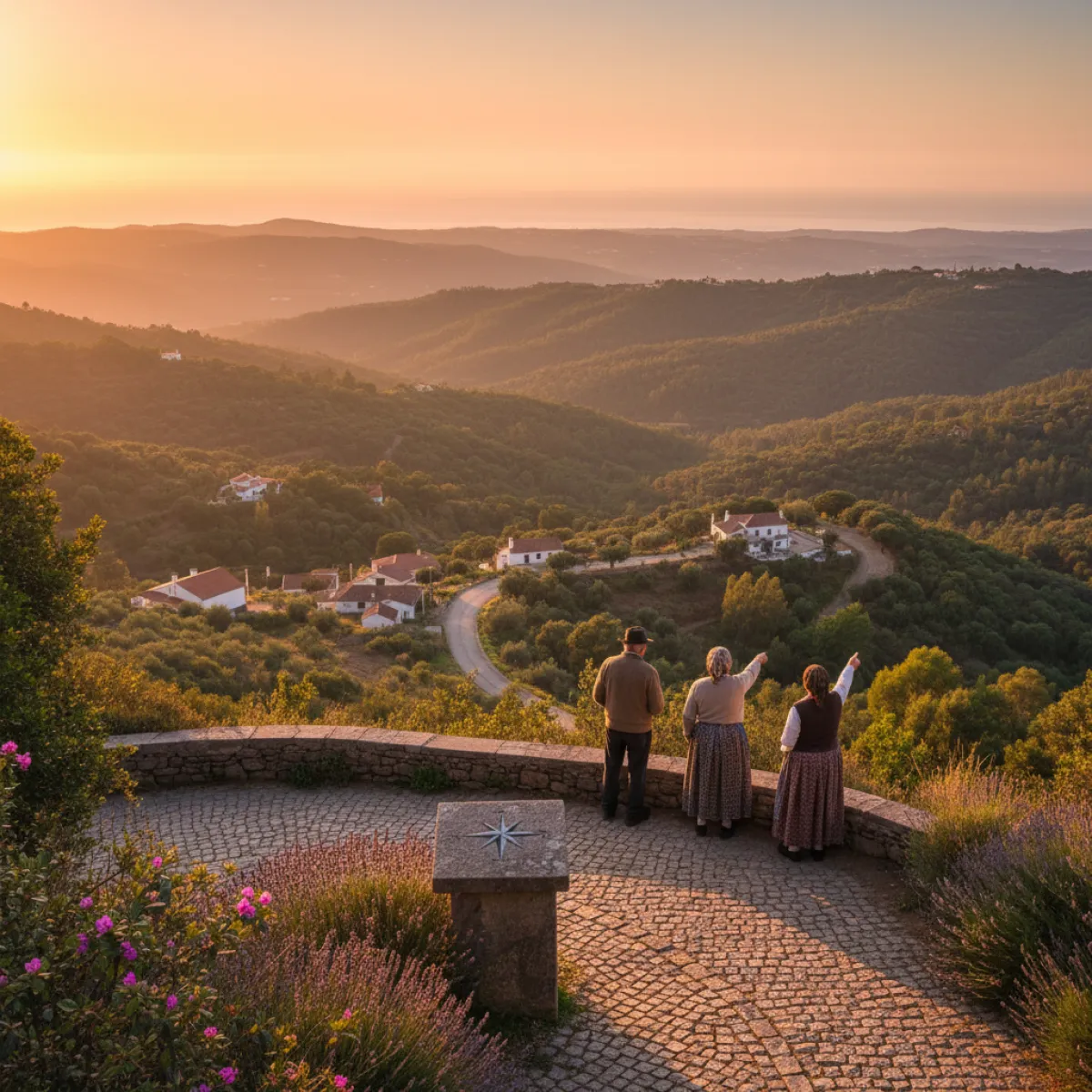
There's an hour in Monchique that changes everything. Not sunrise, despite what every photography manual will tell you. It's the twenty minutes before, when the mountains are still that bruised blue-grey and the Atlantic fog is rolling up the slopes as if someone forgot the stove on down in Portimão. At this hour, from the top of Fóia, you can see the sea from Sagres to Vilamoura in a single frame. Then the sun lifts, the light goes white and hard, and the photograph is dead. Which is why this town deserves a proper appointment, not a flip-flopped afternoon detour.
Let me be direct: Monchique has two viewpoints that everyone knows and half a dozen that no one talks about. The first two are worth it if you know what time to arrive. The second six are worth it always. In this guide I'll tell you which is which, when the light falls right at each one, and where to eat and drink between climbs without falling into tourist traps.
Fóia: the cliché that still works, on a schedule
902 metres. The highest point in the Algarve, and on a clear day you can see from Cape St. Vincent to the Ria Formosa. It's covered in antennas, there's a panoramic restaurant, and by mid-morning the buses unload bewildered tourists in t-shirts taking the same photograph. It's deflating. Don't go mid-morning.
Fóia is a place for two hours of the day: very early (say, 6:45 to 8:00 in summer, 7:30 to 8:45 in winter) and the last half hour before sunset. In the morning you'll catch the low cloud rolling in from the sea, and the mountain seems to float. At dusk, with the sun behind you, the rooftops of Portimão and Lagos turn peach for about ten exact minutes. Check the fog forecast before you drive up. That single variable decides everything.
Practical detail: the road is the M267 from the village centre, eight kilometres of switchbacks. Free parking by the terrace. There's no useful public transport to Fóia, so it's taxi or your own car. And the wind cuts. Even in July, take a jacket. I've seen people shivering in short sleeves in the middle of August.
Where to position yourself
- For sunset: don't stay near the antennas. Walk two hundred metres west, where a small trail drops down to a rocky outcrop. The sun sits in the right part of the frame, with no power lines wrecking the shot.
- For sunrise: stay on the eastern side of the main terrace. The sun comes up behind Picota and the side lighting picks out every ridge with a definition that justifies the trip.
- For foggy days: don't give up, drive up anyway. Above 750 metres you're usually above the cloud, and the sea-of-clouds effect is, without exaggeration, the best you'll see in mainland Portugal.
Picota: the viewpoint locals keep to themselves
If Fóia is the official peak, Picota is the secret one. 774 metres, no antennas, no restaurant, no buses. You access it on foot, by a marked trail of about three kilometres from the secondary road that climbs from Casas Velhas. Allow ninety minutes round trip, with some effort.
The good light here is different. Picota faces more east, towards the interior of the Algarve, so the glory hour is sunrise itself, not the moment before. When the sun pulls up over Silves, the entire range turns orange for about eight minutes. Take a head torch for the climb in the dark, take water, take grippy shoes. The stones are covered in lichen and they slip.
If you go in May, you'll catch the strawberry trees in flower and wild rhododendrons that grow here in higher density than anywhere else in southern Portugal. It's also the best time to see griffon vultures circling. I had never seen griffons in the Algarve before climbing Picota.
The minor viewpoints no one mentions
The stone cross above the convent
Halfway up the Fóia road, there's a turn to the right for the old Convent of Nossa Senhora do Desterro. The ruins alone are worth the stop. But walk fifty metres further, up to the stone cross on a small plateau. From here you frame the village of Monchique against the green of the range, with Picota as the backdrop. At the golden hour of late afternoon, when the sun strikes from the side, the white facades take on a butter-yellow that you don't get from anywhere else. Five-minute stop, maximum. Nobody else is there. It's free.
The old road to Alferce
From the N267 a secondary road peels east toward Alferce. The first three kilometres have four or five curves with open views over the Odelouca valley. Pull over at the third curve after the fork, where there's a small dirt patch on the right. At dawn the valley fills with mist and the hilltops emerge like islands. At day's end the sun sets exactly in the centre of the frame, with cork oak silhouettes cut against the light.
While you're in Alferce, stay for the next morning. There's a cooking class in Alferce where you knead your own bread in a communal wood-fired oven that still works exactly as it did a hundred years ago. It's the most genuine thing you can do in this range, and it gives you a story to go with the dawn photographs.
The water tank above the village
Sounds unromantic. I know. But walk up Rua do Rio to the municipal water reservoir (just follow the signs for the reservoir). There's a small clearing with a direct view of the village, the church tower in the centre of the frame and the mountain behind. At day's end the lights flick on one by one and you catch that transition between the blue hour and the yellow of the windows. Thirty minutes of magic. Tripod useful but not essential if your phone has a decent night mode.
Where to refuel between photographs
Climbing Picota before sunrise and descending Fóia at sunset on the same day is a plan that calls for proper lunches and even better dinners. One thing to know: Monchique is not a chef destination, it's a mountain-cooking destination. Anyone expecting tartares and foams will leave annoyed. Anyone willing to play the local game eats very well.
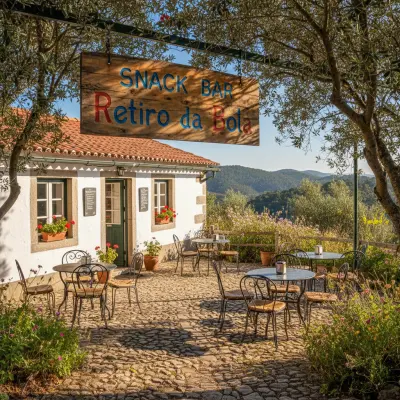
For lunch, after Picota, go to Snack Bar Retiro da Bola. Don't be fooled by the name. It's family-run Portuguese cooking, with daily specials chalked on the board. Order whatever's on the board that day, it's always the freshest. Portions are generous, prices are still reasonable, and the clientele is mostly local, which for me is the best thermometer there is.
At the end of the day, after limping down from Fóia, there's a place where you sit with a medronho and nobody asks where you're from. Bar Travessa is exactly that: the neighbourhood bar of Monchique. Small, unpretentious, with the strawberry-tree spirit this range has produced for centuries. Order the local medronho, not the industrial stuff, taste it for a euro and change, and you'll understand why this mountain produces what it produces. If you're peckish there are simple snacks.
A note on medronho: this is not just a tourist drink for photographs. It's a serious agricultural product, regulated, and the small producers in the range live off it. A good bottle to take home costs between fifteen and thirty euros and is a far more honest souvenir than fridge magnets.
The kit that matters (and the kit that doesn't)
This section is for anyone taking photography moderately seriously. If you only want Instagram posts, skip ahead.
- Polarising filter: non-negotiable. The Algarve light is hard and a polariser makes a huge difference to the greens of the range and the blues of the sea on the horizon. Without it you lose half the contrast.
- Tripod: useful for sunrise and the blue hour. You don't need the most expensive one, any stable tripod works. If you're hiking up Picota in the dark, take a small light one.
- Graduated ND filter: dispensable. The range rarely has the sky-to-ground contrast that justifies one. Bracket your exposures and fix it in post.
- Wide-angle lens: 16-35mm equivalent is ideal for the open viewpoints. But a 70-200mm makes better photos of the layered slopes, especially in foggy dawn light.
What doesn't matter: drones. Local regulations limit flights in parts of the range, and frankly, drone photos at Fóia all look the same. Trust the framing of two feet on the rock.
A 36-hour itinerary for photographers
For anyone coming specifically to shoot, this is the plan I recommend to friends.
Day 1, afternoon: arrive in Monchique mid-afternoon. Scout your locations without rushing to shoot. Climb to the water tank for sunset. Light dinner in the village centre.
Day 2, dawn: hike up Picota on foot, leaving an hour before sunrise. Late breakfast in the village. Free morning for the thermal spas (Caldas de Monchique is separate from the village but worth it if you want a break from viewpoints).
Day 2, lunch and afternoon: lunch at Snack Bar Retiro da Bola. Afternoon exploring the road to Alferce, stopping at the curves with views. Drive up Fóia for sunset. Drink at Bar Travessa.
Day 3, dawn: Fóia again (yes, it's worth it, the light is completely different from Picota). Easy descent to photograph the convent ruins in morning light. Leave Monchique before lunch.
Pairing with other parts of the Algarve
Monchique works well as a base for mountain photography, but it pairs better with other parts of the Algarve than the rest of the Algarve pairs with itself. If you're staying a full week in the region, I suggest alternating mountain and sea.
For dropping down to the sea from Monchique, the west coast is the interesting option. Half an hour by car gets you to the Costa Vicentina, where there's an option of surf lessons at Praia da Arrifana designed for guests staying in Monchique who want to alternate altitude days with board days. The Arrifana waves are honest, the swell is consistent almost year-round, and the contrast between a Picota morning and an afternoon in the water is, photographically, gold.
If your interest is cultural rather than scenic, it's worth crossing the range to Faro to understand the other face of the Algarve. I have a guide on local culture in Faro that points to the places where tradition still moves, away from the beach. For families, I also recommend the honest Silves with kids guide, half an hour from Monchique, which works as a quiet day off from the range. And anyone wanting an urban contrast, with full tourist weight but still genuine corners, will find in the Lagos neighbourhood guide the best way to avoid the same three streets everyone else photographs.
One last thing: patience is the most important piece of kit
I've watched people drive up Fóia, stay eight minutes, declare the weather wrong, and drive back down. Everything is wrong with that approach. The mountain doesn't give photographs to people who arrive and leave. It gives photographs to people who wait. The clouds shift, the light changes, the wind picks up or stops. Bring a book, bring a thermos of coffee, bring the willingness to spend two hours in the same spot.
The best frame I ever made of this range came forty-five minutes after I'd already decided I'd wasted the trip. The fog opened without warning for about ninety seconds, and the entire range looked perfect. If I'd left at the twenty-minute mark, I wouldn't be here writing this. That's Monchique. It rewards the people who stay.