Madeira's Levadas in Summer: Cool Trails, Plus Sintra's Answer
At 8am on the Caldeirão Verde trail, 880 metres up, it is 15 degrees while Funchal bakes below. An honest guide to Madeira's best summer levadas, with timings, the Rabaçal shuttle logistics, and the mainland alternative: Sintra's fog-cooled coastal paths.
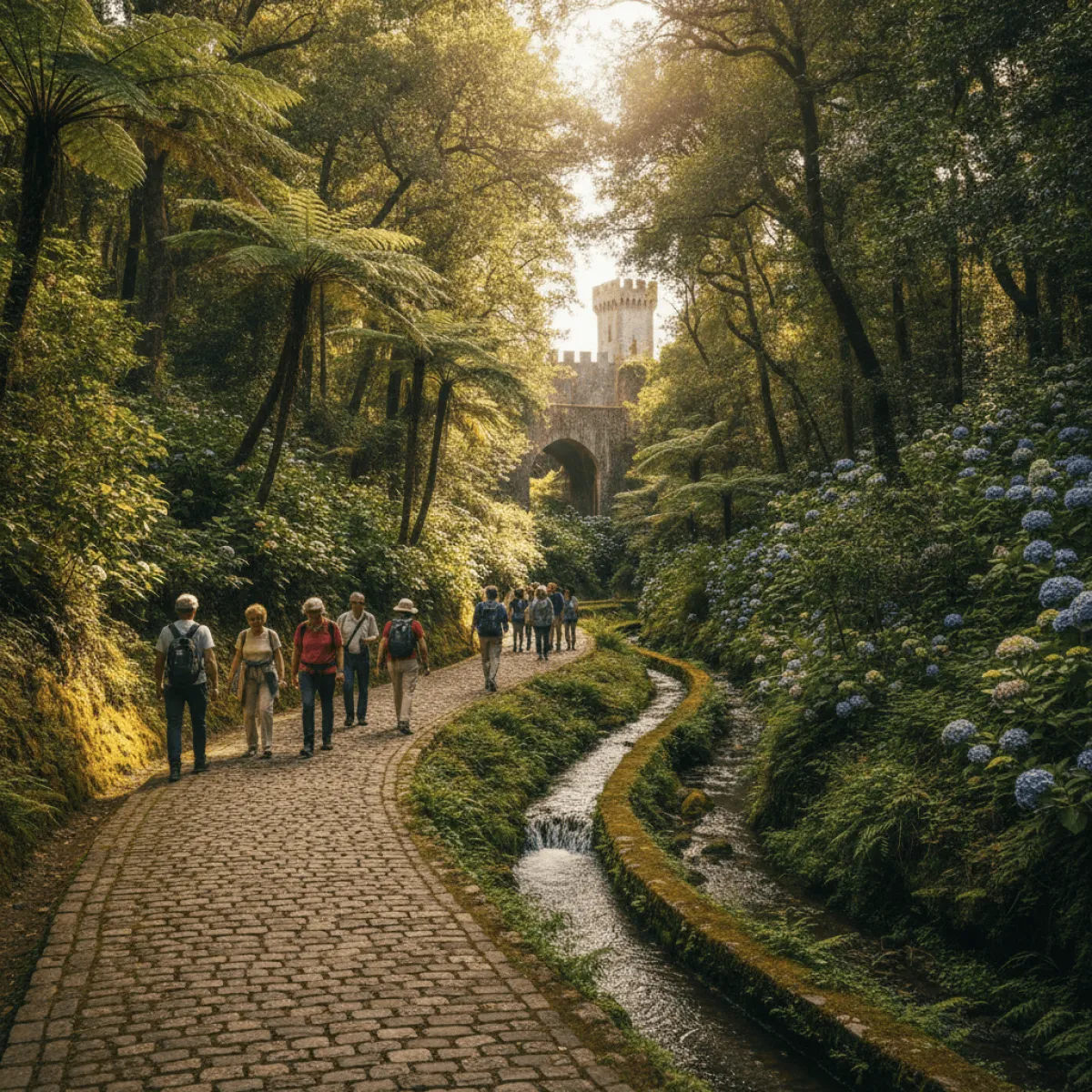
There is a lazy assumption about Madeira that needs retiring: that summer on the island means cruise crowds, hotel pools and sweating through Funchal's old town. Anyone who believes that has never stood in the Queimadas Forest Park at 8am in August, 880 metres up, watching fog drip off the heather while the thermometer reads ten degrees cooler than the seafront below. The levadas, irrigation channels carved into the island's flanks from the 16th century onwards to carry water from the wet north to the dry south, double today as the best summer hiking network in Europe. While mainland Portugal bakes, the laurel forest stays shaded, damp and somewhere between 15 and 20 degrees.
This is a guide to which levadas actually earn their reputation between June and September, what time to start so you beat both the heat and the tour groups, and what to pack. And at the end, a confession from someone writing this in Sintra: if the flight to Funchal is not in the budget, the Sintra hills and coastline are the closest thing the mainland has to levada weather.
Why levadas work in summer
The maths is simple: altitude plus forest equals cool. Funchal in August sits around 26 degrees, but the classic levada walks run between 700 and 1,400 metres inside the Laurissilva, the subtropical laurel forest that has been a UNESCO World Heritage site since 1999. Under that canopy of laurels and til trees, direct sun rarely reaches the path, and the channel of running water beside you works as natural air conditioning.
One practical note before we start: Madeira's official footpaths carry PR numbers, and the region now charges non-residents an access fee on several classified trails. The amount and payment method have changed more than once, so check locally or on the official tourism site before you go, and keep proof of payment on your phone.
The walks I would actually do in summer
Levada do Caldeirão Verde (PR9): the undisputed queen
If you only do one, do this. It starts at Queimadas Forest Park above Santana and follows the channel for roughly 6.5 kilometres each way to a waterfall dropping into a moss-lined rock amphitheatre. The path is almost dead flat, because levadas were engineered for water to flow slowly, but it passes through four hand-dug tunnels. A headtorch is not a suggestion, it is equipment. Even in mid August, temperatures up here rarely pass 20 degrees, and on foggy days you will be glad of a windbreaker.
My honest advice: start at 8am. By 10.30 the organised groups arrive and this narrow path becomes a single-file queue punctuated by selfie stops. At 8am you get the forest to yourself, and the only sounds are running water and the bisbis, the endemic firecrest that behaves like a squirrel with wings.
Levada das 25 Fontes (PR6): overrated at noon, unmissable at 8am
Let me be blunt: 25 Fontes is the most famous trail on the island, and at midday in July the final lagoon looks like a bus stop. But the fame is earned. The route starts at Rabaçal on the Paul da Serra plateau and drops into the laurel forest, ending at a rock wall where dozens of springs trickle into a cold pool. It is a little over 4 kilometres each way, with the Risco waterfall as a bonus detour.
The logistics nobody mentions: the access road down to Rabaçal is closed to private cars. You park by the regional road up on Paul da Serra and either walk the 2 kilometres of tarmac down or take the shuttle that runs the connection. The plateau sits above 1,200 metres, so pack a windbreaker even in July. I have stood there in August in 14 degrees and thick fog, half an hour after leaving a 27-degree Funchal.
Vereda dos Balcões (PR11): for lazy days and families
Not every day needs to be an epic. From Ribeiro Frio, on the road linking Funchal to the north coast, this flat, shaded 1.5 kilometre stroll each way ends at a balcony viewpoint over the Ribeira da Metade valley, with Pico do Areeiro and Pico Ruivo on the skyline on clear days. Half a morning covers it. Pair it with trout in Ribeiro Frio, home to trout farms since the 1950s, and you have a perfect low-effort day.
Levada do Furado (PR10): the full-day crossing
For a proper outing: Ribeiro Frio to Portela is around 11 kilometres along one of the island's oldest levadas, with sections cut into the rock face and steel cables on the exposed stretches. It is a linear route, so arrange transport at Portela or walk back. Fewer people than the two headliners, equally dense forest, guaranteed shade.
Levada do Rei (PR18): the crowd-free alternative
Starting near São Jorge on the north coast, this one runs about 5 kilometres each way to Ribeiro Bonito, a closed valley where the laurel forest looks untouched. It is my August pick: even in peak season you will meet a fraction of the 25 Fontes traffic.
Summer rules I learned the hard way
- Start early. Before 9am you get cool shade, empty paths and better light.
- Always carry a headtorch. Several routes have tunnels. A phone torch works in a pinch but occupies a hand you will want free on a narrow ledge.
- Pack real layers. You can leave your hotel at 26 degrees and walk at 15. A light windbreaker lives permanently in the bag.
- Water and food. There are no cafés mid-levada. A litre and a half per person on the longer routes.
- Check trail status. Landslides and maintenance close paths regularly; Madeira's official tourism site keeps an updated list.
- Grippy soles. Levada paths are packed earth and wet stone. Worn-out running shoes have sent plenty of hikers into the channel.
Can't make it to Madeira? The answer is Sintra
Here comes the part where I write with obvious bias, because I live near these trails. The mainland has one place where summer does not scorch: the Sintra hills and their coastline. The same mechanism as Madeira operates here in miniature. The Atlantic pushes fog over the serra, locals call it the capacete, the helmet, and while Lisbon suffocates at 35 degrees, Sintra often sits at 24 with a breeze.
The clifftop paths between Praia Grande and Praia da Adraga are the mainland's answer to a coastal levada: cliffs, cool wind, and at the end a plunge into 17-degree Atlantic water that resets your nervous system. We have written about hiking the Sintra coast and why March is the perfect month, but the summer version works on one rule: walk in the morning, swim at noon, then retreat uphill to the old town for ice cream and plane-tree shade.
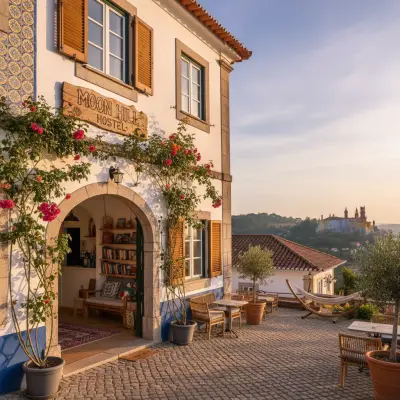
For a base, Moon Hill Hostel is the obvious pick for walkers: relaxed, well located in the town, and full of the kind of guests who are lacing boots at 7.30am. And if your legs file a formal complaint after two days of cliffs, a spa day at Penha Longa offers the recovery option that Madeira's levadas do not. To explore the town properly, our Sintra neighborhood guide points you to the corners the excursion buses skip.
The verdict
If you can, go to Madeira. Caldeirão Verde at 8am on a July morning is one of the finest walks in Europe, and the temperature inside the laurel forest embarrasses any air conditioner. Stay on the north side, in Santana or São Vicente rather than Funchal: you sleep closer to the trailheads and wake to the sound of the stream. If you cannot, Sintra is waiting with Atlantic fog, cliffs and cold water. Either way the rules are identical: start at dawn, pack layers, and keep your phone in your pocket in the tunnels. Your headtorch will thank you.