Linhares da Beira After Dark: Stars Above a Medieval Village
At 820 metres, with the serra as a natural shield against coastal light pollution, Linhares offers one of mainland Portugal's cleanest skies. When to go, where to sleep and why it beats Alqueva on the full package.
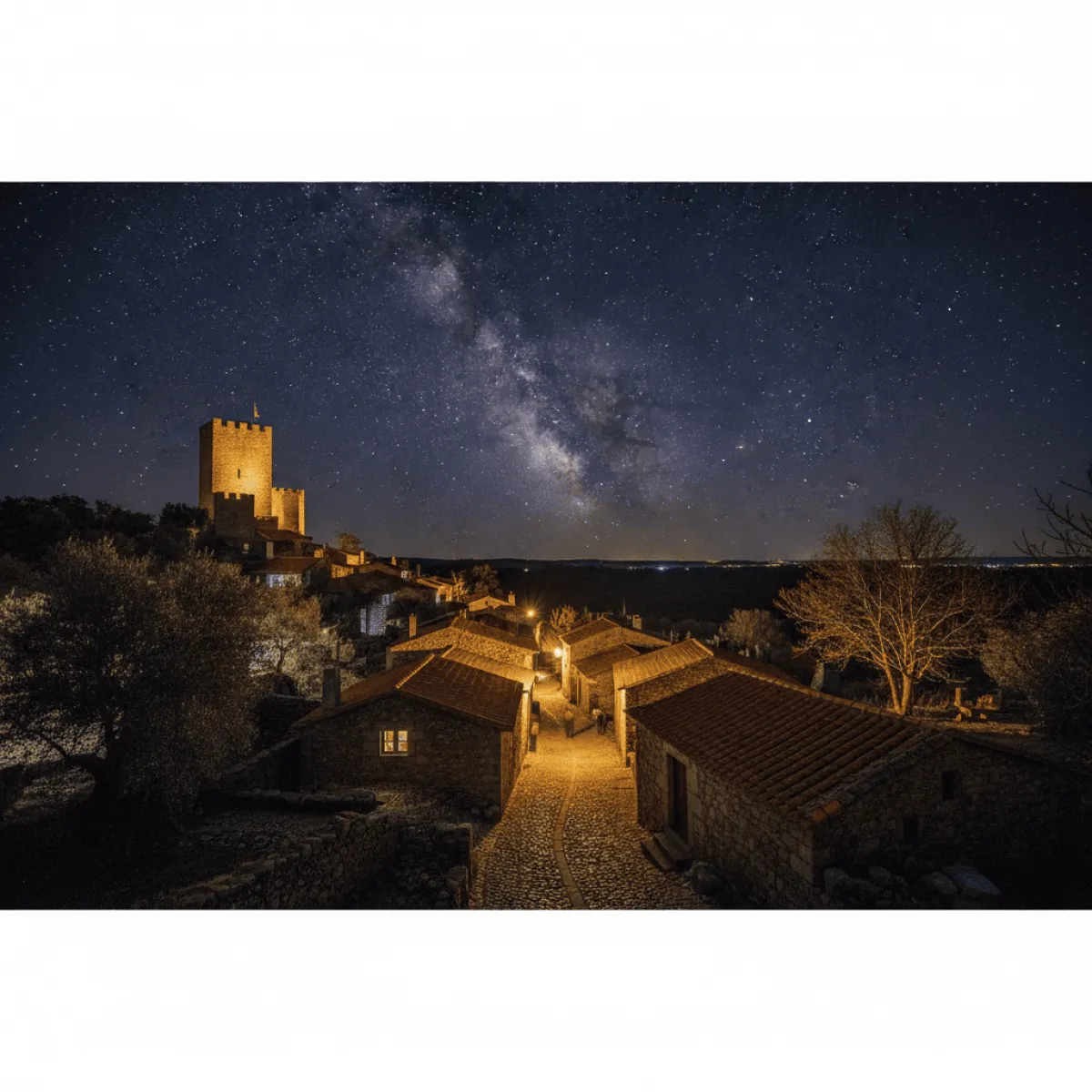
There's a photograph that circulates on the social media of first-time visitors to Linhares da Beira: the silhouette of the medieval castle cut against a sky so absurdly packed with stars it looks edited. People assume the saturation was pushed in Lightroom. It wasn't. That's what the sky looks like when you stand at 820 metres above sea level, with no significant light pollution for kilometres around, and the Serra da Estrela acting as a natural windshield against the lights of the coast.
Linhares is a historic village in the Celorico da Beira municipality, population about 250 in good months and maybe half that in February. It has a 13th-century castle, a Manueline pillory, a medieval synagogue, a platoon of coats-of-arms houses and three restaurants that stay open all year. No traffic lights. No ATM (the closest is 14 km away in Celorico). No noise. And it's that last absence, acoustic silence combined with luminous silence, that makes this one of the best astrotourism bases in mainland Portugal, even without the official Dark Sky certification that the Alqueva already holds.
Why here and not Alqueva
Yes, I know. Alqueva is the official destination. It was the first Starlight Reserve in the world, it has certified operators, professional telescopes and impeccable marketing. Go, if you've never been. It's worth it.
But Linhares offers two things Alqueva doesn't. The first is altitude: at 820 metres, you sit above the usual humidity layer that blankets the Alentejo plains in summer. A sky that's reasonably good in Alqueva in August is a surgical sky in Linhares. The second is the daytime landscape. In Alqueva, after the stars, you have a reservoir and holm oaks. In Linhares, you have a medieval castle, cobblestones designed to wreck ankles, Serra da Estrela cheese, and a view down the Mondego valley that stops the heart of anyone driving up for the first time.
It's a different package. Alqueva is for people who want astronomy with astronomers. Linhares is for people who want stars as the complement to a weekend that was already worth doing for other reasons.
Where to stay: the one option that makes sense
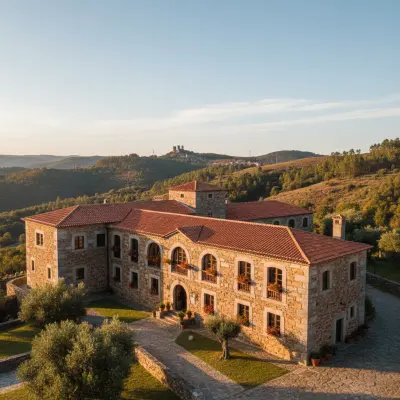
I'll be direct. There are local guesthouses in the village, restored houses with varying degrees of charm, and some are excellent. But if it's your first visit and you want to simplify, the play is the INATEL Linhares da Beira Hotel Rural. It occupies restored traditional buildings in the heart of the village, it has an outdoor pool open in summer, and, more importantly for what we came here to do, it has terraces and gardens from which you can see the sky without having to walk 200 metres with a red headlamp.
Prices vary by season. Peak summer and August weekends are busy, in February and March you basically have the hotel to yourself. Worth asking for a room facing east: at dawn, the light coming over the serra puts on a short but justifying show. Confirm rates and availability directly with INATEL, as they shift considerably.
When to go: the sky's calendar
This is the part nobody tells you and it changes everything. Astrotourism isn't any weekend. There are three variables: moon, weather and astronomical calendar.
Moon
You want to go at new moon or in the three days before and after. A full moon kills the deep sky. Yes, full moon over the castle is a spectacular photograph, but if you want to see the Milky Way as it should be seen, with that almost uncomfortable density of stars, book the weekend nearest new moon. The lunar calendar is in any decent astronomy app (Stellarium is free and does the job).
Weather
The best months are July, August and September for the combination of dry skies and long-but-not-cold nights. In July and August, the sun sets around 9pm and astronomical darkness arrives around 10:30pm. In September, you gain an hour of usable darkness. October is also good, but bring a serious jacket. January and February have endless nights and the cleanest air between fronts, but you can also catch one front after another and see nothing. Check IPMA three days out.
Astronomical calendar
Mark your diary: the Perseids, around 12 August, are the most spectacular event of the year and Linhares fills up. Book the hotel months in advance. The Geminids, around 13 December, are technically better in meteors-per-hour terms, but we're talking about a winter night in the Beira Alta, with everything that implies. The Quadrantids, in early January, are for fanatics. The Milky Way is visible and photographable from April to October, with the galactic core peaking between June and August.
Where to see the stars: three spots, in order of preference
You don't need a telescope. You need a camping chair, a blanket, a thermos of tea and two rested eyes. At least 20 minutes without looking at your phone so your vision adapts (and when you use it, red mode only). The three spots:
- The castle, at sunset. A 10-minute walk up the cobblestones from the village centre. Arrive an hour before sundown, you'll get the golden light over the serra, watch the first star appear (usually Venus, if it's visible), and stay for the transition. Not the darkest spot because the village below has some street lighting, but it's the most cinematic landscape. Proper shoes, those cobbles at night are a trap.
- The paragliding ramp. Heading east out of the village, a road leads to the well-known paragliding take-off ramp. During the day, you'll see pilots flying. At night, it's empty, has a 360-degree horizon and is the best spot for long-exposure photography. Drive to the parking area and walk the last 100 metres.
- Outside the village, on any side road. Take any of the rural lanes and pull over carefully. Five minutes by car is enough to escape what little light pollution exists. Don't drive at night on roads you don't know, take a red headlamp.
The day: what to do while you wait for night
Linhares at one in the afternoon has three people sitting on the benches of the main square. That's not a problem, that's the point. But if you're staying two or three days, you need a daytime programme.
The obvious option is paragliding, and Linhares is one of the best ramps in the Iberian Peninsula for it. Flying in the morning, with the thermals lifting off the Mondego, with the medieval village laid out below you, is one of those experiences that justifies the trip on its own. There are two guides worth reading first: the practical guide that explains how to book, how much it costs and what to expect and the editorial piece on what it actually feels like to fly over the valley. If you've never done a tandem flight, this is a place to start. If you have, this is a place to repeat.
In the village itself, take a slow walk around the medieval synagogue (one of the best preserved in the country), the Manueline doorways scattered along the streets, and the main church, which holds painted panels attributed to Grão Vasco that deserve more than a passing glance. Have lunch with cured Serra da Estrela cheese, presunto and bread. This is the region that makes the best cheese in the country. Don't waste the opportunity on a ham sandwich.
Bases to extend the trip
It's worth booking three nights and making a loop of it. The Serra da Estrela has material for a week and Linhares is well placed as a base. If you want to combine with serious hiking, Manteigas and the snow wells area is about an hour by car and is the heart of the range for people who want their boots on the ground. To the south, and this is worth a full day trip, Fundão during the cherry blossom (late March, early April) overlaps with the start of pre-dawn Milky Way season, which is a pretty coincidence if you want to combine the two.
If you'd rather drop down and cross the Cova da Beira to the schist villages, the one-day road trip between Covilhã and the schist villages is an interesting counterpoint: down there you have dark schist tucked into valleys, in Linhares you have pale granite on a plateau. Two sides of the same range telling different stories.
Eating (which is half the reason to come to the Beira)
I won't recommend specific restaurants by name and address because the offer in Linhares shifts year to year, and what was great in 2023 may have changed cook. What to order, wherever you sit down:
- Cured Serra da Estrela DOP cheese. Not the buttery one, that's for spreading on bread at breakfast. The cured version, in slices, with rye bread and a glass of red Dão.
- Wood-oven roast kid. If you see it on a weekend menu, order it. It's the dish of the region.
- Açorda of cabbage with cod. Shepherd's food, made everywhere and well in few places. Ask before you order.
- Red Dão wine. This is the highest sub-region. The reds have fresh acidity and firm tannins that ask for kid. Avoid cheap supermarket bottles, ask the restaurant for a recommendation.
Logistics without romance
Linhares is about 3h30 from Lisbon by car and 2h30 from Porto via the A25. Exit at Celorico da Beira, then 14 km of well-signposted national and municipal road. There's no useful public transport. It's car or nothing.
Fuel: fill up in Celorico before heading up. There's no pump in the village.
Phone signal: reasonable coverage but with blind spots. Hotel internet works.
Clothing: even in August, the night at 800 metres cools fast. Fleece and long trousers in the boot, even if the day was 35 degrees.
Lights: a red headlamp isn't astronomer vanity, it's what lets you keep your night vision adapted as you move around the village or the terrace. Costs 15 euros in any camping shop. Worth the investment.
Go for a weekend, bring binoculars
A pair of 10x50 binoculars is more useful for a beginner than a telescope. They resolve the Moon in detail, show the moons of Jupiter when it's visible, open up the Auriga clusters in winter and the Sagittarius region in summer. And they fit in a rucksack.
Linhares isn't a destination you do once and tick off the list. It's the kind of place you go back to in the same season, to the same hotel, to eat the same food, and every time you tilt your head up to the sky you see something you missed the first time. Go in July, on a new moon. Then tell me about it.