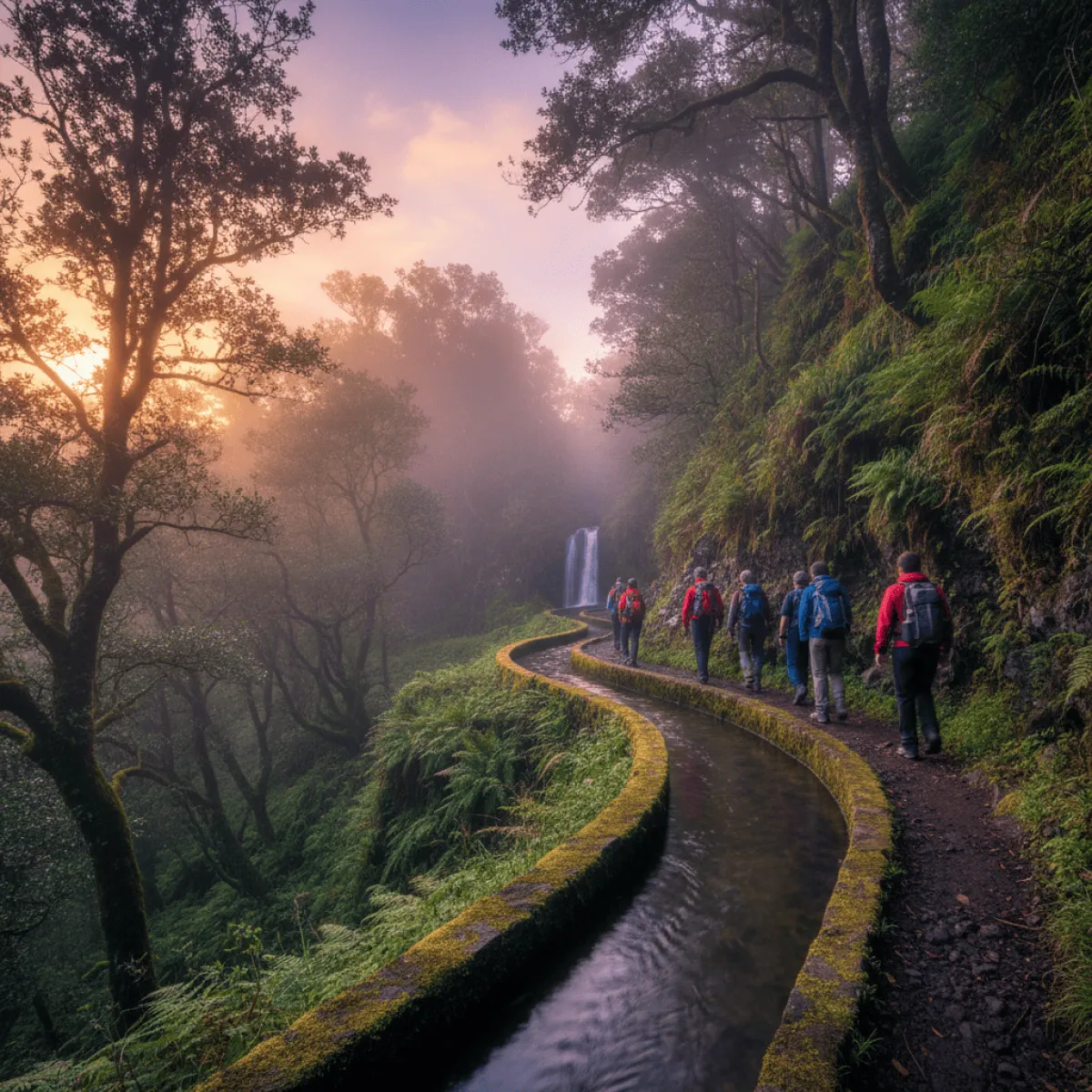
Levada das 25 Fontes at Dawn in Porto Moniz
At 7:15am, you are alone at the 25 Fontes lagoon. By 9am, groups of forty will start arriving. The difference between an unforgettable morning and a tourist circus fits entirely on your alarm clock.
At 6:47am, the Rabaçal parking lot is empty except for a white van where a German couple is sleeping and an older man from Câmara de Lobos who has come up to gather wild watercress. Two hours later, this same patch of asphalt will look like a suburban supermarket on Christmas Eve: tour vans, groups of forty stretching calves, guides shouting instructions in four languages. That is why we are here before sunrise. The Levada das 25 Fontes is probably the most famous trail on Madeira, and it is also the one where tourists most efficiently ruin the experience for one another. There is a way to do this right. And that way involves an alarm clock at 5am.
Why everyone goes to 25 Fontes (and why they are not wrong)
Let me be honest: 25 Fontes deserves the hype. There are prettier trails on Madeira, harder trails, emptier trails. But there are few places in the archipelago where you arrive at a lagoon ringed by a vertical wall of basalt with twenty-five springs falling in thin threads, as if someone had pierced the mountain with a needle. The flow is strongest in spring after a wet winter and weakest by late August. In May, which is when this piece will be most useful, it is exactly right: full without being violent, cold without being painful.
The problem is not the place. The problem is logistics. Rabaçal, the starting point for most people, has a tiny parking lot (about 30 spots) on a narrow mountain road that drops off the ER110. In high season, that lot fills by 8:30am. After that you either walk down from the main road (an extra 1.5 km of steep descent, and on the way back it is uphill in full sun) or you catch the official shuttle, which costs roughly €3 return but involves frustrating waits. Confirm the price and schedule locally because it changes.
The plan: arrive before the world wakes up
The rule is simple. Be at the Rabaçal parking lot by 6:30am, boots on, pack ready. That means leaving Funchal at around 4:45am (an hour and forty by car, mostly via the VE3 and then the ER110, which winds across the Paul da Serra plateau). If you are staying in Porto Moniz, it is easier: about forty minutes on the ER101 and then ER209. But be aware that the Paul da Serra road at dawn frequently catches dense fog. Drive with high beams, slowly, and assume that anything that looks like a cow at the edge of the road is in fact a cow.
If you have never walked a levada, or if you want to fit this trail into a wider plan, start by reading our roundup of the levadas around Funchal worth your time. For 25 Fontes specifically, the official route is PR6, about 4.3 km to the lagoon and the same back, on flat ground (it is a levada, remember), with a few narrow sections where the handrail is metal and there is mild exposure. It is not technical. It is just long enough to wear you down by the fifth group of forty you have to let pass.
What goes in the pack
- A headlamp. You will need it for the first twenty minutes.
- A windbreaker. The Paul da Serra is a windy, cold steppe even in May.
- Water: 1.5 liters per person. There are no drinkable fountains on the trail, despite the name.
- A real snack. Sandwich, fruit, chocolate, anything that delivers calories.
- A small towel and a spare pair of socks if you plan to get your feet wet.
The walk, hour by hour
6:30 to 7:15: the descent in the dark
Leaving Rabaçal on the paved road that drops down to Casa do Rabaçal, it will be dark, or at best a bluish grey that does not yet count as day. This is the boring part of the walk: 1.5 km of steep tarmac. Take it slow, because on the way back it will be a grind. When you reach Casa do Rabaçal (a stone hut that doubles as a gathering point for guides during the day), turn left and step onto the levada proper.
The first light starts filtering through laurel and til trees, and you realize you are inside the Laurissilva, the primitive forest that has survived since before the last glaciation and that has been a UNESCO World Heritage Site since 1999. The smell is damp, slightly sharp, with notes of wet moss. The birds start to wake up. A Madeira firecrest, which is endemic to the island, may show up if you are lucky.
7:15 to 8:00: arrival at the lagoon
You will reach the 25 Fontes lagoon practically alone. It is a strange moment: this place, which saw literally thousands of people taking selfies the day before, is yours and maybe two or three other early walkers. The water is freezing (do not joke about diving in, hypothermia is real even in May), it glows emerald green when the sun hits, and the sound of the springs falling is the kind of noise that makes any city feel like nonsense.
Stay twenty minutes. Eat an apple. Do not take thirty photos, take three. Sit on the flat rock to the right of the main waterfall (careful, it is always wet) and let the place do what it has to do. Around 8am, you will hear the first tour group arriving. That is your cue.
8:00 to 9:30: the way back and the Risco detour
On the way back, before you get to Casa do Rabaçal, there is a signed detour to the Risco waterfall, about five hundred extra meters. Take it. In May, with the flow at full, Risco is a hundred-meter vertical curtain falling against a basalt wall. It is always less crowded than 25 Fontes and costs you fifteen extra minutes.
Back at the parking lot by around 9:30am, you will cross the crowds who are just getting started. Nod politely. You already did the work.
After the walk: head down to Porto Moniz and eat properly
You will be starving, the good kind of hunger that only comes from six kilometers of levada and three hours of fresh air. The descent from Paul da Serra down to Porto Moniz on the ER209 is one of the most beautiful roads on the island: zigzag of tight switchbacks, fajã wall to your right, ocean appearing and disappearing on your left. About forty minutes.
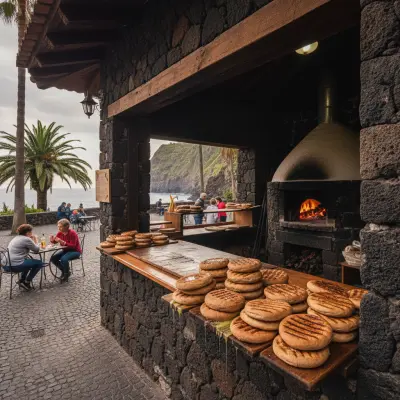
In Porto Moniz, forget the natural pools for now (do those in the afternoon when the sun is on them). Go straight to lunch. The bolo do caco with garlic butter is mandatory, but order it as a starter, not as a side, because the bread fresh off a hot basalt stone is its own event. For the main, grilled limpets with lemon if they are on the menu, or a fillet of tuna with onions. Drink a regional poncha, not a tourist five-fruit poncha that looks like a hotel cocktail. The original is honey, lemon and sugarcane spirit. Nothing more.
How to stretch this day (or this trip)
If you have adrenaline to spare and you are in shape, the Ribeira da Laje runs down the Porto Moniz side and offers one of the better canyoning experiences on the island. Read our detailed guide to canyoning the Ribeira da Laje before booking, because there are different technical levels and not all of them suit beginners. Local operators leave the village in the morning, but afternoon sessions slot in well if you have done 25 Fontes at dawn.
For a slower plan, it is worth booking a boat trip. The northwest coast has cetaceans year round, and May is particularly good for pilot whales. I wrote an honest guide to whale watching between Calheta and Porto Moniz that is worth reading before choosing an operator, because there are real differences between companies in how they treat the animals.
If you are stretching the trip across the island, two other pieces may help. In June, Funchal goes into festival mode with tuna as the centerpiece of a series of food events: our roundup of Funchal in June with tuna, levadas and festival nights gives you the dates. And for total contrast with Porto Moniz, a full day in Santana on the north side is the right way to close the trip: read 24 hours in Santana done slowly to understand why that village deserves more than the thatched houses everyone photographs.
Common mistakes everyone makes
- Wearing sneakers instead of boots. The levada is wet, the ground is uneven, and there are sections of roots. Boots with a real sole are the difference between a good morning and a twisted ankle.
- Bringing too little water. There is nowhere to refill a bottle on the trail. 1.5 liters minimum.
- Dressing for Funchal weather. The Paul da Serra is ten degrees colder. Layers, always.
- Walking it at midday in August. Heat, zero shade in places, crowds. Early morning or skip it.
- Ignoring the weather. Heavy rain can close the levada for safety. Always check the trail status on the official Madeira Forestry site the night before.
So is it worth it?
It is, with one condition: do it the way described here. At midday in high summer, with a queue to get past, flip-flop tourists asking you to step aside for their photo, guides talking over each other in German, Spanish and English, 25 Fontes is a mess. At 7:15am, alone, with the sound of the springs hitting basalt and the entire Laurissilva still half asleep, it is one of the most beautiful experiences you can have on Madeira. Same levada, two different worlds. The difference is the alarm clock.
Set it.