Whale Watching from Calheta to Porto Moniz: Honest Guide
Half a day, two coasts: starts by van from Calheta, climbs to the Ponta do Pargo lighthouse, then returns by sea along the wild north coast with Madeira Wild Blue. Cetacean sightings are near guaranteed May to October, from 90 euros.
There are dozens of whale watching boats around Madeira, but this trip is built differently: it starts on land at Calheta Marina, drives up the western coast to Porto Moniz with a stop at the Ponta do Pargo lighthouse, then comes back by sea along the wild north coast. Half a day, two completely different landscapes, and the only sensible way to combine the Laurissilva forest, the westernmost lighthouse on the island, and a serious cetacean search in one ticket.
Who runs it, and why it matters
The operator is Madeira Wild Blue, based out of the H2oMadeira shop inside Calheta Marina, between the Savoy Calheta Beach and Savoy Saccharum hotels. Small team, biologists on board, and a land based spotter who radios coordinates to the captain, which dramatically shortens the time spent searching blind. Official site: madeirawildblue.com. Phone: (+351) 965 104 018. Email: vanguardolphin@gmail.com.
It matters because Madeira enforces strict rules around cetacean approach: minimum distance, observation time limits, maximum number of boats per group. Certified operators respect this. If you ever see a Zodiac doing tight circles around a dolphin pod at speed, it is not Wild Blue, it is someone who should be fined.
How the day works
1. Meeting at Calheta Marina
The meeting point is the H2oMadeira shop inside the marina. GPS: N 32º43'067" W 017º10'240". Show up 15 to 20 minutes early. Payment, quick safety briefing, and a short talk about what you can and cannot do near the animals (no touching, no shouting, no throwing anything overboard, the obvious stuff but it gets said).
2. Drive up to Porto Moniz
The group rides a van up the western coast. The route stops at Ponta do Pargo lighthouse, the westernmost point of the island. On clear days you get a 270 degree ocean view and, if the haze is thin, the Desertas islands to the south. The descent into Porto Moniz is the most cinematic stretch: ER101 cuts switchbacks down a cliff face into the harbor.
3. Boarding at Porto Moniz
The boat leaves from the Porto Moniz pier. Before boarding, glance over at the volcanic natural pools right next door, even if you have no time to swim. For after the trip, if you can, grab a bolo do caco with garlic butter before driving back.
4. Crossing the north coast
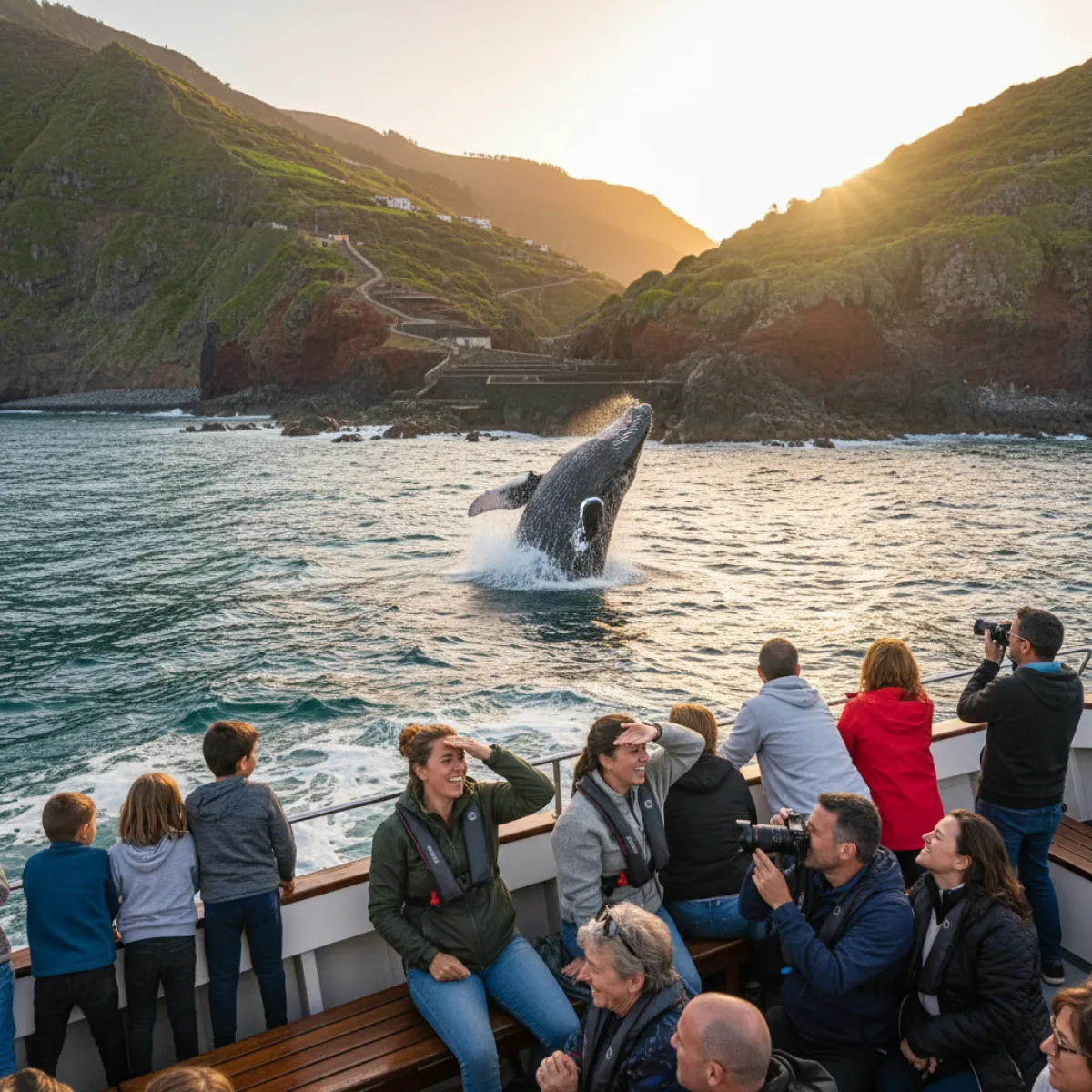
This is the section that justifies the price. Madeira's north coast is the wild face of the island: 400 meter vertical cliffs, waterfalls dropping straight into the ocean, Laurissilva forest reaching nearly to the waterline. You see Seixal, Ribeira da Janela, sea caves, tunnels carved straight through rock. Even without a single dolphin, this leg is worth the ticket.
5. Searching for whales and dolphins
The most common species are common dolphins, bottlenose dolphins, Atlantic spotted dolphins, and pilot whales. Summer brings sperm whales and, on lucky days, Bryde's whales. The shore spotter coordinates by radio. Once the boat reaches a pod, engines go off and the boat drifts. The animals decide whether to come closer. That is the deal.
Price and duration
The combined trip starts at around 90 euros per person (about 97 USD depending on the booking channel). Total time is roughly 4 to 5 hours, including the land transfer and the boat crossing. Book at least 24 hours ahead. Free cancellation up to 24 hours before; after that, no refund. If the operator cancels for weather (common between November and February), you can reschedule or get a full refund.
Best time to go
May to October is the consistent window. Calmer sea, more species, longer daylight. July and August give the highest sperm whale odds, but also the most crowded and hottest conditions (sunburn on board is real). I prefer June or September: fewer tourists, water still warm, side light that makes the north coast photograph properly. For framing that light, this photography guide for Porto Moniz helps.
What to bring
- Windbreaker. Even with 28 degrees on land, 20 knot wind on the boat gets cold.
- Mineral sunscreen, SPF 50. Sea reflection burns fast, and chemical filters do not help the ecosystem.
- Hat with a chin strap. Wind takes anything loose.
- Polarized sunglasses. They make a real difference for seeing animals just below the surface.
- Water and a sandwich. No bar on board.
- Dry bag or Ziploc for your phone. It is not a dive trip, but there is spray.
- Seasickness tablet if you are sensitive, taken about an hour before.
Honest note about kids
The trip accepts children from age 5, but the land transfer to Porto Moniz plus the sea leg can be long for very young kids. If you travel with under 8s, consider doing only the standard 2 hour boat trip out of Calheta instead of the half day combo.
What to do around it
If you have time left in Porto Moniz that day, use it. There are good quiet beaches and snorkel spots a few minutes from the pier, and a couple of museums worth visiting on days when the sea is closed.
Is it worth it?
Yes, with one caveat. If you just want to see dolphins, there are shorter and cheaper boats from Funchal or directly from Calheta. But if you want to understand Madeira's geography, see both coasts in one day, and you have half a day to spend, this is one of the most complete experiences on the island. The best moment, for me, is not the cetacean sighting. It is the instant the boat rounds Ponta do Tristão and the north coast opens up ahead, vertical and green, with not a single road in sight.