Historic Villages of Central Portugal in Spring
Between March and May, the Historic Villages of Central Portugal are at their finest: poppy fields, fortress walls claimed by wild roses, and streets you'll have to yourself. With an essential detour through Arraiolos and its centuries-old rug artisans, this is the itinerary for anyone who wants the real interior.
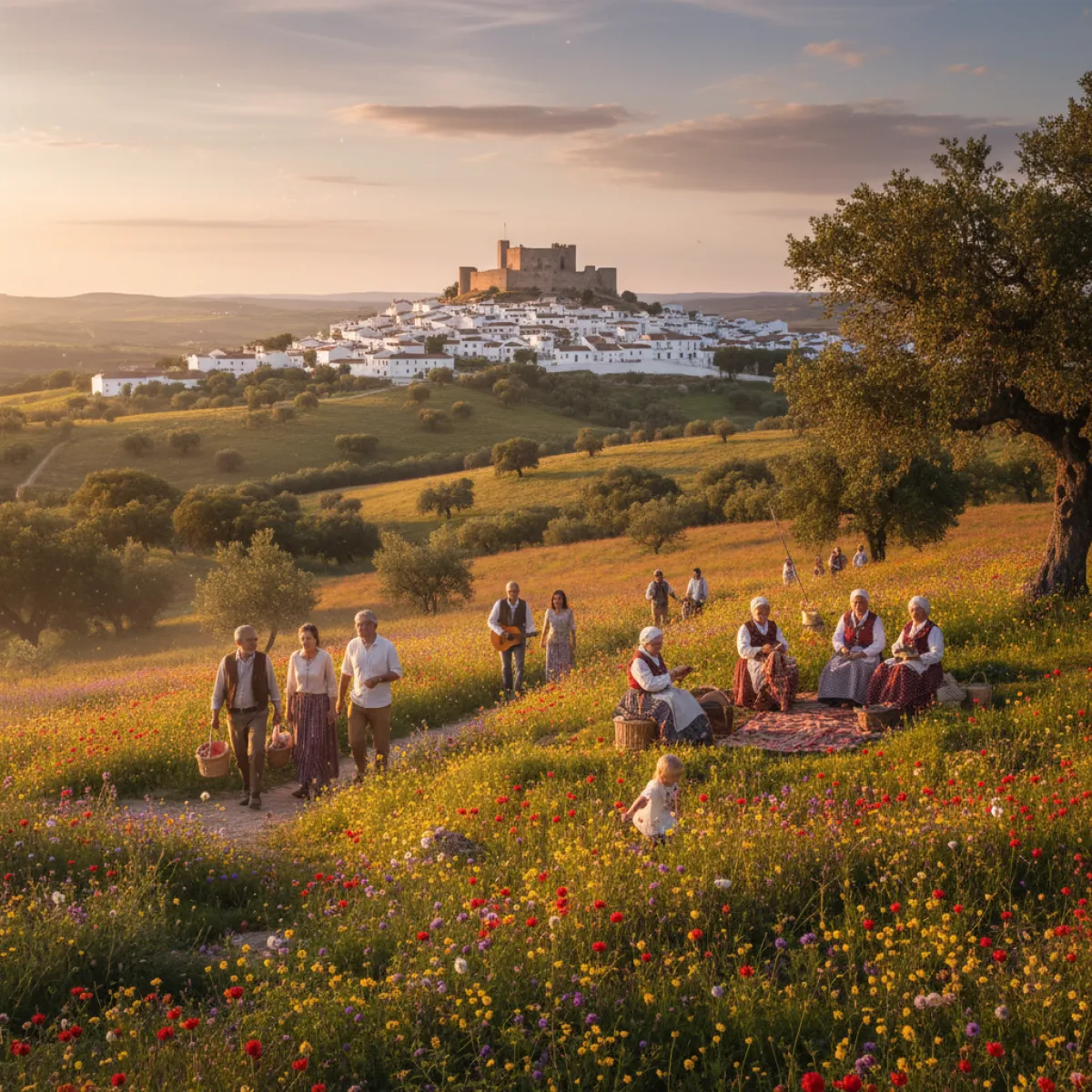
There's a window, roughly mid-March through the end of May, when the Historic Villages of Central Portugal go from merely beautiful to something altogether different. Wild roses claim the fortress walls, poppy fields stretch to the horizon, and you can walk entire streets without seeing another person. This isn't marketing. It's what happens when you visit before the tour buses arrive.
The official network includes twelve villages, Monsanto, Idanha-a-Velha, Castelo Rodrigo, Almeida, Linhares da Beira, Piódão, Sortelha, Belmonte, Castelo Mendo, Castelo Novo, Marialva, and Trancoso, scattered between the Serra da Estrela mountains and the Spanish border. Each has its own character, and the temptation to see them all in one trip is real, but wrong. Pick three or four, give them time, and you'll understand why.
Where to Start (and What to Skip)
Monsanto is the most famous, and deservedly so. The village built among giant boulders is so photogenic it became a national symbol. But fair warning: on weekends, especially between April and June, it fills up with organized tour groups. If you can go on a Tuesday or Wednesday, you'll have the village practically to yourself. Climb to the castle first thing in the morning, the path is steep but short, and stay at the top for a good twenty minutes. The view over the Beira Baixa lowlands, with spring wildflowers carpeting the fields, is worth every bead of sweat.
Sortelha is my pick for anyone who wants the real weight of history without a tourist veneer. The entrance through the medieval gate, the square with its pillory, houses that seem to grow directly from the rock, all within 13th-century walls. There are one or two cafés near the village gate serving Serra cheese and local cured meats. Don't expect elaborate menus. Expect honesty.
Piódão is unlike any of the others. Tucked into a deep valley in the Serra do Açor, with its schist houses and blue doors, it looks like a nativity scene at full scale. The access road is winding, not recommended for those prone to car sickness, but the arrival, when the village suddenly appears around a bend, is one of those moments. In spring, the contrast between dark schist and the intense green of chestnut trees is something else entirely.
The Villages Almost Nobody Visits
Castelo Mendo and Marialva are, for me, the great surprises of this network. Castelo Mendo is tiny, we're talking about a dozen houses inside walls, but the medieval citadel is practically intact and there's not a souvenir shop in sight. In spring, storks nest on the towers and the only soundtrack is wind and birdsong.
Marialva deserves its own paragraph. The abandoned citadel on the hilltop is one of the most striking things you'll see in Portugal's interior. Roofless houses, cobbled streets invaded by grass, a ruined church with the sky as its vault, and almost nobody there. At the foot of the hill, the newer village has half a dozen excellent rural tourism houses and a restaurant, Castas e Pratos, that handles regional ingredients with real care.
Idanha-a-Velha is another story entirely. Here we're not talking medieval, we're talking Roman. The ancient Igaedis was a diocesan seat, and ongoing excavations continue to reveal layers of occupation from Romans to Visigoths. The Visigothic cathedral, though small, is a rare historical document. The village has fewer than fifty inhabitants. In spring, the surrounding fields fill with wildflowers and you can walk to the Ponsul River, which flows nearby.
How to Build Your Itinerary
Four days is the ideal timeframe for visiting four to five villages at a proper pace. My favorite spring route:
- Day 1: Belmonte and Castelo Novo. Belmonte has the Discoveries Museum and a rich Jewish history (the Bet Eliahu synagogue is one of the few active ones in Portugal's interior). Castelo Novo is twenty minutes away and perfect for late afternoon, the Lagoa (a 16th-century fountain in the square) is the natural meeting point.
- Day 2: Sortelha in the morning, Monsanto in the afternoon. They're about an hour apart. Have lunch in one of them, both have modest but honest options.
- Day 3: Idanha-a-Velha and Castelo Mendo. They're small villages, but the drive between them passes through open Beira Baixa landscape that in spring is spectacular.
- Day 4: Marialva and Trancoso. Trancoso has more infrastructure, it's a town, not a village, with good pastry shops inside the walls and the famous Bandeira (a local conventual pastry).
If you have more time, add Piódão and Linhares da Beira, but know that they're more isolated and the roads are slow. Piódão in particular requires a significant detour.
What to Eat in the Centro
The cuisine here is mountain food: robust, direct, no pretense. Wood-oven roasted kid goat is the undisputed king, and spring is when it's at its best. Cured Serra da Estrela cheese, not the fresh version, which is good but different, with rye bread makes a perfect lunch if you don't want anything heavy.
In Trancoso, look for Sardinhas sem Espinhas, it's a conventual sweet, not fish, made with eggs and almonds. In Belmonte, the Belsol restaurant serves solid regional food without pretension. In Monsanto, Adega Tipica O Cruzeiro has a good local reputation, but confirm hours before going, in the interior, schedules can be creative.
The regional wine is Beira Interior DOC, little-known outside Portugal but with interesting high-altitude reds. Ask for local recommendations, small producers change, and what was excellent two years ago may no longer exist.
Northern Alentejo: The Perfect Complement
If the Historic Villages whet your appetite for deep-interior Portugal, Northern Alentejo, particularly the Portalegre area, is the natural extension. Portalegre is a city with fascinating textile history, serious Alentejo food, and a human scale you can explore on foot. Our guide to a real weekend in Portalegre gives you the itinerary without the tourist clichés. If you like walking, the neighborhoods worth exploring on foot are an excellent starting point. And when hunger strikes, knowing where locals actually eat makes all the difference, because the gap between the tourist restaurant and the right spot is enormous.
Arraiolos: The Essential Detour
Arraiolos isn't part of the official Historic Villages network, but it absolutely deserves a detour, especially if you're heading south from the Centro region. The town is famous for its hand-embroidered rugs, a tradition dating back to the 17th century that is very much alive. This isn't tourist-grade handicraft. These are pieces that take months to embroider, with patterns blending Persian and Portuguese influences, collected seriously by people who know textiles.
If you want to truly understand what's behind this craft, the rug weaving masterclass is one of the most complete experiences I know, this isn't a fifteen-minute tourist demonstration, it's a real immersion in the technique and the history. For those who prefer hands-on learning, the workshop with local artisans lets you learn the basic stitches directly from women who've been doing this for decades.
The town itself is small but handsome: the castle on top of the hill (with a church inside it, which is unusual), whitewashed streets with blue trim, and a central square where the pace of life is exactly what you'd expect from the Alentejo. In spring, the late-afternoon light here is extraordinary, golden and long, perfect for photographing the details of the façades.
Practical Information
There's no way around it: to visit the Historic Villages, you need a car. Public transport between villages is essentially nonexistent, and while the distances aren't huge, the roads don't allow for high speeds. Renting a car in Coimbra, Guarda, or Castelo Branco is the most practical option. Budget roughly 30 to 50 euros per day for a small car, depending on the season.
Accommodation: forget chain hotels. Here the offering is rural tourism, restored village houses and, in some cases, pousadas. Book ahead in spring, especially around Easter and the April/May holidays, demand has risen significantly in recent years. Expect to pay between 60 and 120 euros per night for a double room with breakfast, depending on comfort level.
Fuel: don't forget to fill up before entering the more rural areas. Some villages are twenty or thirty kilometers from the nearest petrol station.
Footwear: the villages are cobbled, with uneven and sometimes steep surfaces. Trainers or walking boots, not sandals. Seriously.
Mobile coverage: patchy. In some villages it works, in others it doesn't. Download offline maps before you leave. Google Maps makes this easy.
Spring in Central Portugal is, honestly, the best time of year for this kind of trip. Temperatures hover between 15 and 25 degrees, the days are long, the landscape is at peak color, and the crowds haven't arrived yet. If you can only make one trip to Portugal's interior, make it in April or May. You won't regret it.
