Granite and Lime: A Walking Tour of Évora’s Historic Centre
An investigation into the granite bones and white-washed silence of Évora, where Roman ruins and Gothic spires dictate a slower pace of life. Explore the Alentejo capital’s architectural layers and its unique, contemplative atmosphere.
The Cadence of the Alentejo Capital
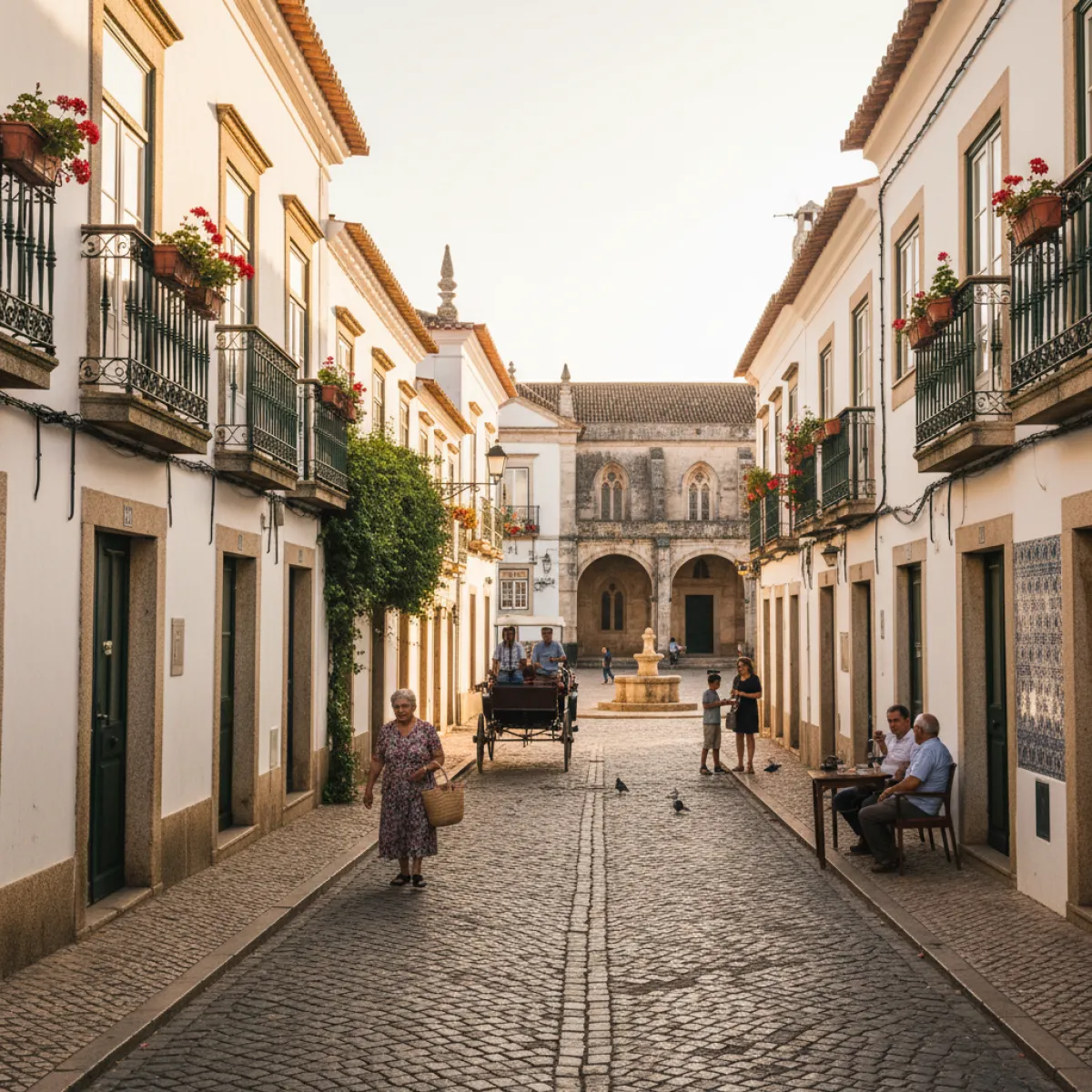
Évora does not reveal itself to the hurried traveler. Arriving from Lisbon, crossing the vast plains dotted with cork oaks and olive trees, the city appears on the horizon like a white mirage crowned by grey granite. It is a city that demands a shift in frequency, an adjustment to the rhythm of both step and thought. One does not come here to check monuments off a list, but to feel the density of two millennia of history layered in almost geological strata.
The starting point is invariably Praça do Giraldo. With its Moorish arcades and the austere facade of the Church of Santo Antão, the square is the city’s gravitational center. Avoid the noisier cafes under the arches; find a spot in the sun on a terrace, order a coffee, and watch the world go by. Here, time feels dilated. If you are planning your logistics, the guide One Day in Évora: A Precision Itinerary for the Alentejo Capital provides the necessary structure to navigate the density of the historic center without succumbing to exhaustion.
Ascending to the Temple and the Cathedral
Walking up Rua 5 de Outubro, a commercial artery where cork handicrafts and wool blankets from Reguengos tempt passersby, you reach the highest point in the city. The Roman Temple, often and incorrectly attributed to Diana, is Évora’s most iconic monument. Its Corinthian columns in granite and marble from Estremoz have resisted time not out of a veneration for the past, but due to practical utility: they were incorporated into the walls of a medieval castle and even served as a municipal slaughterhouse. There is a lesson in Alentejo pragmatism in this survival.
A few meters away, the Cathedral of Évora (Sé) imposes itself with its fortress-like appearance. It is the largest medieval cathedral in Portugal and one of the most fascinating. Climbing to the roof is an essential experience. From the top, the view over the sea of pink roofs and the vastness of the surrounding plain is overwhelming. It is the ideal place to understand the region’s geography and how the city integrates into it. This aerial perspective perfectly complements the reflections found in Stone and Silence: A Sentimental Guide to Évora, which explores the intimate relationship between architecture and local identity.
Erudition and Mortality
Descending toward Largo da Porta de Moura, we find the University of Évora, housed in the former Jesuit College of the Holy Spirit. The 16th-century cloister, with its Renaissance arcades and azulejos depicting various academic disciplines, is an oasis of intellectual serenity. It is easy to imagine the Jesuits debating philosophy in these corridors. The university returns a youthful energy to the city that contrasts with the ancient stone, preventing Évora from becoming a static museum-city.
In the opposite direction, the Church of Saint Francis houses the Chapel of Bones (Capela dos Ossos). The inscription at the entrance, “We bones that are here, for yours we wait”, is not a gratuitous exercise in the macabre, but a Baroque reflection on the transience of life. The walls covered in human skulls and bones, sourced from overcrowded monastic cemeteries in the 17th century, invite a contemplative silence that is rare in other European tourist destinations.
The Aqueduct and the City’s Fringe
One of the most singular aspects of Évora is the Silver Water Aqueduct (Aqueduto da Água de Prata). Built by Francisco de Arruda in the 16th century, the aqueduct runs for miles before entering the city. What makes it fascinating is how the inhabitants, over the centuries, have integrated the arches into their homes. At the end of Rua do Cano, houses and shops were built literally inside the spans of the aqueduct, transforming a hydraulic engineering structure into an organic element of urban life. It is this type of adaptation that keeps Évora a living city.
Gastronomy: The Science of Alentejo Flavor
Dining in Évora is an act of resistance against haste. Alentejo cuisine is based on humble ingredients, bread, olive oil, garlic, and aromatic herbs, transformed into banquets of surprising complexity. For a serious lunch, look for places that respect the cooking time of lamb or the freshness of asparagus migas. The Évora cheese, with its sharp bite and hard paste, is the mandatory prelude. To better understand this regional context, the guide Évora: The Slow Pulse of the Alentejo deeply explores the traditions that shape the table and the daily life of the city.
Practical Information and Budgeting
- When to go: Spring (April-May) and Autumn (September-October) are ideal. Summer can be brutal, with temperatures easily exceeding 40°C (104°F), making daytime walks almost impossible.
- Budget: Évora is affordable compared to Lisbon or Porto. A coffee costs about €0.80; a meal at a mid-range restaurant is around €25-35 per person. Entry fees for monuments range from €4 to €6.
- What to order: Ask for Encharcada or Pão de Rala for dessert. These are egg-rich, sugar-heavy conventual sweets, a direct legacy of the convents that once dominated the city's social life.
- Logistics: The historic center is perfectly navigable on foot, but wear shoes with good grip for the uneven cobblestones. Avoid driving into the historic center; use the peripheral parking lots outside the walls.
Évora ends where the plain begins. In the late afternoon, when the golden light hits the walls, the city seems suspended between its Roman past and an uncertain future. It is a place that does not offer easy answers but provides the silence necessary for questions to arise. Walking through its historic center is, ultimately, an exercise in patience and observation.
