Fortified Geometry: The Moats and Bulwarks of UNESCO Elvas
Explore the military mastery of Elvas, the world's largest bulwarked fortification. A guide to the geometry of Forte da Graça, the plum-making tradition, and the architectural rigor of the frontier.
The Granite Sentinel on the Frontier
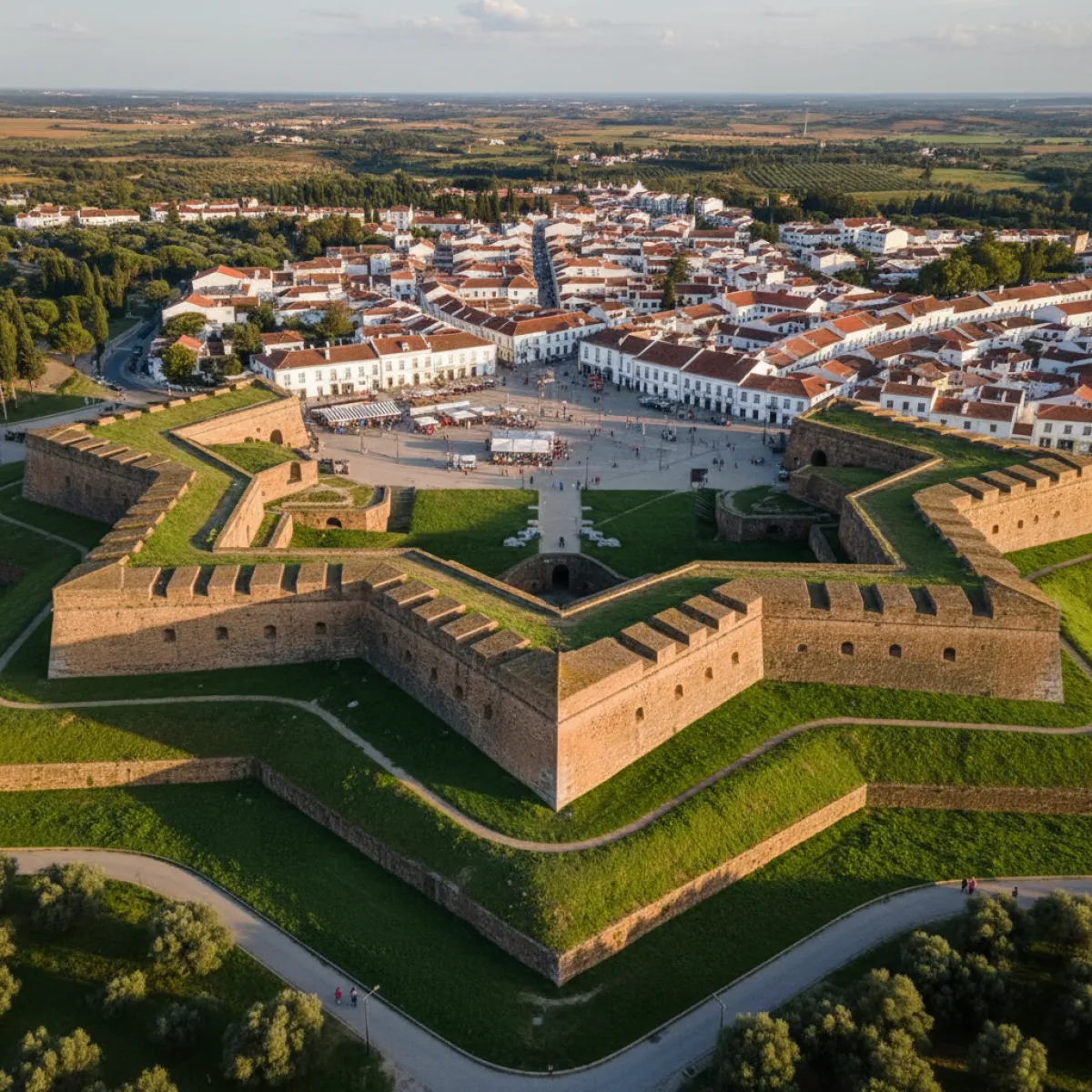
There is a mathematical severity that greets those crossing the Alentejo plains toward the Spanish border. Elvas does not reveal itself through organic ornaments or haphazard urban sprawl; it presents as a theorem of military engineering etched into the soil. As the Amoreira Aqueduct, a structure of 843 arches that defies human scale, stretches across the landscape, one realizes this city was built not merely for habitation, but for endurance. Elvas is the world's largest system of bulwarked dry-ditch fortifications, a labyrinth of moats, ravelins, and curtain walls that transformed the necessity of defense into a geometric art form recognized by UNESCO.
Unlike neighboring Spain, which often opted for vertical citadels, Elvas expanded horizontally, hugging the earth with angles calculated to deflect artillery fire. Walking its ramparts is to understand the transition from medieval warfare to the modern era, where the design of a star was the difference between sovereignty and surrender. If Stone and Silence: A Sentimental Guide to Évora teaches us about monastic introspection and Renaissance elegance, Elvas speaks of external discipline, of a vigilance that never sleeps.
Forte da Graça: The Masterpiece on the Hill
No analysis of the geometry of Elvas is complete without the ascent to the Fort of Our Lady of Grace. Strategically situated on a hill that once threatened the city, this fort is arguably the most perfect mountain fortification ever constructed. From above, its floor plan reveals a concentric complexity reminiscent of a tactical mandala. The central body, with its chapel and governor's house, is protected by successive layers of bastions and moats that made any attempt at invasion an exercise in futility.
The fort's recent restoration allows visitors to traverse colossal cisterns and cells where light enters dramatically, creating contrasts that would appeal to any architectural photographer. There is none of the lightness found in Évora: The Slow Pulse of the Alentejo; instead, we find a density of purpose. The view from the summit extends as far as Badajoz, reminding us that the peace we enjoy today was purchased with centuries of obsessive planning. The silence at Forte da Graça differs from the silence of the plains; it is a silence heavy with tactical history.
Life Between Walls: Gastronomy and Substance
Descending to the intramural city, military rigidity gives way to an Alentejan hospitality that manifests with particular vigor at the table. Elvas is famous for its Elvas Plums (DOP), a green-plum preservation process that takes weeks and results in a translucent, sweet fruit essential for accompanying Sericaia, the egg and cinnamon pudding that defines regional desserts. At the restaurant A de Graca, order the Bacalhau Dourado, tradition holds that the original recipe was born in this city, a precise mixture of eggs, straw potatoes, and shredded cod that requires an expert hand to maintain its creaminess.
For those seeking a deeper understanding of the region, One Day in Évora: A Precision Itinerary for the Alentejo Capital offers an excellent counterpoint, but Elvas demands its own cadence. Here, lamb is served in rich stews with local herbs, and Alentejan bread, with its hard crust and dense crumb, is the mandatory support for any meal. The Pousada de Elvas, housed in the city's former college, offers a refuge that balances historical austerity with contemporary comfort.
Logistics and Planning
Visiting Elvas requires attention to the calendar. July and August bring a scorching heat that makes exploring the ramparts a physical challenge. Spring, especially April and May, offers the ideal temperature and the sight of the plains still green. The budget for a two-day stay, including entrance fees to the forts and high-quality meals, is around €180 per couple, excluding accommodation. It is a city to be explored on foot, with stiff-soled shoes to handle the uneven cobblestones and the steep slopes of the dry moats. The link between military history and daily life is what makes Elvas unique: where armies were once watched, white sheets now dry in the sun under the watchful eye of granite sentry boxes.
