Elvas: The Geometry of Stone and the Border’s Long Silence
Discover Elvas, the Alentejo’s stone sentinel and a UNESCO World Heritage site. A guide to the world’s largest bulwarked fortifications, its imperial plums, and the geometric perfection of Forte da Graça.
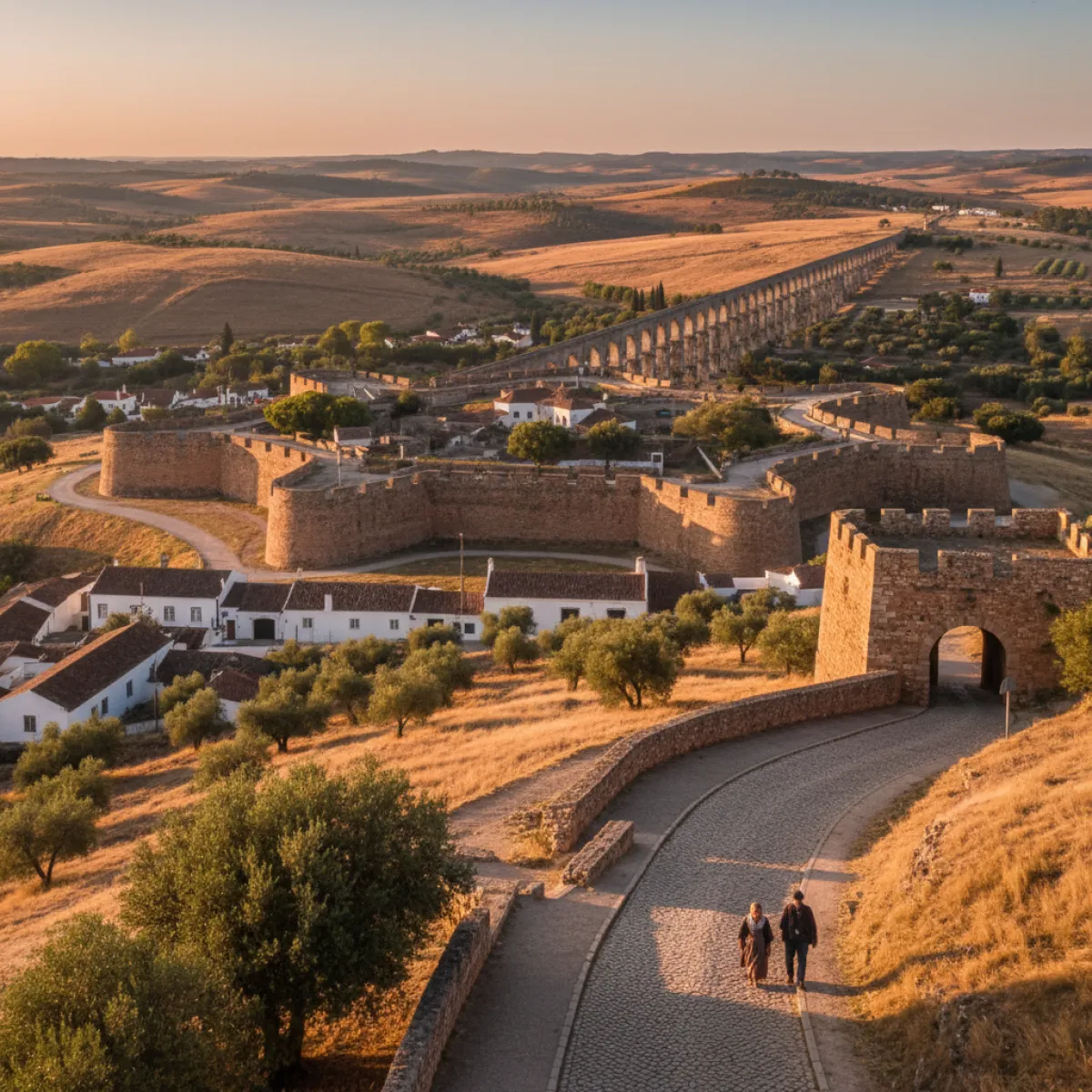
The Unyielding Sentinel of the Alentejo
Approaching Elvas is, first and foremost, an exercise in scale and perspective. Driving along the A6 toward Spain, the horizon is suddenly claimed by the Amoreira Aqueduct, a structure that doesn’t merely span the valley but seems to anchor the city to the earth. With over eight hundred arches surviving four centuries, this feat of hydraulic engineering serves as a visual preamble to the largest bulwarked fortification in the world. Elvas is not just a city; it is a stone-carved manifesto of Portuguese survival and sovereignty.
Unlike other destinations that have surrendered to a postcard-perfect aesthetic, Elvas maintains an authentic, almost stubborn austerity. Here, military architecture dictates the rhythm of the streets. The urban layout is dense, designed to baffle invaders and shelter inhabitants. It is a fascinating contrast to the open, introspective plains found elsewhere in the region, a feeling best captured in Évora: The Slow Pulse of the Alentejo. In Elvas, the pulse is one of readiness, even if the cannons are now silent and aimed at a peaceful horizon of olive groves.
Forte da Graça: A Star in the Landscape
If there is a single site that defines the mastery of 18th-century military engineering, it is the Forte de Nossa Senhora da Graça. Perched atop the Monte da Graça, its star-shaped floor plan is a marvel of geometric perfection that verges on the obsessive. Walking through its galleries and bastions, you realize that every angle was calculated to eliminate blind spots. This defensive structure was never taken by force, standing as a testament to Lusitanian resistance during the War of the Oranges and the Napoleonic Invasions.
A recent restoration allows visitors to explore the Governor’s House, a neoclassical building at the heart of the fort, offering some of the most unobstructed views of the Spanish borderlands. The city of Badajoz, just across the line, seems within arm's reach, a constant reminder of the historical tension that shaped this landscape. For those who appreciate the dialogue between stone and time, this fort is the perfect companion to the reflections in Stone and Silence: A Sentimental Guide to Évora, echoing that same melancholy but within a context of vigilance and defense.
The Table: Of Plums and Alentejo Salt
In Elvas, the dining table is a battlefield of flavors where the deep Alentejo manifests with rigor. One cannot discuss this city without mentioning the Ameixas de Elvas (PDO). The production process, involving successive boilings in sugar syrup, transforms the fruit into translucent jewels that were once staples at the tables of European royalty, including Queen Victoria. Visiting the local plum factories is like stepping into a living museum of conventual confectionery.
As for main courses, Bacalhau à Brás finds one of its most respected interpretations here, but the local pork dishes and cured meats (enchidos) are where the regional identity truly shines. The restaurant 'A Santa Luzia,' located near the fort of the same name, is a reliable harbor for those seeking authentic Alentejo Gazpacho or Migas with pork ribs. Expect to pay between €35 and €45 for a quality meal for two, including a local wine, look for the robust reds from Borba or Vidigueira that are served here with immense pride.
The Old Town and Jewish Heritage
Descending from the castle toward the Praça da República, the streets become narrow and whitewashed, punctuated by azulejo tilework that has weathered the centuries. The Church of Nossa Senhora da Assunção, the former cathedral of Elvas, dominates the central square with its Manueline façade, an essential stop to understand the city's ecclesiastical importance. However, it is in the less obvious corners that Elvas reveals its most complex soul.
The House of Jewish History, set in a former 16th-century synagogue, is a necessary space of memory. It recalls the significance of the Sephardic community in the border economy and culture, a story of coexistence followed by persecution that left indelible marks on the city's urban fabric. This deep dive into local history is an ideal extension for anyone following One Day in Évora: A Precision Itinerary for the Alentejo Capital, stretching the understanding of the Alentejo soul all the way to the frontier.
Practicalities and Logistics
Elvas is best visited in the spring or late autumn. Summer in the High Alentejo is unforgiving, with temperatures frequently soaring above 40°C (104°F), making the climb to the bastions a test of physical endurance. If you choose to visit in September, you might catch the Festas de São Mateus, one of the country's largest religious pilgrimages, where the city transforms into a hub of color and tradition.
For the contemporary traveler, I recommend staying within the city walls. 'Travassos 11' is a prime example of how the rehabilitation of historic houses can offer modern comfort without erasing the patina of time. Budgeting for a stay in Elvas is surprisingly accessible compared to the Portuguese coast: a high-end room rarely exceeds €120 per night, and entrance fees for municipal monuments are symbolic, usually around €5. It is a destination that rewards curiosity and a slow pace, far from the pressures of mass tourism and deeply rooted in national identity.
