Coimbra's Graffiti Trail: Beyond the University Walls
Bordalo II's owl is gone from the Colégio das Artes, but Coimbra's walls keep talking. From the Quebra Costas steps to the student república facades, this is the street art trail no conventional guide gives you.
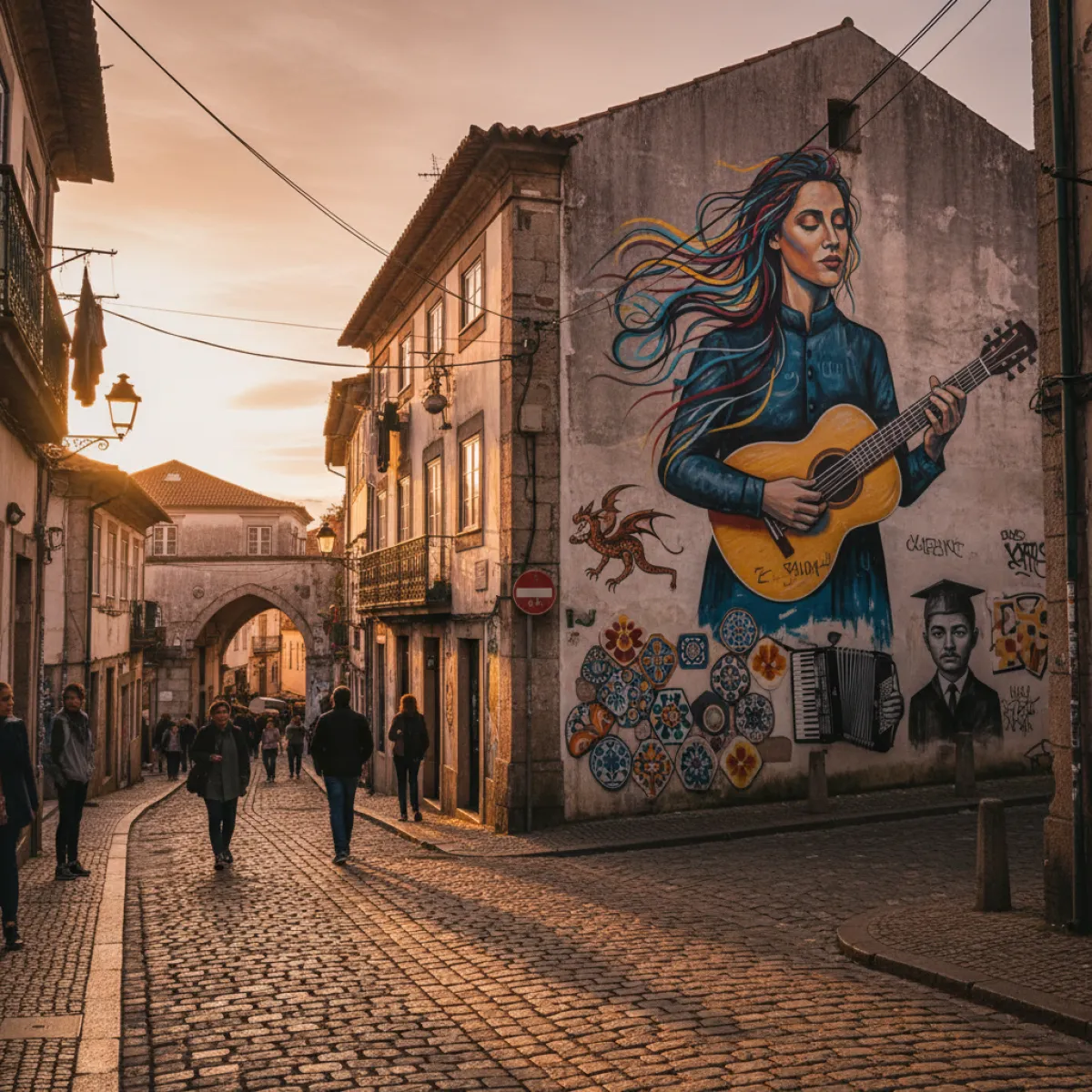
Coimbra has a complicated relationship with its walls. On one hand, it's home to Portugal's oldest university, with protected facades and limestone that nobody dares touch. On the other, it's a student city. And students, as a rule, don't ask permission.
The result is one of the country's most compelling street art scenes, almost entirely overlooked by guidebooks that prefer to talk about the Joanina Library for the thousandth time. This route is for the people who want to see the other Coimbra: the one that gets painted at night and discovered in the morning.
The Alta: where it starts (and where your legs give out)
Rua do Quebra Costas translates, roughly, as "Backbreak Street." The name is earned. The steep steps connecting the Baixa to the Alta are a cardiovascular test disguised as a road. But it's exactly in this corridor, between the Arco de Almedina and the Sé Velha, that you'll find a good chunk of Coimbra's most accessible street art. The walls of derelict buildings have become canvases in recent years, with interventions ranging from quick stencils to elaborate full-wall murals.
If you've already read our guide on the murals reshaping the Alta, you know this area has undergone a serious visual transformation. But the big murals are only half the story. What makes Quebra Costas special is what happens at the margins: student republic tags, political stencils, ephemeral paste-ups that last a week before being covered by something else.
The tip is simple: go up Quebra Costas slowly, look both ways, and don't limit yourself to the main street. The side alleys, particularly Beco da Carqueja, are where lesser-known artists leave their mark. Early morning, before ten, you'll have the street nearly to yourself, and the low-angle light makes colours pop in a way that's lost by midday.
Bordalo II and the owl that's no longer there
If you came to Coimbra specifically to see Bordalo II's famous owl on the north facade of the Colégio das Artes, I have bad news: the piece was removed in March 2026. Installed in January 2022, the sculpture made entirely from recycled materials depicted a long-legged owl, split between a classical side and a colourful one facing the future. The owl, of course, is the University of Coimbra's symbol, present in the institution's insignia alongside the goddess Minerva.
Its removal is, in some ways, the best lesson street art can teach: it's ephemeral by nature. What you see today might not be there tomorrow. That urgency is exactly why you should walk these circuits now, not "when you have time."
The Colégio das Artes building, next to the Science Museum, is still worth visiting for the architecture alone. And Praça da República, nearby, is the student heart of the city, full of cheap cafés where you can recharge between murals.
The Rua da Sofia circuit
Rua da Sofia is known for its Renaissance colleges, but the perpendicular streets tell a different story. Over the past few years, several artists have left interventions in this area, taking advantage of building facades undergoing renovation. Work by artists like Costah, known for colourful birds and expressive characters, appears at various points around the city.
Add Fuel, the artist who reinvented the Portuguese azulejo as a street art medium, also has a presence in Coimbra. His work plays with symmetrical patterns that recall traditional tiles but with a contemporary twist that works particularly well on Coimbra's facades. Keep an eye out for geometric panels in shades of blue: it could be an original Add Fuel, or it could be a tribute from a fine arts student with good taste.
From Largo da Portagem, follow the Sofia towards Jardim da Manga. This 500-metre stretch, doable in ten minutes on foot, has at least half a dozen interesting interventions on its side streets. Check locally which ones still exist, because the turnover is real.
The FIO project: industrial memory on walls
One of the most coherent urban art projects in Coimbra is FIO, by artist João Samina, curated by the Mistaker Maker platform. The concept uses memory as raw material, creating a series of murals scattered across the city and surroundings that pay homage to Coimbra's industrial past.
It's an interesting counterpoint to the spontaneous university graffiti. While the republic tags are immediate and irreverent, the FIO murals are researched, thought-through, with historical references that only make sense once you know the context. Two different languages coexisting on the same streets, and that tension is part of what makes Coimbra different from Lisbon or Porto when it comes to street art.
Vale do Inferno and the view that explains everything
At some point during the route, you need perspective. Literally. The Miradouro do Vale do Inferno gives you exactly that: a view over the Alta hillside where you can see how the city grew in centuries of construction, with university buildings at the top and older houses cascading down to the Mondego river.
From here, you can spot several of the larger murals you visited on foot. It's like looking at the map after walking the territory. In the late afternoon, golden light over the rooftops makes this one of the city's best photography spots, with or without street art in the frame.
Republic graffiti: the layer that doesn't get curated
You can't talk about graffiti in Coimbra without talking about the repúblicas. These student communes, some with over a hundred years of history, have a tradition of marking territory that predates the modern concept of street art. The emblems painted on facades, the slogans on walls, the caricatures of freshers: all of it is urban art, even if no gallery would recognise it as such.
The best-known repúblicas are in the Alta, between the Sé Velha and the Pátio das Escolas. Each one has its own visual identity, and many maintain graphic traditions that pass from generation to generation. The Real República Conimbricense dos Galifões, the Ksjardas, the Psjinhos: each name is a story, each facade a living archive of Portuguese student culture.
If you want to actually understand Coimbra, don't just look at the pretty, Instagrammable murals. Stop in front of a república and read what's on the walls. It's rude, it's political, it's funny, and it's absolutely genuine.
When to go and how to organise the route
The best time for this trail is morning, between 8am and 11am, when the light is good and the Alta streets are empty. Weekends work particularly well because the university area empties out and you can photograph freely without cars in the way.
The full loop, from the Baixa to the Alta and back, takes two to three hours on foot. Comfortable shoes are non-negotiable: it's all uphill, stairs, and uneven cobblestones. Bring water.
The Street Art Cities platform has a collaborative map of Coimbra with updated mural locations. It's worth checking before you head out, especially if you're looking for specific pieces.
- Start at Largo da Portagem and walk up Rua Ferreira Borges to the Arco de Almedina
- Climb Quebra Costas with detours down the side alleys
- Continue to Largo da Sé Velha and up towards the Pátio das Escolas
- Head down past the Colégio das Artes area to Praça da República
- Return via Rua da Sofia, exploring the perpendicular streets
What to do after the walls
A street art trail works best when you mix it with other things. If you're in Coimbra in the evening, a night of fado at À Capella is the perfect contrast: from the irreverence of the walls to the tradition of Coimbra fado, which is different from Lisbon's and proud of it.
If you have time to leave the city, the olive oil experience at Passeite in Condeixa is a good way to decompress after a day on your feet. Condeixa is fifteen minutes by car from Coimbra, and the region's olive oil is among Portugal's best.
And if Coimbra is just one stop on a longer trip through Central Portugal, our week-long itinerary through the heart of the country gives you the full context to fit the city into a route that makes sense.
Coimbra's street art isn't the most famous in Portugal. It doesn't have Lisbon's scale or Porto's concentration. But it has something those cities can't replicate: eight centuries of university tradition as a backdrop. When you see a political stencil next to a seventeenth-century inscription, you realise that this city's walls have always been the newspaper for people who had nowhere else to speak. That hasn't changed. Only the ink is different.