Car-Free Monção: Thermal Baths, Walls and Alvarinho on Foot
The train to Monção stopped in 1990 and the town came out ahead: the rails became a riverside path along the Minho. Thermal baths in the centre, walls facing Galicia, lamprey in season and Alvarinho always. All on foot, no parking required.
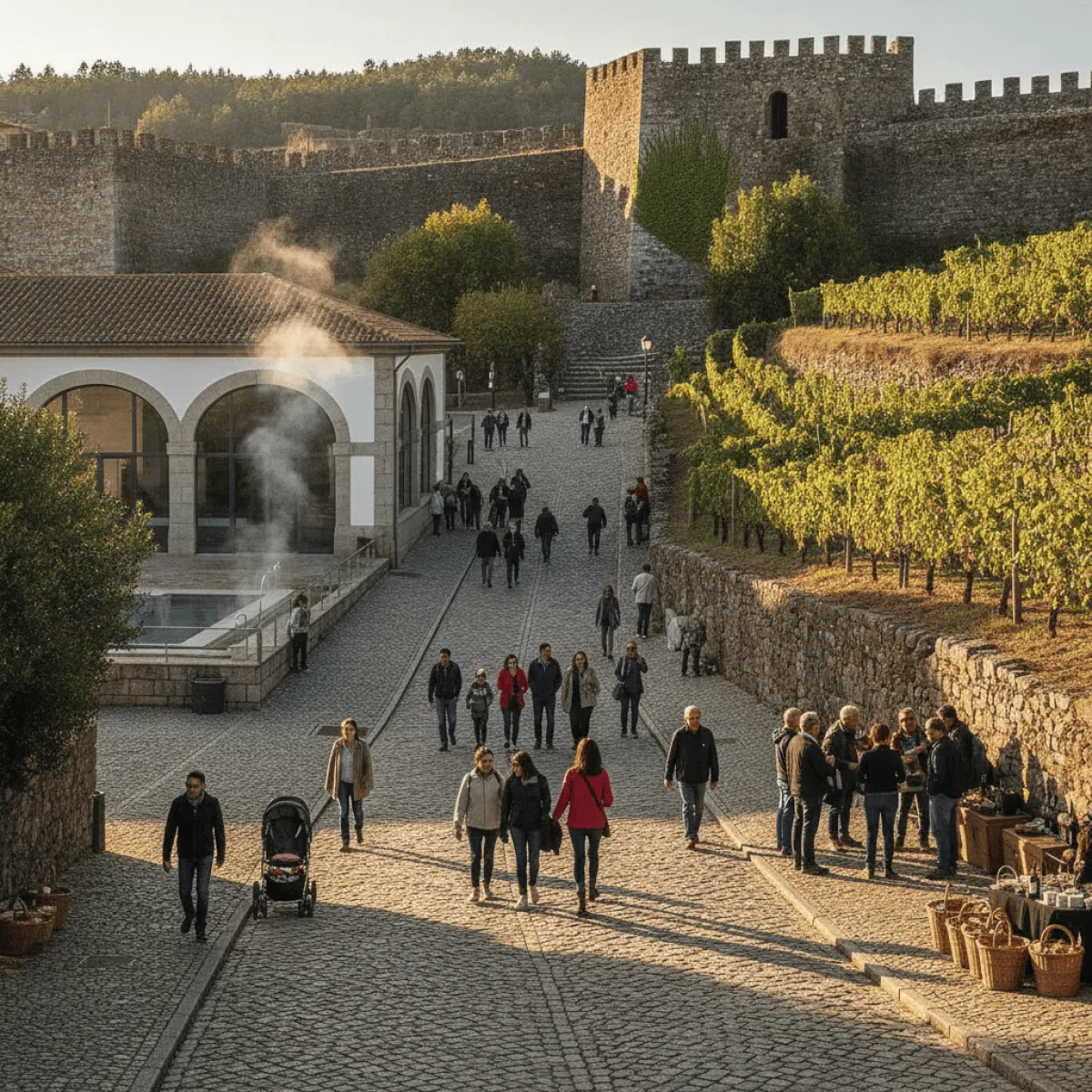
Let's start with the supposed bad news: the train to Monção stopped running in 1990. The branch line from Valença was closed, and for years that meant a simple equation: no car, no Monção. The good news is that the town did the smartest possible thing with the abandoned rails and turned them into a flat riverside path along the Rio Minho. The second piece of good news is that Monção, inside its old walled perimeter, takes about ten minutes to cross on foot. Thermal baths, the main square, restaurants, viewpoints over the river and over Galicia on the far bank: all of it fits into one slow morning's walk. This guide is for people who arrive by bus, drop the bag, and never think about parking again.
Getting there without a car (and why you won't miss it)
You come by bus, with services from Porto, Braga and Viana do Castelo. Timetables and operators change with the seasons, so check before you travel, especially on Sundays, when the whole Alto Minho slows down. From Porto, count on roughly two hours depending on stops. Once you arrive, forget about transport entirely: the historic centre is small, mostly flat, and built at walking scale. The one exception is the Palácio da Brejoeira, about five kilometres out, and for that there are taxis in town. Everything else, your feet will handle with room to spare. If you're coming from Spain, Salvaterra de Miño sits directly across the river, connected by the international bridge.
Praça Deu-la-Deu: the woman who broke a siege with bread
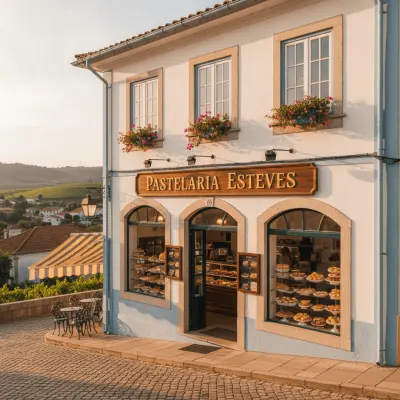
The whole town orbits Praça Deu-la-Deu, and the name earns its story. In the 14th century, during the Fernandine wars, Monção was under Castilian siege and starving behind its walls. Deu-la-Deu Martins, the governor's wife, ordered the last of the town's flour baked into loaves and threw them over the wall to the besiegers, with the message that if they needed more, they only had to ask. The bluff worked: convinced the town had supplies for months, the Castilians packed up and left. She's on the town's coat of arms, loaves in hand, and her statue presides over the square. Take a table at a terrace, order a coffee and look up at her: few Portuguese squares have a better secular patron. Before or after, stop at Pastelaria Esteves for morning coffee and a pastry; it's the kind of place where the town crosses paths mid-morning, and it's where you'll calibrate to the local pace. Then climb to the stretch of wall facing the river: from the viewpoint you see the Minho, wide and green, and Galicia on the other side. It is the calmest border you will ever look at.
Thermal baths in the middle of town, not in a remote valley
Here is Monção's oddity: the thermal baths are inside the town. In most Portuguese spa towns, the bathhouse sits isolated in a valley, surrounded by period hotels and boredom. Not here. You walk out of a treatment and within minutes you're on a terrace in the square with a glass of Alvarinho, which strikes us as the correct order of things. The water comes out of the spring hot, which is rare this close to a historic centre, and the bathhouse focuses on rheumatic and respiratory treatments, plus wellness programmes for anyone who just wants half an hour of hot water after a day of walking. Note that the thermal season doesn't run all year and prices vary by programme, so check locally before booking. Our suggested usage: river path in the morning, baths in the late afternoon, dinner straight after. It is hard to design a better day.
Eating: lamprey, foda à moda de Monção, and the rest of the year
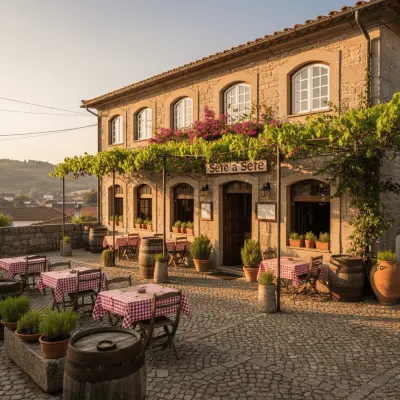
Monção eats seriously, from the river and from the hills. Between January and April, lamprey rules: a prehistoric-looking creature that divides opinion at the first forkful and creates converts by the second. Arroz de lampreia is the classic, dark and intense, and in season people cross the country for it. Outside lamprey season, the dish that defines the town has a name that makes every Portuguese speaker smile: foda à moda de Monção, wood-oven roasted lamb served with rice cooked in the roasting juices. It's a festive Sunday dish, historically tied to the local pilgrimages and feast days, and one taste of that rice, soaked in the drippings, explains its reputation. To put all of this to the test, book a table at Restaurante Sete a Sete and ask what's good that day; in lamprey season, ask for the lamprey, and in any season order Alvarinho from the local subregion, because ordering anything else in Monção borders on rudeness. Book ahead at weekends: the Alto Minho takes Sunday lunch very seriously.
Alvarinho: walk to the glass, taxi to the quinta
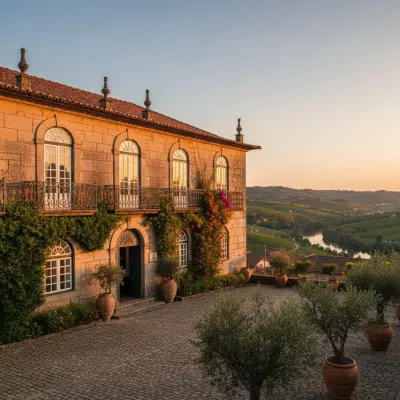
Monção and Melgaço form the Vinho Verde subregion where Alvarinho performs at its best: granite soils, a microclimate drier and warmer than the rest of the region, and generations of producers who treated the grape as serious business long before it became fashionable. Inside the town, you can taste Alvarinho at any decent restaurant or terrace. To go to the source, Monção's Alvarinho wine route takes you to the quintas for tastings with the people who actually make the wine, which beats reading back labels every time. And then there's the Palácio da Brejoeira, the neoclassical palace at Pias that is probably the grape's most famous label: about five kilometres from town, ten minutes by taxi, with visits best confirmed in advance. If you're around in spring, check the dates of the town's annual festival dedicated to Alvarinho and smoked meats: it is the best possible excuse to taste a great deal within a two-hundred-metre radius.
The old railway path and the river
The former railway line to Valença is now a riverside path along the Minho: flat, shaded in stretches, with the river almost always in view and Galicia on the opposite bank. It's the obvious morning outing, on foot or by bike, and railway gradients mean nobody arrives out of breath. Bring water and start early in summer, because the Minho valley heats up too. If you'd rather be on the river than beside it, there's kayaking on the Rio Minho between Monção and Melgaço, which swaps the tarmac for the water's-eye view, with the border running literally alongside your paddle. Between the path and the kayak, choose according to the day's energy; between either of them and an afternoon on the sofa, choose the river.
If you can time it for June: the Coca
Monção hosts one of the strangest and best festivals on the Portuguese calendar: on Corpus Christi, Saint George, on horseback, fights the Coca, a dragon, in the middle of the street, with the whole town cheering. Tradition says that if Saint George strikes the beast's head, the year will go well. It's popular theatre with centuries behind it, no irony, no staging for tourists, and if your visit can coincide with the date, rearrange your plans without hesitation. Confirm the programme locally, because the festival fills the town and beds vanish fast.
Sleeping inside the map
The logic of a car-free visit demands sleeping where everything happens, and that's exactly what Paço Alojamento Local is for: it's within walking distance of everything in this guide, which in Monção means minutes. Waking up and being in the square before your coffee cools, walking home from dinner without thinking about driving after the second glass of Alvarinho: that is the real luxury of a small town, and you should use it.
And after Monção?
If the trip continues south, the Minho still has plenty to give. Barcelos sits on the way to almost everything, and if you're travelling in May, our honest guide to the Festa das Cruzes tells you what's worth your time and what you can skip. But that's another trip. This one ends here: on the wall in the late afternoon, the river running towards the Atlantic, a cold glass in hand, and the comfortable certainty that you never needed the car at all.