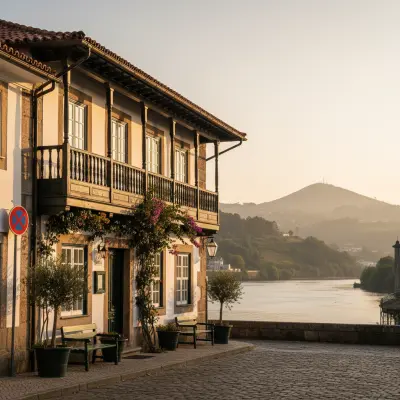
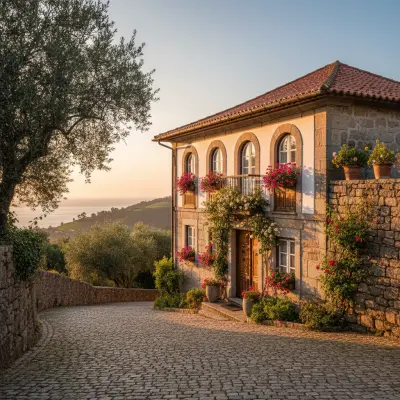
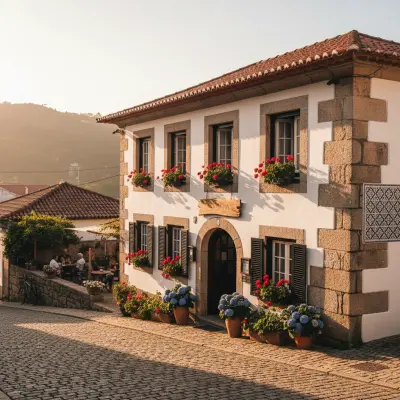
Caminha by the Cup: The Right Cafés and What to Order
Caminha has no specialty coffee scene and no latte art to photograph. What it has is dark wooden counters, proper jesuítas, and baristas who know your name by day three. An honest guide to where to drink and what to order at each spot.
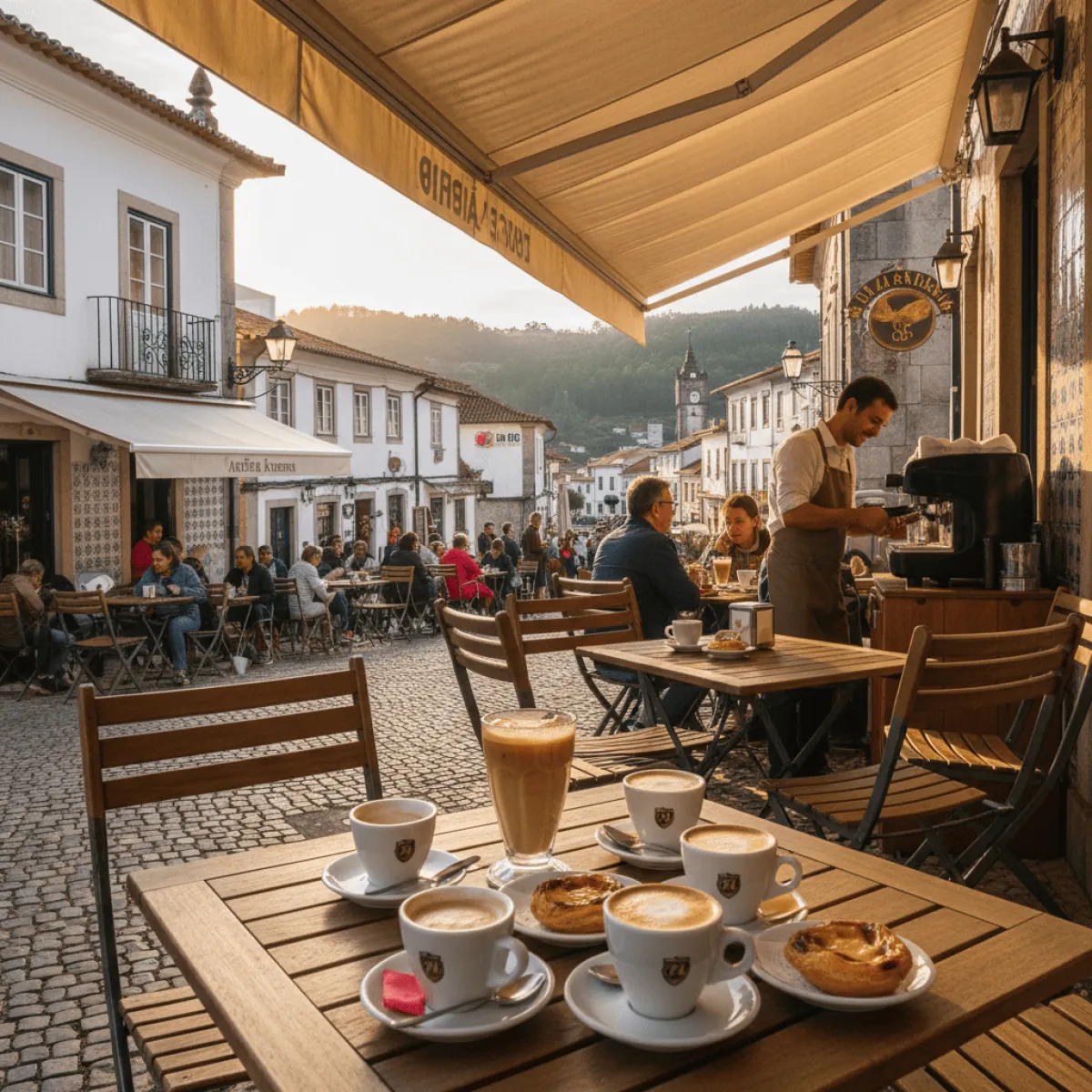
At seven in the morning on Praça Conselheiro Silva Torres, Caminha is so quiet you can hear the awning of a café being unrolled and the milk being steamed inside. This is the right hour to understand why this small town in the far north of the Minho, pressed against the Spanish border, takes coffee so seriously. There are no international chains here. No lattes with dubious Italian names. Nobody is going to ask you whether you want it to go in a paper cup. You order at the counter, you drink it standing up or sitting down, and you carry on with your life.
Caminha is exactly the right size for a decent coffee routine: small enough that the barista will know your name by day three, big enough that there are real options. The town sits between the Minho and the Coura rivers, with the Serra de Arga in the background, and that geography explains a lot, including the pace at which people drink their espresso. Some travellers come here to do the kayak trip on the Minho estuary between Portugal and Spain and discover, early in the morning, that the best breakfast of the day was a simple coffee and a slice of homemade toast at a counter on Rua Direita.
This is an honest, unfussy guide to where to drink coffee properly in Caminha and, more importantly, what to order at each place. Because the truth is this: not all coffee here is equal, even when the espresso costs between 0.70 and 0.90 euros and seems to come from the same machine. The bean is different. The grind is different. And the person behind the counter at eight in the morning makes all the difference.
First, a note on coffee in the Minho
If you come from southern Portugal, forget the word "bica". In the Minho, it is "café" and that is the end of the discussion. You will hear "cimbalino" sometimes, but that is more of a Porto thing. If you want a fuller espresso, ask for a "café cheio". If you want it shorter, "café curto". A "pingo" is the same as a "garoto": espresso with a dash of milk, served in a small glass. A "galão" is coffee with milk in a tall glass. A "meia de leite" is the same thing, but in a cup. And if you ask for an "americano" without explaining, you will get that patient Minho look that is friendly but unmistakable.
The dominant bean around here is Delta, with strong showings from Sical and Nicola in some places. Do not expect light roasts or Ethiopian single origins. This is traditional Portuguese coffee, with a robusta blend, full-bodied, slightly bitter, designed to be drunk with sugar (or without) in a gulp and a half. When it works, it works very well.
The cafés that matter in Caminha
The classics on the square
Praça Conselheiro Silva Torres, with its Clock Tower and Renaissance fountain in the middle, is the social heart of the town and has two or three cafés with terraces that fill up in the late afternoon. This is where you see half of Caminha walking past between five and seven, and where you learn more about the town in half an hour than from any tourist brochure.
What to order: in the morning, coffee and toast with butter. Minho toast comes with proper butter and there is no debate about it. In the late afternoon, slow down with a light galão and a pastel de nata, or, if it is on offer, a slice of homemade bolo de bolacha (a no-bake biscuit cake). Avoid the industrial cakes wrapped in plastic. There is always a glass case with cakes of the day, usually made by a lady from the town, and those are the ones worth your money.
The café on Rua Direita
Rua Direita is the pedestrian artery that climbs from the square towards the Mother Church. Along the way you will find at least one old-school café with a dark wooden counter and glass jars of biscuits behind glass, which serves as the headquarters of the town's retired men. This is the place to stop mid-morning, order a coffee and a pastel de feijão or a queijada, and listen to the conversation without joining in. The arguments about football, local politics and the weather are as predictable as they are comforting.
What to order: a café cheio and a local pastry. If they have tigeladas (a Minho speciality of beaten eggs with cinnamon baked in the oven), order two. If you see bolo rei in December or pão de ló at any time of the year, do not hesitate. You are not here for the design, you are here for the bean and the tradition.
The café by the river
Caminha has a modest but pretty waterfront, looking across the estuary to Spain on the other side. There are cafés with terraces facing the water, especially near the ferry pier that connects Caminha to A Pasaxe (yes, with an X, it is Galician). These cafés get more touristy in summer, quieter the rest of the year, and offer the best spot in town to spend a lazy Sunday morning.
What to order: for breakfast, a galão and a torrada mista (toast with cheese and ham). In the afternoon, a coffee and a sparkling water. Do not order hot meals here, they are usually weak. Order coffee, order patience, and watch the boats crossing to Spain.
The serious bakery
In any self-respecting Portuguese town, there is a bakery that is more than just a bakery: it is an institution. In Caminha, the best one is not necessarily the largest or the most visible. Look for the one with a queue of locals on Saturday mornings, a glass case full of meios-amargos, jesuítas and cavacas, and a coffee machine that never stops working. Ask the man on the street "where do you get the cakes for Sunday?" and follow his answer.
What to order: a jesuíta with café cheio. The jesuíta is a triangular puff pastry filled with cream and topped with caramelised sugar, originally from this part of the north, and when it is well made it is one of the best pastries in Portugal. If you prefer something more traditional, ask for a cavaca de Resende (yes, originally from Resende, but they make it here too) or a sonho. To take home: a box of meios-amargos, round biscuits with chocolate icing, perfect with afternoon coffee.
How to build a decent coffee day in Caminha
Here is the routine I recommend for a weekend, based on two and a half days in town with decent late-spring or early-autumn weather.
Saturday, 8.30am: Coffee and toast with butter at one of the square cafés. Cost: about 2 euros. Do not sit down, stand at the counter, read the local paper. You will hear more authentic Portuguese in fifteen minutes than in a week in Lisbon.
Saturday, 11am: Coffee break with a pastel de feijão on Rua Direita. Cost: 2.50 euros. Walk up to the Mother Church afterwards, the view and the silence are worth it.
Saturday, 4pm: Galão with a view of the river. Cost: about 1.80 euros. Bring a book or bring nothing. Nothing is often the best company.
Sunday, 9am: Visit to the serious bakery. Buy a box of cakes to take home and have a café cheio with a jesuíta. Cost: 12 to 15 euros for the box, 2 euros for the coffee and the pastry. This is the meal you will still remember in six months.
Sunday, 6pm: Back to the square, terrace, coffee and water. Cost: 2 euros. Watch the town wind down, in the good sense of that expression. Kids playing football, ladies talking, men with their hands behind their backs.
Where to stay for an efficient coffee routine
The location of your accommodation makes a difference to the quality of your morning. Wanting to go to the café should ideally mean leaving the front door and being at the counter in less than five minutes.
The Litos AL Alojamento Local is a solid choice for proximity to the historic centre, with the advantage of being a short walk from the main streets where the cafés are. For something with more character, Donna Nega Alojamento Local offers a more intimate stay, ideal for couples who want to make their coffee routine and short walks part of a slower way of travelling. If you are after something more social, with a shared kitchen and people from various places, Arca Nova Guest House & Hostel is the right call, and it has space to store a bike if you want to cycle to Vila Nova de Cerveira.
Coffee seasonality in Caminha
The coffee itself is a constant, but what you eat with it changes a lot with the seasons. In January and February, you will find bolo rei and rabanadas left over from Christmas, and in some bakeries, malasadas (a Carnival speciality). In March and April, the folares de Páscoa appear, with or without a boiled egg on top, depending on the house. In May and June, it is the season for strawberries, cherries, and fresh cakes with regional fruit.
If your trip to the Minho falls in this period, it is worth planning an extension to Barcelos for the Festa das Cruzes in May, one of the best religious festivals in the north, with carpets of flowers, fireworks, and stalls of sweets that justify the one-hour drive from Caminha on their own. In summer, July and August, expect a lot of Spanish tourists, queues at the riverside cafés, and lighter versions of pastries (mousses, artisanal ice cream, cakes with fruit). From September to November, autumn pastries return: chestnut cake, walnut treats, and warm tigeladas. In December, it is bolo rei, broas, and anything with honey.
Coffee with kids, without stress
Portuguese cafés have always welcomed children, especially the older ones where the staff are middle-aged men who seem to have always been middle-aged men. In Caminha, any of the square cafés works with kids: they have fresh juices, hot chocolate, croissants and cakes. The trick is to ask for a table on the terrace and let the children run around the fountain.
If you are planning a longer family trip through the Minho, take a look at our Barcelos with kids guide, with tested suggestions for families who want more than theme parks. And if your obsession is specifically with coffee, the guide Barcelos by the Cup, a café-by-café order guide is also worth a read, because it applies the same philosophy to the city of the rooster.
How to get there and how much it costs
Caminha is about an hour by car from Porto along the A28 motorway, with an exit for Vila Praia de Âncora or directly for Caminha. Without traffic, it is a fast and stress-free drive. By train, there is a connection on the Linha do Minho, with a stop at Caminha station, and the journey from Porto takes about two hours. The train is slower but it has the advantage of running alongside the river for the last stretch, which is always a pleasure.
In terms of coffee budget for a weekend: count on about 15 to 25 euros per person on coffee, pastries and breakfasts over two days. If you include a box of cakes to take home (and you should), add another 12 to 18 euros. We are talking about less than 50 euros for a genuine Minho coffee experience, and that is money well spent.
Final rules for drinking coffee like someone from Caminha
- Order at the counter whenever you can. It is cheaper and that is where the conversations that matter happen.
- Do not order coffee to go in a paper cup unless you really are in a rush. Drink it there, give yourself the time.
- Trust the barista. If they recommend the pastry of the day, it is genuinely the pastry of the day.
- Do not ask for plant-based milk without checking first. In some traditional cafés, the answer is "we have milk". And that is that.
- Pay in cash when you can, at least for small amounts. The card machine in some older cafés is still a negotiation.
- If you sit on the terrace, wait for the waiter to come to you. Do not click your fingers or wave your arms.
- Always say "bom dia", "boa tarde" and "obrigado". In Caminha, this is not optional, it is culture.
Caminha is not a spectacular coffee town, in the sense that there is no specialty coffee movement here, no latte art to photograph. What there is, is a solid culture of traditional, well-made coffee, in real places, with real people. And that, in a country where everything is becoming more uniform, is increasingly rare and increasingly valuable. Drink slowly, stay at the counter, and let the town tell you its story at its own pace. You will leave here with more peace of mind than you arrived with.