Caldas da Rainha: Best Viewpoints and the Right Light
Three viewpoints around Caldas da Rainha, three exact hours when each one works best. Foz do Arelho at sunset, Santa Catarina at dawn, Salir do Porto at blue hour. An honest guide for anyone arriving with a camera.
Here's something nobody tells you about photographing Caldas da Rainha: the light here isn't Alentejo light, or Algarve light, or even Lisbon light. It's coastal light filtered by the proximity of Óbidos Lagoon and the Atlantic, and it changes character every thirty minutes. Learn to read it and you go home with photographs worth keeping. Ignore it and you go home with another SD card full of bleached skies and washed-out horizons.
This isn't an exhaustive list. It's a route through the three viewpoints that actually matter around Caldas, with the hour each one works best. If you have one day, follow the order. If you have two, sleep here and do the same route at sunrise and sunset, in opposite directions.
The basic rule of light in this area
Forget the generic "golden hour" theory. Here, in the strip between Caldas and the coast, there are three real windows:
- 06:30 to 08:00 (May to September): clean frontal light from the east, with the lagoon still in shadow. Good for silhouettes and still reflections.
- 17:30 to 19:30 (autumn and winter) / 19:00 to 21:00 (summer): ocean light. Warm, low, with that golden tone that makes the dune pines glow.
- Right after rain, any time of year: the air clears of dust, the sky fills with cinematic clouds, and colours saturate. It's the best light in Caldas, and it's free.
Memorise this. The rest is just knowing where to be at each of these hours.
Miradouro da Foz do Arelho: for sunset, no argument
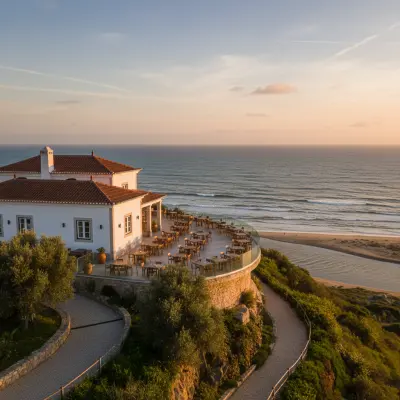
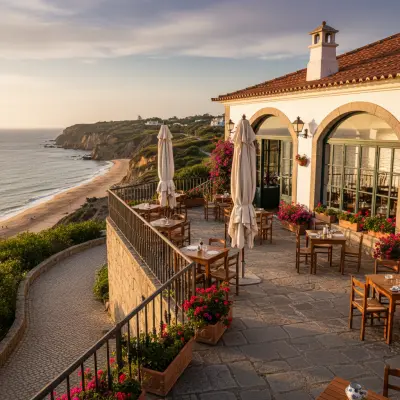
Let's start with the obvious, which in this case also happens to be the best. The Foz do Arelho Viewpoint sits where Óbidos Lagoon meets the Atlantic, and it's literally impossible to take a bad photograph here between 18:00 and sunset, on any day without thick fog.
The question isn't whether you'll get a beautiful photograph. It's how you'll get one that isn't identical to the other ten thousand that already exist of this view. A few pointers:
- Don't stay at the main parapet. Walk fifty metres to the southern side of the viewpoint, where there's a half-hidden stone bench. The composition opens up, you get the curve of Foz beach in the frame, and you disappear from other tourists' photos.
- Bring a 35 to 50mm lens. Wide angle here is a trap, it distorts the lagoon's curve and makes everything look smaller than it is.
- If you want the water as a mirror, go at the end of low tide. Check the Portuguese Hydrographic Institute's tide tables before heading up. It's not harder than that.
Practical bits: parking at the village entrance, free, usually space available except in August between 19:00 and 20:30. Five-minute walk up. There's no café at the viewpoint itself, but Foz beach has three or four terraces below where a beer costs what it costs at any Portuguese beach in 2026. Do what the locals do: photo first, beer after.
Miradouro de Santa Catarina: the secret of morning light
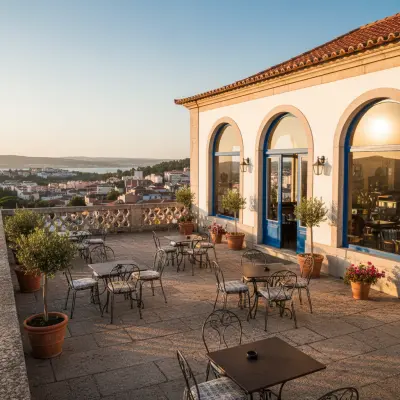
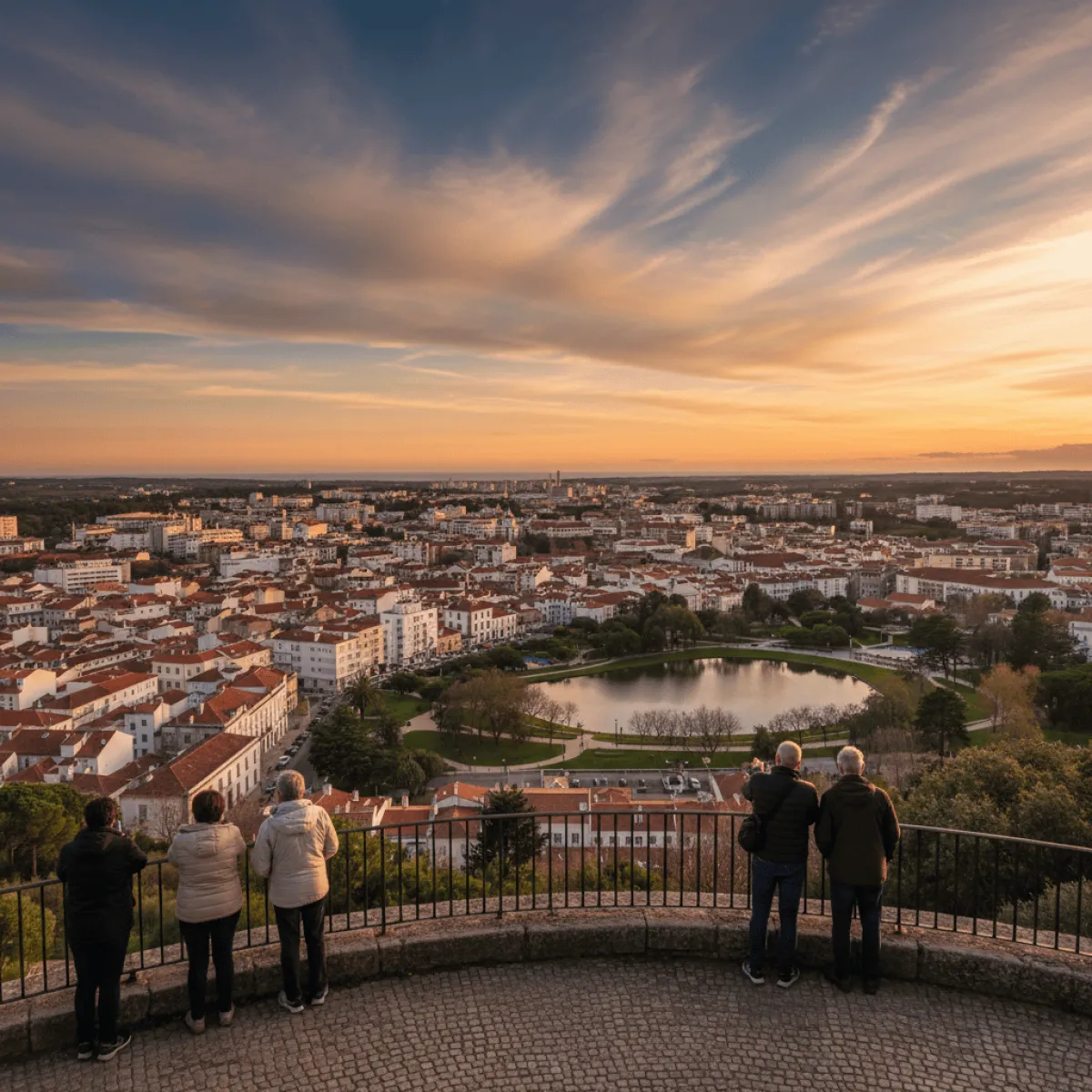
This is the viewpoint almost nobody uses for photography, and that's precisely why you should. The Santa Catarina Viewpoint gives you a framed view over Caldas da Rainha and the valley, with the Candeeiros mountain range in the distance, and it works best at an hour when practically nobody thinks about viewpoints: between 07:00 and 09:00.
Why? Because the sun rises in the east, behind you, and lights the town frontally. Portuguese tile roofs take on that particular orange, the steam from the thermal baths (on cold mornings) rises like stage smoke, and if you're lucky there's low fog in the valley that dissipates as you shoot. It's a forty-five-minute show, and then it's over.
Honest warnings: there's no real infrastructure. You'll need your own coffee before heading up, because central cafés don't fully open until around 08:00. The nearest bakery that opens early, depending on the day, is one near the fruit market square. It opens at 06:30 on weekdays, check locally before going. Grab a takeaway galão and be at the viewpoint by 07:15.
Technically: tripod is optional, but if you have one, bring it. For the soft morning light, a half-second exposure gives you the sense of steam moving without blur. Standard lens is enough, this isn't a wide-angle view.
Miradouro de Salir do Porto: what nobody tells you
The Salir do Porto Viewpoint is the most underused of the three, and the one with the best surprise. It faces the giant Salir dune, one of the largest on the Iberian Peninsula, and the mouth of Óbidos Lagoon from the opposite side to Foz do Arelho.
There are two completely different strategies here:
Strategy 1: noon, with the sun high
Everyone tells you to avoid shooting at midday. At Salir, do the opposite. The white dune reflects light with an intensity that, at noon, produces tropical-beach contrasts: incandescent sand, saturated blue water, short hard shadows. It's the opposite of usual Portuguese landscape photography, and it works.
Strategy 2: blue hour, after sunset
Twenty minutes after the sun has set, the sky takes on that cobalt blue that lasts exactly eight minutes. From up here, with Salir do Porto's lights coming on below and the dune still holding the last of the light, you get a photograph that can't be made anywhere else. Bring a jacket, even in July. The wind off the inlet is treacherous.
How to get there: 15 minutes by car from Caldas, via the Foz do Arelho road and cutting across to Salir. Limited parking, on top of the cliff. There's no decent signposting for the viewpoint itself, follow the signs to Salir beach and, before going down, there's a left turn.
Where photography crosses into the rest
If you're here to photograph, you're here to photograph. But you don't have to only do that. Caldas has a town centre worth a morning with the camera in hand. The museum marathon through the city gives you interiors, Caldas ceramics (the real ones, Bordallo Pinheiro and that crowd) and good material for portraits in soft skylight. It's the perfect rainy-day activity, which is also the worst kind of day for the viewpoints.
For anyone wanting to combine landscape with wildlife, there's bird watching at Óbidos Lagoon, done from the northern shore on the Caldas side. Herons, flamingos at certain times of year, spoonbills. For this you really do need a telephoto, 300mm or longer, and patience. Check the migration windows in advance, because outside those you see much less.
And then there are the walking trails around the area, which cross some of these viewpoints if you want to do everything on foot instead of by car. It's slower, but that's how you really discover the light: by walking inside it for several hours.
Gear worth bringing, and what's just dead weight
I won't pretend I'm indifferent to gear. But for this region, and given what it now costs to fly anywhere with excess baggage, simplify:
- One camera, one standard 24-70 zoom or equivalent. Covers 90% of useful photographs here.
- A polariser. The one indispensable filter. Coastal light reflects a lot, and cutting glare off the lagoon completely changes the photograph.
- Light tripod, only if you're doing blue hour at Salir. Otherwise, leave it at home.
- Extra battery. Coastal wind drains batteries faster than you'd expect.
- Microfibre cloth. The salt mist that settles on your lens over half an hour of shooting is real and it ruins photos.
What you DON'T need: a drone (without permits it's not worth it, and the Lagoon area has restrictions), graduated ND filters (the landscape here doesn't have dramatic enough horizons to justify them), three different lenses.
A 24-hour itinerary, if you only have one day
For anyone arriving in Caldas with a camera and wanting to make the most of it:
- 07:00: takeaway coffee, head up to Santa Catarina Viewpoint, photograph the town at sunrise.
- 09:00: a proper breakfast in the centre. Pastéis das Caldas (typical fried pastries filled with egg sweet), at any bakery in the historic centre.
- 10:00 to 12:30: town centre on foot, the fruit market (still operating, still worth a visit), passing through the museums if it's a good day for interiors.
- 13:00: lunch. Caldas has good tascas. Order fish if you're near the coast, meat if you stay in town.
- 14:30: drive to Salir do Porto. Noon has passed, but in May or September the 15:00 light still gives you those dune contrasts.
- 17:00: Foz do Arelho, with time to spare. Walk around, pick your angle, wait for the light.
- 19:30 (or the equivalent for the season): sunset at the viewpoint.
- 21:00: dinner at Bom Sucesso or back in central Caldas, depending on energy levels.
If you're staying longer in the region, consider extending the trip. Coimbra in the right week (Queima das Fitas) gives you completely different photography, urban and nocturnal. And if your visit coincides with May 13th or October 13th, Fátima on the pilgrimage days is a photographic exercise of another order, portrait and faith, which has nothing to do with landscape but everything to do with what this part of the country also is.
One last note: the light you'll miss
You will miss light. It's inevitable. The day you finally make it up to Santa Catarina at dawn will be the day it's solidly overcast. The time you decide to risk blue hour at Salir will start raining at 19:45. It's part of the deal. Landscape photography in Portugal isn't like in places where sun is guaranteed, it's a constant negotiation with the weather.
What I've learned from these three viewpoints, across several stays in Caldas, is that it's worth more to return a second time to the same spot in different light than to rush through six viewpoints in a day. Pick one, stay an hour, watch it change. That's where you find the photograph nobody else has.