Sines at Sunset: An Industrial Port Walking Route
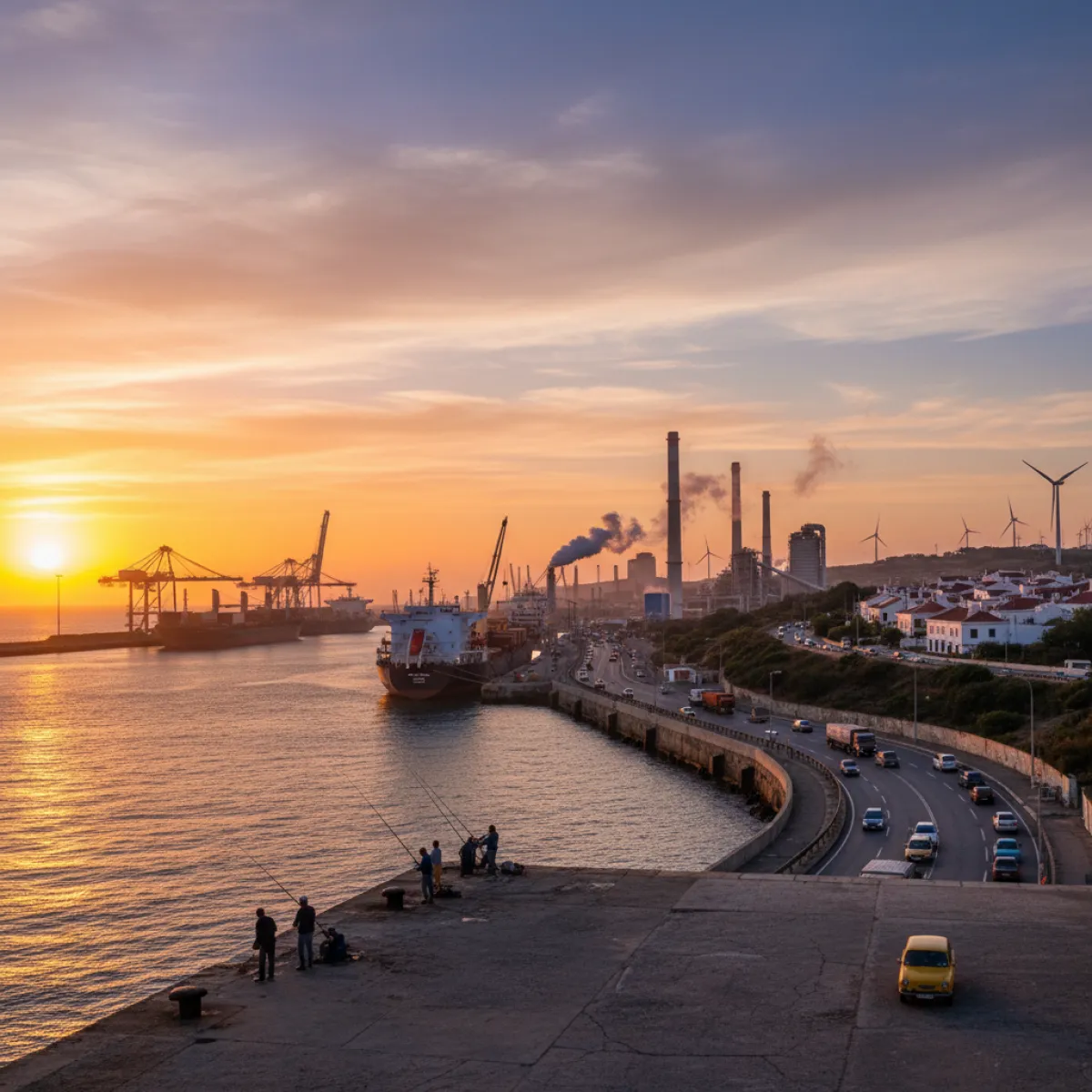
Sines isn't just beaches and a castle. The walk from the historic center to the industrial port zone at sunset is one of the most striking visual experiences on the Alentejo coast, cranes against an orange sky, container ships in the bay, and the refinery lit up at dusk.
Most people come to Sines for the castle, the Vasco da Gama beach, or the FMM world music festival in July. Fair enough. But there's a route through this city that almost nobody walks, and that, in the late afternoon, becomes one of the most visually striking experiences on the Alentejo coast. I'm talking about walking from the historic center to the industrial port zone, with shipping containers and cranes silhouetted against the Atlantic's orange sky. It's not conventionally pretty. It's better than that.
Why the Industrial Zone
Sines is, first and foremost, a port. Portugal's largest cargo port, responsible for a huge share of the country's energy supply, oil, natural gas, containers. This isn't quaint fishing village folklore. This is heavy infrastructure, 60-meter cranes, oil tankers that make the medieval castle look like a scale model. And it's precisely this contrast that makes Sines different from every other destination on the Costa Vicentina.
Some people think the industrial zone ruins the landscape. I think the opposite. The coexistence of a 15th-century castle, an urban beach, and a petrochemical complex is what defines Sines. Ignore any of these elements and you're not really seeing the city.
The Route: From the Castle to the Port
Start at Sines Castle in the late afternoon, say, two hours before sunset. Built in the first half of the 15th century to defend the coast from corsairs, the castle is now the best viewpoint over the bay. Inside, a small museum collection pays tribute to Vasco da Gama, who tradition holds was born here. Entry is free (check locally for current hours, as it tends to close in the late afternoon during winter months).
From the castle, walk downhill toward Praia Vasco da Gama. This is an urban beach tucked against the fishing port, don't expect wild dunes. What you'll find is clean sand, fishermen mending nets, and the silhouette of port facilities as a backdrop. Late in the day, with the tide out, the golden light hits the water and the fishing boat hulls in a way that justifies the walk.
If you want to explore the coastline in more depth, the Vasco da Gama trail from the castle to the coves is one of the best ways to see the rocky coast south of town. But for this route, the goal is the opposite direction, north, toward the industrial port.
From the Beach to the Marina
Follow the waterfront toward the Sines Recreational Port. This is a mandatory stopping point for vessels sailing the Portuguese coast, and in summer months there's some life to it. But what matters here is the perspective: you're walking between old Sines, whitewashed houses, narrow streets climbing toward the castle, and new Sines, the port machinery gradually appearing on the horizon.
The View from Forte do Revelim
Before heading into the industrial zone proper, detour to Forte do Revelim (also called Forte de Nossa Senhora das Salvas). This fort, now repurposed, houses the Ocean Observatory, the Museum of the Sea and Port of Sines. The museum visit is worth it if you have time, but even if you arrive after closing, the esplanade and the approaches around the fort offer one of the best panoramic views in Portugal. From here, you see the entire bay: the castle behind you, the beach below, and the container terminal ahead. With the sun going down, it's an extraordinary photographic composition.
The Port Zone: What to Expect
Fair warning: you cannot enter the industrial port grounds. It's a restricted-access area with security. What you can do, and what I recommend, is approach the peripheral zones, particularly the road that skirts the area south of the terminal, from which you can see the container loading and unloading operation.
The Port of Sines has four main terminals: containers, petrochemicals, liquefied natural gas (LNG), and multipurpose. Together, they handle millions of tons of cargo per year. From a distance, at sunset, the gantry cranes at the container terminal look like sculptures, metallic arms against a sky shifting from orange to purple. The container ships, hundreds of meters long, anchored in the bay, complete a landscape that is industrial but genuinely impressive.
You don't need to be a logistics enthusiast to appreciate this. It's scale. It's the sensation of seeing something human-built that rivals the natural cliffs in terms of sheer dimension.
The Refinery at Dusk
If you continue along the EN120 heading north (by car, at this point in the route), you'll pass the Sines refinery complex. At night, the refinery lights create a kind of parallel city, luminous dots scattered across the plain, chimneys with controlled flames. I'm not romanticizing it: it's an oil refinery, with everything that implies environmentally. But visually, at dusk, it's a spectacle that contrasts radically with the beaches of Porto Covo just a few kilometers away.
Where to Eat After the Walk
Sines has an honest food scene, focused on fish and seafood. It's not the gastronomic capital of the Alentejo, for that, the inland towns do it better, but you eat well by the sea here.
What to look for: grilled catch of the day, açorda de marisco (a bread-based seafood stew), and the fried cuttlefish that's practically a religion on this stretch of coast. Avoid the overly touristy restaurants in the castle area at lunch in August, prices rise and quality doesn't always keep up. At dinner, with fewer crowds, things improve.
Trinca Espinhas, near the waterfront, is known for seafood and generous portions. Volta do Mar offers ocean views and a more refined approach. Check hours locally, especially outside peak season.
When to Go
This route works year-round, but the best months are May, June, and September, good light, pleasant temperatures, and fewer people. In July, the FMM, Festival Músicas do Mundo, transforms the castle and Avenida Vasco da Gama into open-air stages, and the town fills up. If you coincide with it, that's an extraordinary bonus: hearing music from around the world with the industrial port as a backdrop is an experience only Sines offers.
For sunset specifically, avoid days with sea fog (common in early summer). When the north wind is blowing strong, the sky clears and the colors are better.
Getting There
Sines is about 160 km south of Lisbon. By car, take the A2 to Grândola then the N120/N261, roughly two hours. Rede Expressos runs buses from Lisbon (Sete Rios), with journeys around 2h30, check schedules and fares on their website. Within Sines, everything is walkable except the refinery zone, for which you'll want a car.
More Alentejo: From Coast to Interior
Sines is the gateway to the Costa Vicentina, but the Alentejo is far more than coastline. If this industrial route has whetted your appetite for Portuguese destinations off the obvious circuit, consider heading up to the Alto Alentejo. Portalegre makes for a weekend well spent, with a characterful upper town and a surprisingly good food scene. For those who enjoy walking, the neighborhoods of Portalegre explored on foot offer a total contrast to Sines' coastal flatness. And if eating well is the priority, find out where locals actually eat in Portalegre, it's one of the interior's best surprises.
The Right Angle
Sines is not a postcard town. It doesn't have the cinematic perfection of Óbidos or the faded charm of Tavira. What it has is honesty: a city that lives from the sea, from industry, and from fishing, that doesn't hide its cranes or its chimneys, and that at sunset puts on a visual show most visitors miss because they're looking the other way, toward the beaches, toward the castle, toward what's supposed to be beautiful.
Turn toward the port. Bring a camera. And stay until the last crane lights up against the dark sky.