Whale Watching in Ponta Delgada: The Honest Guide
We left Portas do Mar with Futurismo and within twenty minutes were over a thousand metres of ocean. A lookout network on land, biologists on board, and around 98% sighting success. Spring is blue whale season; sperm whales show up year-round.
Why Ponta Delgada is one of the best places on earth for this
There are very few places where you leave the harbour and, within twenty minutes, you are floating over water more than a thousand metres deep. Ponta Delgada is one of them. The continental shelf drops away steeply just off the coast of São Miguel, which is why cetaceans that elsewhere only appear far offshore turn up here almost on the city's doorstep. Across the year, roughly a third of all whale and dolphin species on the planet pass through these waters. That is not brochure hype: it is geography.
The operator I know best and the one I recommend is Futurismo Azores Adventures, founded in 1990 and one of the oldest, most experienced companies in the archipelago. They depart from Portas do Mar in central Ponta Delgada and carry marine biologists on board, which completely changes the experience. It is not just watching a distant spout: someone explains what you are seeing and why that animal is there.
What to expect, step by step
The meeting point is Shop 26 at Portas do Mar (9500-771 Ponta Delgada). Arrive early, because check-in and the briefing are part of the roughly three-hour duration. The briefing is given by a biologist, with maps and photographs, and it is worth paying attention: this is where you understand the lookout system.
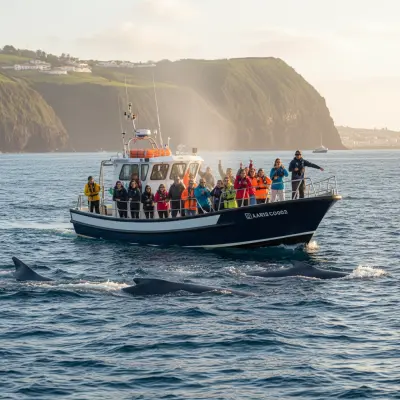
That system was the part that surprised me most the first time. On land, at the old spotting points once used by whalers, sit the vigias, observers with powerful binoculars who scan the ocean and radio the animals' position to the boats. That is why the success rate sits around 98%. When there is no sighting, Futurismo lets you repeat the trip for free.
Then there is the choice of boat, and here you have to decide what kind of day you want:
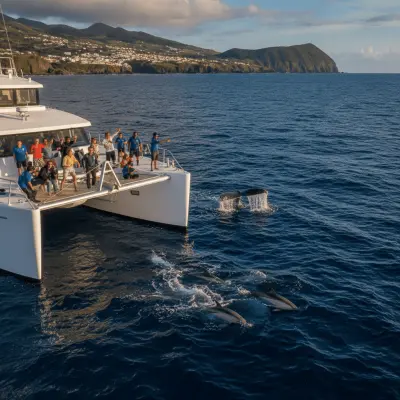
- Catamaran: bigger, stable, with a toilet on board and more shelter. Better for families, for anyone prone to seasickness, or for a rougher sea day.
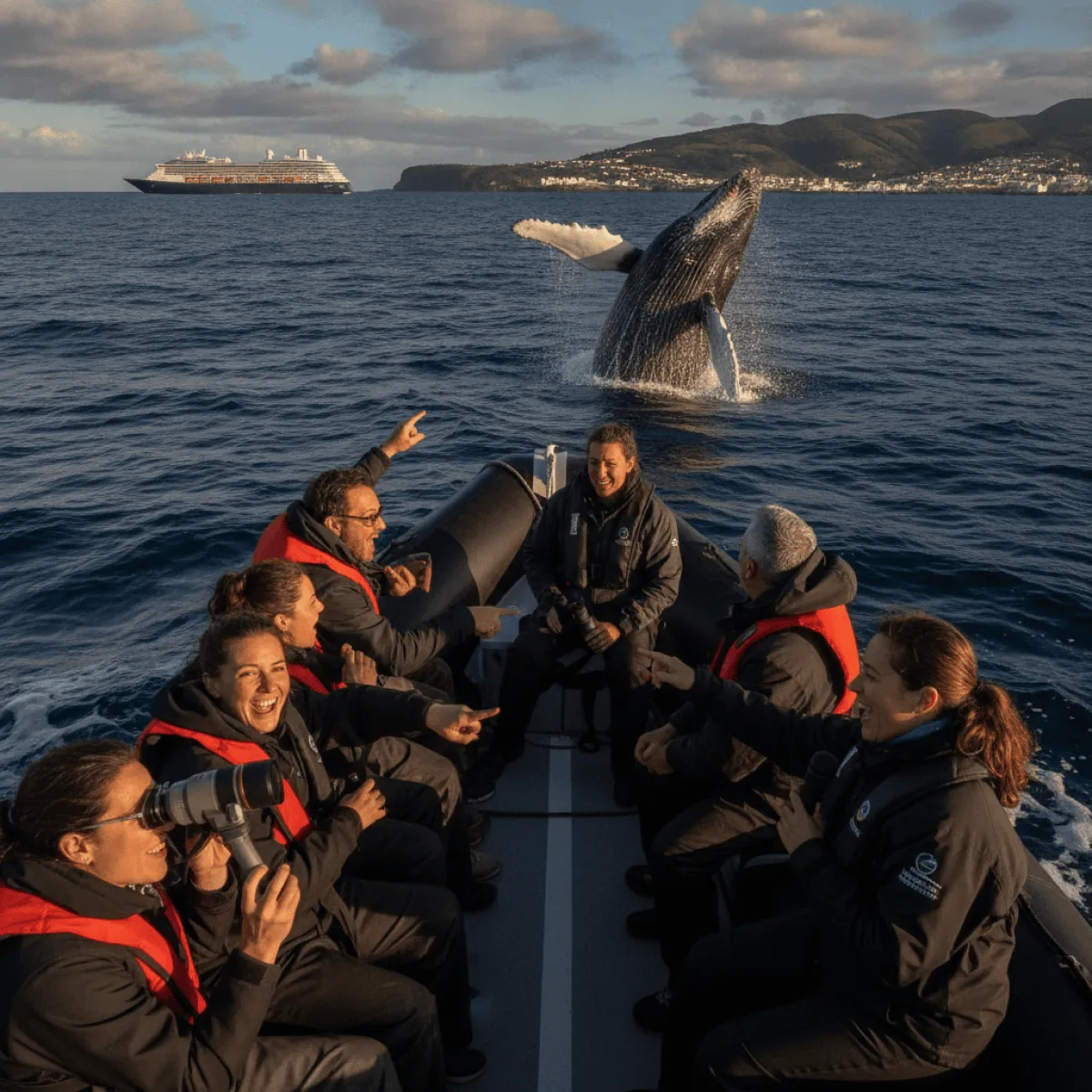
- Zodiac (RIB): faster, lower to the water, closer to the animals and considerably wetter. Minimum age 6. It is my favourite when the sea is calm.
The trip itself lasts around two hours at sea. You leave the harbour, head for the area the lookouts have flagged, and when the boat slows down, that is the signal you are close. The best moment, for me, is not the first distant spout: it is when common dolphins decide to ride the bow, dozens of them leaping side by side. It happens often and it never gets old.
"At its peak": when to go and what you'll see
The strong season for the big migratory whales, the blue, the fin and the sei, is spring, mainly from April to early June, as they follow the plankton blooms north. If you are coming at this time hoping for the blue whale, the largest animal that has ever lived, this is the window.
But there are cetaceans all year round. The sperm whale is resident and seen in almost every month, along with several dolphins: common and bottlenose year-round, spotted dolphins in summer. So even outside the migratory window, you are unlikely to come back empty-handed. As for time of day, I always prefer the morning trip: the sea tends to be flatter, there is less glare, and the light on the water is cleaner for photographs.
Practical tips that make a difference
- What to wear: layers. Even on a sunny day, the wind out at sea is cold. Bring a windbreaker; on the zodiac Futurismo provides waterproof jacket and trousers when needed.
- What to bring: sunscreen, a hat, water, and sunglasses on a strap (I have seen plenty fly off). Camera or phone with a neck cord.
- Seasickness: if you are sensitive, take the tablet about an hour before and choose the catamaran. Fix your eyes on the horizon and stay out on deck in the fresh air.
- Booking: high season fills up, especially May to September. Book online a few days ahead. Cancellation is free up to 48 hours before.
- Getting there: Portas do Mar is central, walkable from almost anywhere in the old town. There are two paid car parks via the same entrance ramp.
Price: on Futurismo's official page the trip is listed at 70 euros per adult, plus a small online booking fee. Children under 5 go free when included in an adult booking. Prices vary by season, so confirm directly with the provider when you book.
How to fit this into the rest of your day
The trip takes half a day, which leaves the other half free. The sea makes you genuinely hungry, and nothing beats staying by the water with good fish and seafood: for that it is worth following the recommendations in the Ponta Delgada food trek guide or seeing where locals actually eat in the Ponta Delgada food guide. If you are staying longer and want to balance the ocean with the green interior, lakes and trails, the Azores in May guide helps you plan. And for a place to sleep away from the bustle, with countryside views, take a look at Quinta da Casa Grande.
Is it worth it?
It is, very much so, as long as you go in with the right expectation: this is nature, not an aquarium. The animals are wild, free, and there is always a fraction of luck involved. But with the lookout network and Futurismo's experience, the odds are firmly on your side. The moment a sperm whale lifts its tail fluke before diving, or a hundred dolphins surround the boat, stays with you long after you are back on dry land.
Provider: Futurismo Azores Adventures. Bookings: futurismo.pt | [email protected] | (+351) 296 628 522. Meeting point: Portas do Mar, Shop 26, 9500-771 Ponta Delgada.