Bragança: Guided Tour of the Bishop's Palace Museum
Inside Bragança's former bishop's palace, now the Museu do Abade de Baçal, a guided tour costs 60 euros per group plus a 5 euro admission ticket and covers fourteen rooms of archaeology, painting and furniture. Go right after the 9:30am opening, before the groups arrive.
A bishop's palace turned into a museum
Bragança does not have a palace in the Sintra or Queluz sense, but it has something rarer: an 18th century bishop's palace that survived almost intact and is now visited as a museum, not as a postcard backdrop. The Museu do Abade de Baçal has occupied the former Paço Episcopal since 1915, and it is here you understand why the Diocese of Bragança-Miranda chose this city, tucked into the most isolated corner of the country, as its seat of religious power for centuries.
The facade does not impress at first glance, flat stone, regular windows, the kind of building you might walk past without noticing if you didn't know what it held inside. That contrast is exactly what makes the visit interesting: from the outside it is an administrative building, inside there are fourteen rooms of collections ranging from Roman archaeology to 19th century painting, plus furniture that belonged to the family of writer Guerra Junqueiro.
How the visit works
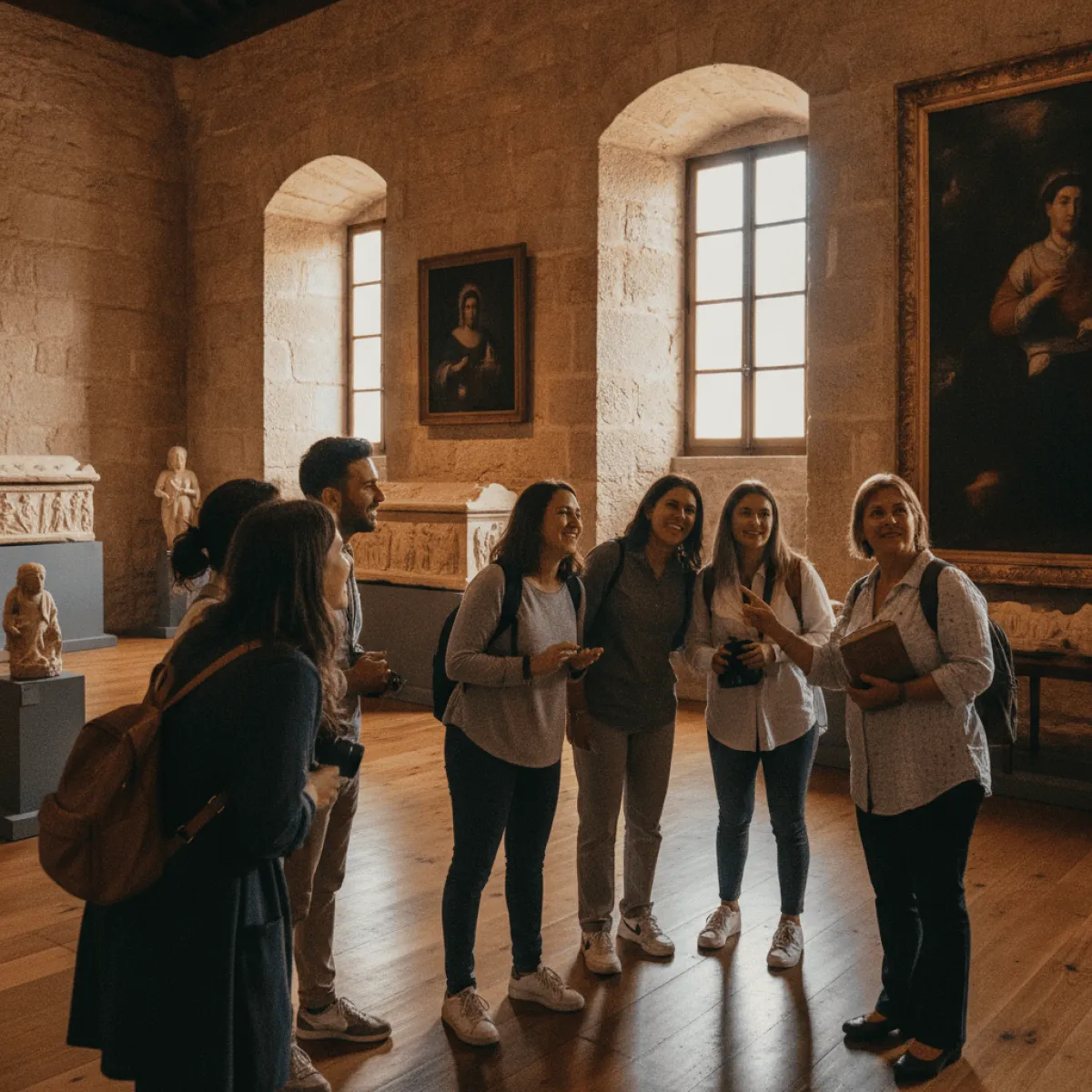
You can walk through on your own, at your own pace, or book a guided tour. I recommend the second option without hesitation: without a guide, you risk walking past the furniture and goldsmithing rooms without understanding why those specific pieces are there, and the archaeology collection, with pieces from the northeast region predating the founding of Portugal, needs context.
The guided tour costs 60 euros per group of up to 20 people, on top of the individual admission ticket, which is 5 euros at the standard rate, with reductions for seniors and visitors aged 13 to 24. For a small group of four or five people, the per-person cost of the guided portion works out to roughly 12 to 15 euros, plus the ticket. If you're travelling solo, it's worth asking at the front desk whether a guided tour is already scheduled that day rather than paying for a full group by yourself.
What to see, room by room
- The archaeology room, with pieces from pre-Roman hillforts in the region, including zoomorphic sculptures the guides explain with more enthusiasm than any wall label.
- The painting and drawing rooms, with works by 19th century Portuguese artists rarely seen outside Lisbon or Porto.
- The furniture and goldsmithing collection linked to Guerra Junqueiro, which gives a clear sense of how the regional upper class once lived.
- The small interior garden, a good spot to pause for five minutes before heading back out.
The best time to go and what to skip
Go in the morning, right after opening at 9:30am. At that hour the museum is nearly empty, the light coming through the tall windows hits the rooms differently than in the afternoon, and the guides, when they don't have another group waiting, have more time to answer questions. Avoid going on a Sunday close to the 6pm closing time, when staff are already preparing to shut down and the visit feels rushed.
One thing worth confirming before you go: the days and conditions for free or reduced admission change from time to time, so confirm directly with the museum before your visit, especially if you're travelling with a large group or students.
Practical information
- Address: Rua Abílio Beça, 27, 5300-011 Bragança
- Hours: Tuesday to Sunday, 9:30am to 12:30pm and 2pm to 6pm. Closed Mondays and on select holidays (January 1, Easter Sunday, May 1, August 22, December 25).
- Contact: +351 273 331 595 / mabadebacal@museusemonumentos.pt
- Admission: 5 euros standard, 2.50 euros reduced (seniors, visitors aged 13 to 24)
- Guided tour: 60 euros per group of up to 20 people, plus individual admission, advance booking required
Wear comfortable shoes, the floors in the older rooms are wood and occasionally uneven, and bring a light layer even in summer, since the rooms stay cool no matter how high the temperature climbs outside. If you're staying near the historic center of Bragança, the museum is a short walk from the cathedral and the citadel, so it's worth building the visit into a morning of walking around the old town.
Why it's worth it, even without the fanfare
Bragança doesn't oversell this visit. There are no lines, no tour groups following little flags, and that's exactly why the experience works: you get the time and space to look closely at the pieces, to ask the guide why a particular carved chest came from Miranda do Douro instead of Bragança itself, to understand the difference between the civic power of the citadel and the religious power of this palace, two centers of authority that coexisted in the same small city for centuries.
If you want to keep exploring the region afterward, it's worth reading about Montesinho Natural Park, less than twenty minutes away by car, or planning your trip around June, when the heat hasn't set in yet and the citadel's streets are quieter. And if you'd rather understand the city from another angle, the guide on fado and local music helps explain why Bragança holds onto so much for those patient enough to look.
Visiting the Museu do Abade de Baçal isn't the kind of experience you recommend with superlatives. It's more of an invitation to slow down, to look carefully at a building that held religious power over the northeast region for centuries, and to walk out understanding Bragança in a way the citadel alone doesn't explain.