Walking Viseu: The Neighborhoods Worth Your Shoes
Viseu is Portugal's largest city without a train station, but it more than compensates on foot. From Rua Direita to the hidden corners of Fontelo Park, past the Cava de Viriato and azulejo facades nobody photographs, this is a guide for those who'd rather walk than drive.
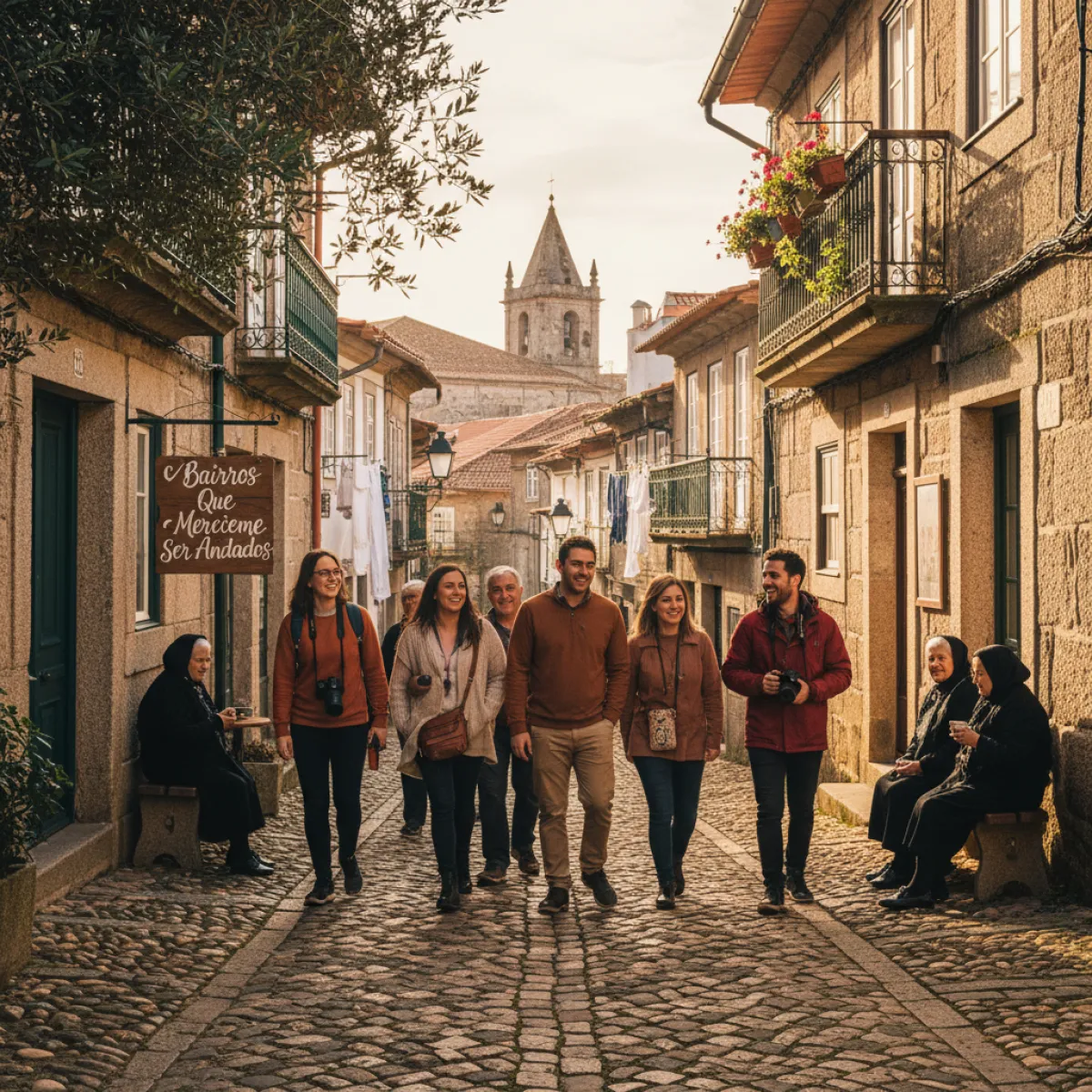
Viseu has a problem, the good kind. It's a city that works best at walking pace. The best moments aren't at the monuments on the brochures but in the streets between them. On corners where granite buildings meet half-peeling azulejo facades. In squares where old men sit on stone benches like they've signed a lifetime lease. In cafés where nobody is in a hurry to leave.
Most visitors arrive, see the Cathedral, snap a photo of the Rossio, and drive on to Serra da Estrela. Mistake. Viseu is a city for walking without a fixed destination, for getting lost in streets that climb and drop with no apparent logic, and for discovering that inland Portugal has an urban sophistication most people underestimate.
The Historic Centre: Rua Direita and the Side Alleys
Rua Direita is the obvious axis. It connects Praça da República, the Rossio, as everyone calls it, to the upper part of town, where the Cathedral and the Grão Vasco Museum sit. But the charm isn't in the street itself. It's in the alleys that branch off to the sides, those narrow passages that seem to lead nowhere and suddenly open onto a tiny square with a dry fountain and a tree nobody has pruned in years.
Start at the Rossio in the morning. Not too early, Viseu isn't a city of early risers. By 9:30am the cafés have a decent crowd but you can still find a seat. This is where you measure the city's rhythm. Retirees with newspapers, students from the polytechnic, shopkeepers before opening time.
Walk up Rua Direita without hurrying. The shops are a curious mix: haberdasheries that seem unchanged since 1978, next to specialty coffee spots with Scandinavian design. Viseu has that contrast, old and new coexist without friction, perhaps because nobody here is trying to impress anyone.
Halfway up, detour into Rua do Comércio or Rua da Árvore. They're quieter, lined with two- and three-storey buildings, wrought-iron balconies, and laundry drying in the sun. This is everyday Viseu, no filter.
The Cathedral Square and Largo de Santa Cristina
Viseu's Cathedral is imposing, as you'd expect from a building that's essentially a granite fortress. But what many people miss is that the square around it is one of the finest public spaces in central Portugal. On one side, the Grão Vasco Museum. On the other, the old Paço dos Três Escalões. And in between, a square with a calm that contrasts with the scale of the buildings.
The Grão Vasco Museum is worth entering, the collection of 16th-century painting is genuinely impressive, and the building itself is handsome. But if the weather is good, the square is enough. Sit on one of the stone benches, look at the cloisters, and consider that this space has seen centuries of walkers just like you.
From the square, walk down through Largo de Santa Cristina toward Fontelo Park. This area is residential, with manor houses that once belonged to important families and are now divided into flats. Cats on every wall. It's possibly the most photogenic part of the city, with the advantage of zero crowds.
Fontelo Park: A Forest Inside the City
If Viseu has a real secret, it's Fontelo. A huge park, nearly 10 hectares, attached to the historic centre, with centuries-old trees, dirt paths, and a quiet that feels impossible five minutes from the Rossio.
Fontelo was the garden of Viseu's bishops. Today it's public and it's where locals go to run, walk the dog, or simply disappear for an hour. There are sports facilities, a pavilion, and at the edges of the park, views over the Pavia valley that justify the detour.
A morning walking through Fontelo followed by a coffee in the centre is probably the best way to start a day in Viseu. You don't need a map, enter through the main gate near Largo de Santa Cristina and let yourself drift.
Cava de Viriato and the Riverside
Cava de Viriato is strange, in the best way. An octagonal earthwork about 500 metres in diameter, surrounded by a raised embankment attributed vaguely to the Romans or the Lusitanians, depending on who's telling the story. The truth is nobody quite knows what it was. Military camp? Market? Religious structure?
Regardless of its origins, it's an excellent space for walking. The full circuit along the embankment takes about 20 minutes on foot, with views over the rooftops of the lower town. In the late afternoon, when the light turns golden, it's particularly beautiful.
From the Cava, head to the riverside along the Rio Pavia. Viseu has invested in recent years in a green corridor along the river, with wooden walkways and a cycle path. It's not the most spectacular riverfront in Portugal, but it's pleasant, functional, and empty. At 8am you'll find joggers and cyclists. By noon, almost nobody.
Where to Eat (Without a Tourist Guide)
Viseu eats well. Surprisingly well for a city its size. Beirã cuisine is substantial, cured meats, cheeses, goat, veal, and the city has a food scene that goes well beyond the typical.
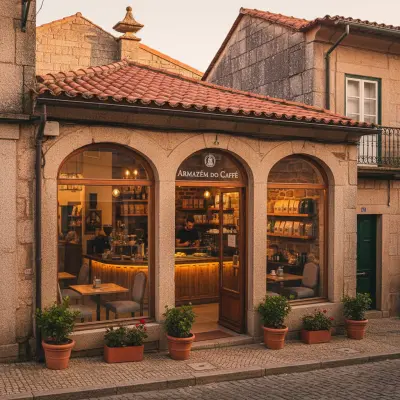
Armazém do Caffè is an essential reference. Set in a converted industrial space, it takes a contemporary approach to Portuguese cooking that works without being pretentious. It's the kind of place where you can have a full lunch or just sit at the counter for a coffee and a slice of cake. Perfect after a morning walking the historic centre.
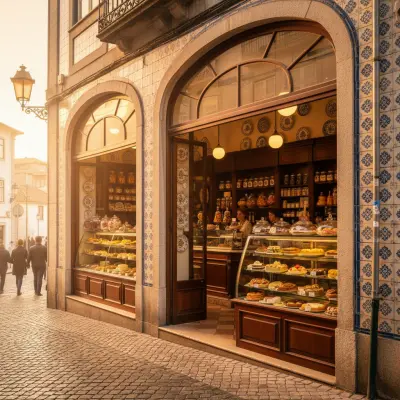
For pastry, and in Viseu, pastry is serious business, Confeitaria Amaral is an institution. It's not a modern place, it wasn't designed for Instagram, and that's exactly what makes it special. The pastéis de Vouzela, the viriatos (the signature regional pastry), and the puff pastries are made as if time hadn't passed. Go in the morning, when everything has just come out of the oven.
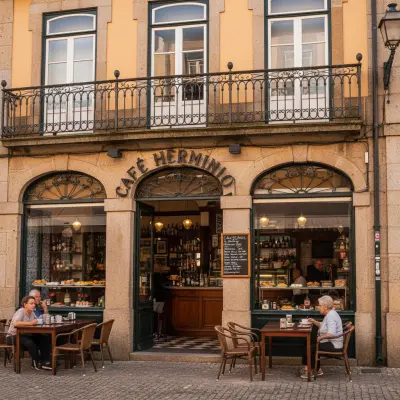
For a coffee stop with character, Café Hermínio is the kind of café that barely exists in Portugal anymore. A neighbourhood coffee house with personality, where you go to be present, not just to consume. Order a coffee, sit down, and watch.
The region's gastronomy has strong identity. Serra da Estrela cheese, produced in the nearby mountains, is one of Europe's great cheeses, and if you have time to explore the subject properly, there are hands-on cheese-making workshops at Casa da Ínsua that are worth the trip.
Rua Formosa and the Além-Ponte Quarter
Rua Formosa is probably Viseu's most underrated street. It runs parallel to Rua Direita but on a lower level, and has a mix of traditional commerce, grocers, and small tascas that give it a rawer, less polished character.
This is where Viseu shows its provincial city face without apologising. The shopfronts are modest, the prices are real, and people know each other. If you're looking for the non-tourist version of the city, this is it.
Cross the bridge over the Pavia and you enter a more residential, more recent area, but one with its own points of interest. There are excellent neighbourhood bakeries, small markets with local products, and the advantage of walking streets where nobody expects tourists.
Azulejo as a Map
One thing Viseu has that goes largely unnoticed is azulejo. Not the monumental tile work of Lisbon or Porto, but domestic azulejo, house facades from the 18th and 19th centuries covered in geometric patterns in blue, yellow, and white. Pay attention to the facades as you walk Rua Direita and the adjacent streets.
If this kind of craft fascinates you, there's a tile painting workshop in Viseu with Mestre António Cruz that offers a hands-on experience. This isn't a workshop designed for tourists to take selfies, it's a serious introduction to a technique with centuries of history.
Street art is another phenomenon growing across inland Portugal. If the subject interests you, it's worth seeing what's been happening in Coimbra with the murals in the Alta district, about an hour's drive from Viseu.
Practical Logistics
Viseu sits in the centre of Portugal, which makes it accessible but not obvious. It has no train, it's the largest Portuguese city without a rail connection, a fact locals mention with a mix of pride and indignation. You get here by car (A25 or IP3 motorways) or by bus (Rede Expressos connects to Lisbon and Porto in roughly 3 hours).
Once in the city, everything is walkable. The centre is compact and largely pedestrianised. Free parking exists on the periphery, near Cava de Viriato, for instance, and paid parking in the centre. The city has a local bus network, but for exploring neighborhoods on foot you won't need it.
For accommodation, the historic centre has quality options at prices far below Lisbon or Porto. Look for local guesthouses near Rua Direita or the Rossio, being in the centre on foot makes all the difference.
If you're planning a wider trip through inland Portugal, Viseu fits perfectly into a week-long itinerary through the heart of the country that includes Serra da Estrela, the Dão wine region, and the Historical Villages.
The Final Note
Viseu isn't trying to be Lisbon. It isn't trying to be anything other than what it is: a mid-sized Portuguese city with a long history, a generous table, and a historic centre you can walk in half an hour, but that deserves a full day. Maybe two. Viseu's beauty is in its well-executed normality. In clean streets, in cafés where coffee costs what coffee should cost, in public parks that actually work, and in a quality of life that most European capitals have already lost.
Wear comfortable shoes. Leave the car. Walk.