The Vertical Silence: Paragliding the Glacial Valleys of Linhares da Beira
Explore Linhares da Beira, Portugal's paragliding capital, where medieval granite meets the weightlessness of flight against a backdrop of glacial valleys and absolute silence.
The Mechanics of Weightlessness
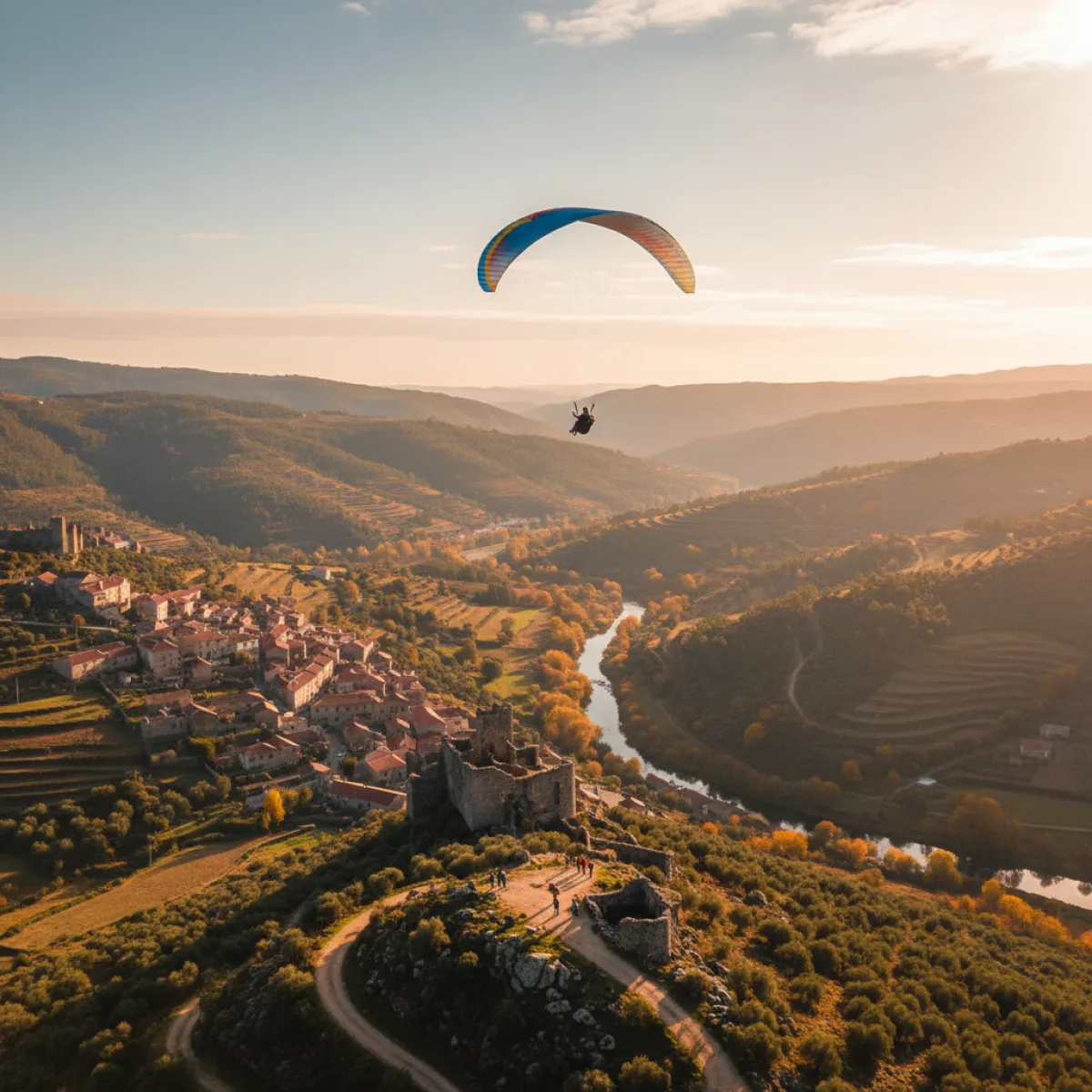
Linhares da Beira is not a destination one stumbles upon by accident. Tucked away on the western shoulder of the Serra da Estrela, this Historical Village demands a deliberate journey through roads carved into monolithic granite. Yet, for those who understand the language of the wind, the village is merely a starting point. Linhares is globally recognized as the 'Cathedral of Paragliding,' a title earned by the unique thermal properties of the Mondego Valley and the reliable orographic lift of its slopes. Here, the sky is not a void but a tactile element, a playground of invisible currents that allow for a perspective of Portugal that few ever witness.
The ascent to the takeoff point at Esperança is a ritual of anticipation. As you drive higher, the lush valley floor gives way to a stark, alpine landscape where boulders the size of houses are scattered across the terrain. The air changes, losing the humidity of the coast and gaining a sharp, mineral clarity. It is a setting defined by its permanence, a rigid geological structure that stands in fascinating contrast to the fluid, modern lines found in nearby Seia, where Modernism in the Mountains: The Architectural Legacy of Cottinelli Telmo in Seia showcases a different kind of human ambition carved into the rock.
A Flight Through History
From a height of a thousand feet, Linhares da Beira reveals its true form. The medieval castle, a fortress of grey granite, becomes a miniature sentinel guarding a patchwork of ancient fields and Roman roads. You are not just flying over a village; you are gliding over a thousand years of history. The Roman road that winds its way through the valley is clearly visible from the air, a straight line of human intent cutting through the chaotic beauty of the mountain side. This view provides a profound sense of scale, reminding the flyer that while our presence is fleeting, the stone of the Beira region is eternal.
The act of takeoff is a brief, intense dialogue between human and wing. There is no engine, no mechanical roar, only the whistle of the wind through the lines and the sudden, breathtaking transition from gravity to lift. The silence is the first thing you notice. It is a vertical silence, broken only by the occasional beep of the variometer indicating an ascent. In early spring, the visual experience is peerless. While the highest peaks of the Estrela might still hold a dusting of white, the lower slopes begin to mirror the floral transformation happening to the south, where The Ephemeral Bloom: A Guide to Seeing Cherry Blossoms in Fundão marks the definitive arrival of the season.
Navigating the Invisible: The Science of Thermals
Paragliding in Linhares is as much about physics as it is about poetry. The southwest-facing slopes act as giant solar collectors, heating the air until it breaks away in rising columns known as thermals. Pilots use these to spiral upward, often joined by local residents of the sky. Griffon vultures and eagles are common companions here; they are masters of the air who treat paragliders with a mix of curiosity and regal disdain. Sharing a thermal with a bird of prey, watching its wingtips adjust to the same invisible force as your own wing, is a moment of pure biological connection.
For the uninitiated, a tandem flight is the perfect introduction. Local schools like In-Vento offer professional pilots who handle the technicalities while you focus on the horizon. A tandem flight typically costs between €80 and €120, a modest price for a twenty-to-forty-minute suspension of reality. It requires patience, however. The mountain dictates the schedule. If the wind is too strong or the direction is wrong, you wait. This waiting is part of the experience, it forces a slow-down that is rare in modern travel. It is a time for observation, much like the focus required for Surfing Portugal in March: The Best Beaches and Conditions, where timing and respect for the elements are the only way to ensure success.
The Gastronomy of the Beira Alta
Landing in the Mondego Valley, your body feels the sudden return of its own weight. The adrenaline leaves a specific kind of void that only the local cuisine can fill. In Linhares, food is an extension of the landscape: dense, honest, and deeply satisfying. The Queijo da Serra, a sheep's milk cheese protected by a Denomination of Origin, is the undisputed king of the table. It is soft, almost liquid in the center, and best enjoyed with a slice of heavy rye bread. For a more formal meal, Cova da Loba offers a sophisticated take on mountain flavors, where the lamb is slow-cooked to the point of collapse and the Dão wines provide a structured, elegant accompaniment.
Staying in the village is highly recommended to fully absorb its atmosphere. Solar de Linhares, a manor house with deep roots in the community, provides thick stone walls and a quiet dignity that suits the location. A weekend budget of €300 per person will comfortably cover a tandem flight, two nights of boutique accommodation, and meals that you will remember for years. It is an investment in a different pace of life, one governed by the sun and the wind rather than the clock.
Practicalities and Planning
The flying season in Linhares runs from March through October, but the shoulder seasons, spring and autumn, often provide the most interesting conditions for those looking to fly for longer periods. The air is more active, and the scenery is more vibrant. If you are planning a visit, consider the following:
- Clothing: Even in summer, the air at 1,000 meters is cold. Bring technical layers and a windproof jacket. Proper hiking boots with ankle support are mandatory for takeoff.
- Transport: A car is essential. Linhares is remote, and the drive from Porto or Lisbon takes about three hours. The roads are well-maintained but winding.
- Preparation: Book your flight at least a week in advance, but keep your schedule flexible. Pilots will often call you the day before to confirm if the weather is suitable.
Linhares da Beira offers something that is increasingly rare in the travel world: a true sense of perspective. It is a place where you can leave the ground and, for a few moments, understand the world as a topographical map rather than a series of tasks and appointments. It is a village of silent stone and loud wind, a place where gravity is merely a suggestion and history is written in the granite below.
