Templar Tomar: Beyond the Convent of Cristo
The Convent of Christ is just the beginning. The real Templar route in Tomar descends the hill to Portugal's oldest Synagogue, crosses the Nabão to the forgotten pantheon of Santa Maria do Olival, and ends at a 30-metre aqueduct nobody expects to find.
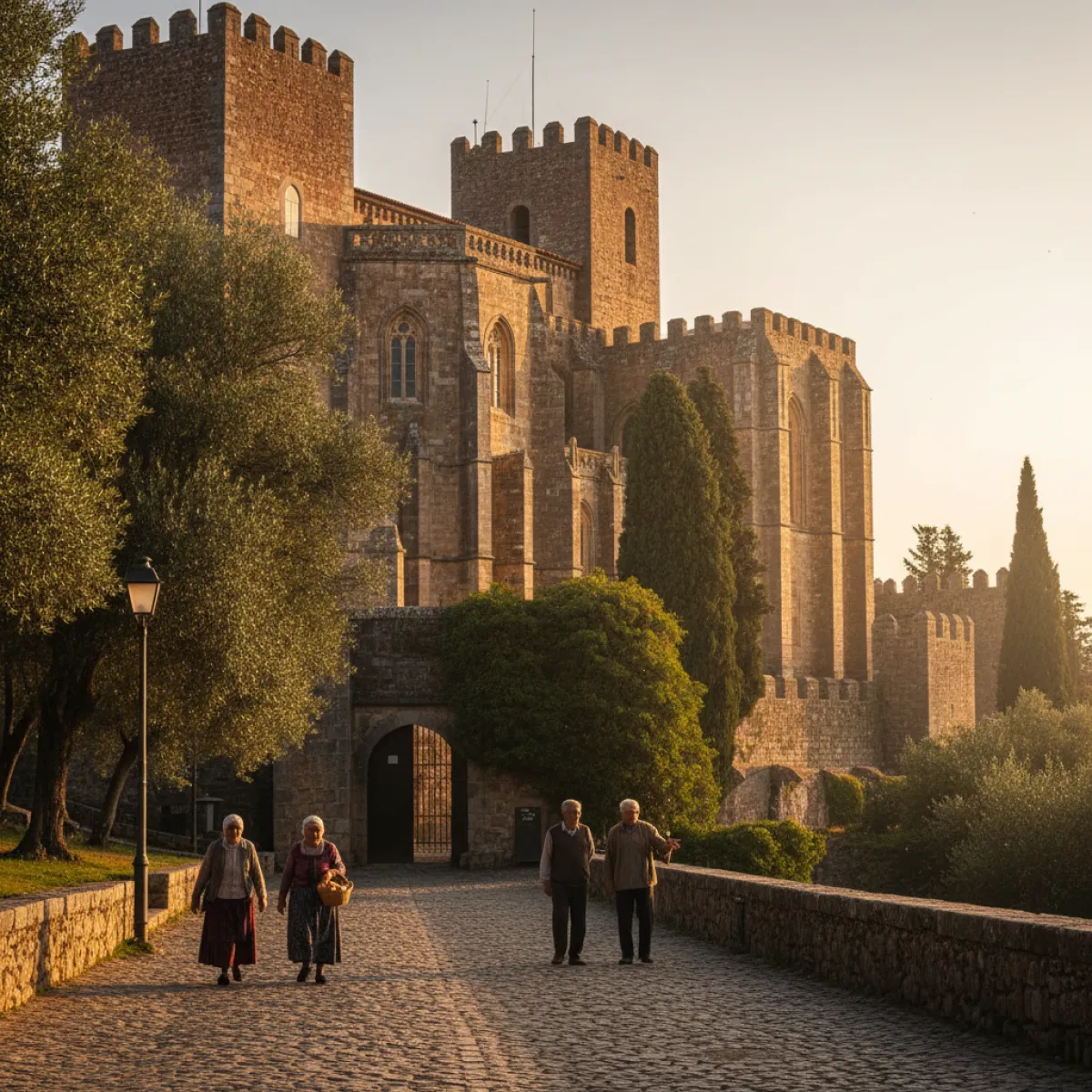
Tomar has a problem. Or rather, Tomar has a blessing that became a problem: the Convent of Christ is so extraordinary, so overwhelmingly beautiful, that most visitors drive up the hill, gape for two hours, and drive back down without ever setting foot in the town below. It's like going to a party and spending the entire night in the foyer. Yes, the chandelier is spectacular, but the party is inside.
This guide is for people who want the whole party. We'll go to the Convent, obviously, because ignoring it would be foolish. But we'll also walk downhill, cross the Nabão river, and wander the streets where the Knights Templar left marks that no audioguide will mention.
The Charola: where knights prayed without dismounting
Let's start with the obvious, because the obvious deserves fresh eyes. The Charola inside the Convent of Christ isn't just a pretty round church. It's the largest and best-preserved of its kind in Europe, inspired by the Church of the Holy Sepulchre in Jerusalem. Templar knights rode in on horseback and stayed mounted during mass, while the chaplain celebrated at the centre. Think about that: a church designed for warriors who didn't have time to park.
Admission to the Convent costs around €6 (check locally, prices update). My recommendation: arrive at opening, 9am. By 11am in summer, queues snake through the courtyard. Go on a weekday if you can. The morning light entering through the Charola's narrow openings is something no Instagram photo will convey.
Allow at least ninety minutes. Some people say 45 minutes is enough. Those people probably think you can see the Prado in half an hour. Every cloister deserves time: the Main Cloister, Manueline and Renaissance in style, is the star, but the Washing Cloister, more modest, has a serenity that rewards the detour.
The Chapter Window: stop taking selfies and look up
The famous Manueline window on the western façade is possibly the most reproduced piece of architectural sculpture in Portugal. Ropes, seaweed, chains, roots, the Cross of the Order of Christ. Some see Templar symbolism in every detail. Others see a sea-obsessed king stamping his mark on his predecessors' monument. I see both, and I think that ambiguity is what makes it fascinating.
The best view isn't from straight on, where everyone clusters. Walk around to the right, along the terrace of the Santa Bárbara Cloister. From there, you see the window from the side, with depth, and you realise it's not flat decoration: it's a sculpture with nearly a metre of relief.
The Castle and the viewpoint worth the climb
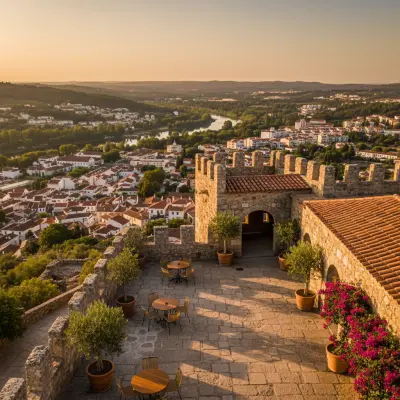
Before heading down to town, do yourself a favour: climb to the Miradouro do Castelo de Tomar. The view is panoramic over the entire city, the Nabão river winding below, terracotta rooftops, and on the horizon, the Ribatejo plain stretching out without hurry. In the early morning, especially on days with low fog, Tomar looks like it's floating. This is where you understand why Gualdim Pais chose this spot in 1160: you control everything from here.
And if you want an even more radical perspective, some people opt for paragliding above the heart of Ribatejo. Not for everyone, but for those with the stomach for it, it's a way of understanding Templar geography that no map allows.
Walking downhill: the town the tour buses skip
Walk down. The road connecting the Convent to town is steep but pleasant, lined with olive trees and old stone walls. In 15 minutes you're in the centre, at Praça da República, with the Church of São João Baptista and its 15th-century bell tower dominating the square.
This is where Templar Tomar meets living Tomar. Cafés ring the square with sun-drenched terraces. If it's lunchtime, don't rush. The fatia de Tomar, the town's conventual pastry made with almonds and egg yolks, is mandatory. You'll find it at several bakeries in the centre. Avoid the industrial versions wrapped in plastic.
The Synagogue: Portugal's oldest
On Rua Dr. Joaquim Jacinto, a few minutes from Praça da República, stands the Tomar Synagogue. Built between 1430 and 1460 by order of Prince Henry the Navigator, it's the oldest synagogue in Portugal and one of the best preserved on the Iberian Peninsula. It's small. It's discreet. And that's exactly why it works.
Four slender columns support the ceiling, and the acoustics are remarkable: guides say a whisper in one corner reaches the opposite corner perfectly. After the expulsion of the Jews in 1496, the building served as a prison, warehouse and hay barn before being rediscovered and classified. Today it functions as a museum. Admission is free. Go.
Santa Maria do Olival: the pantheon nobody visits
This is, for me, the most underrated stop in Tomar. The Church of Santa Maria do Olival, on the other side of the Nabão, was the headquarters of the Templar Order in Portugal and the burial place of its Grand Masters. Gualdim Pais, founder of Tomar, is buried here. His tomb slab, dated 1195 with a Gothic inscription, is still preserved inside.
The church is a classic example of Portuguese Gothic: sober, vertical, free of decorative excess. Unlike the Convent of Christ, which shouts power and wealth, Santa Maria do Olival whispers. And in that contrast you read the real story of the Templars in Portugal: they began as austere warrior-monks and ended as one of the richest orders in Europe.
There are no crowds. No audioguides. Most of the time, you'll be alone. Check locally for opening hours, as they vary throughout the year.
The Pegões Aqueduct: the monument nobody expects
About 4 km from central Tomar, accessible by car or on foot if you like walking, stands the Pegões Aqueduct. At 6 km long and 30 metres high at its peak, it was built during the reign of Philip I to supply water to the Convent of Christ. It's a National Monument and, frankly, it's impressive.
It's not Templar, technically. It's 16th century. But it's part of the same story: the obsession of successive powers with the Convent of Christ, which always demanded more water, more stone, more ambition. At sunset, the double arcades cast long shadows across the terrain, and you understand why Philip I's engineers chose this route: it was the most dramatic.
The Templar Festival and when to visit
If you can choose, visit Tomar in July during the Festa Templária. The town transforms: there are medieval processions, period markets, historical re-enactments, and an atmosphere that oscillates between rigorous and kitsch in a perfectly Portuguese way. In 2025, the theme celebrated 830 years since the death of Gualdim Pais.
Outside festival season, Tomar works perfectly as a day stop on a week-long trip through the heart of Portugal. It's ninety minutes from Lisbon by motorway, with easy parking in the centre. By train, the Linha do Leste connects Lisbon-Santa Apolónia to Tomar, but check timetables, as services are less frequent on weekends.
Where to eat: no fake lists
I won't pretend I know every restaurant in Tomar. What I do know: the region's food leans on kid goat, goat cheese, cured meats and Ribatejo olive oil. Sopa da pedra, which is actually more associated with nearby Almeirim, also appears on local menus. Order whatever's on the daily specials board, and skip the laminated tourist menus.
For sweets, the fatia de Tomar and beija-me depressa, another local conventual pastry, are the right choices. With a coffee at one of the bakeries on Rua Serpa Pinto, it's a fitting way to end the visit.
Combining with the region
Tomar sits at the heart of an area that deserves more than a day. If you're exploring Central Portugal, you could combine it with walks around Caldas da Rainha or head north to Coimbra to see the street art murals reshaping the Alta. If you prefer two wheels, the Ecopista do Dão between Viseu and Santa Comba is within reasonable distance and is one of the best cycling routes in the country.
But start with Tomar. Climb to the Convent, descend to the Synagogue, cross the Nabão to Santa Maria do Olival. Walk the full route, from grandeur to sobriety, from power to prayer. The Templars did it for 150 years. Give them at least one full day.