Tavira's Museums: Which Are Worth It, Which to Skip
Tavira has more museums than you'd expect for its size. The Palácio da Galeria hides Phoenician structures under glass floor panels, the Islamic Museum houses the extraordinary Tavira Vase. But the Camera Obscura? You can skip it, the castle view is better and it's free.
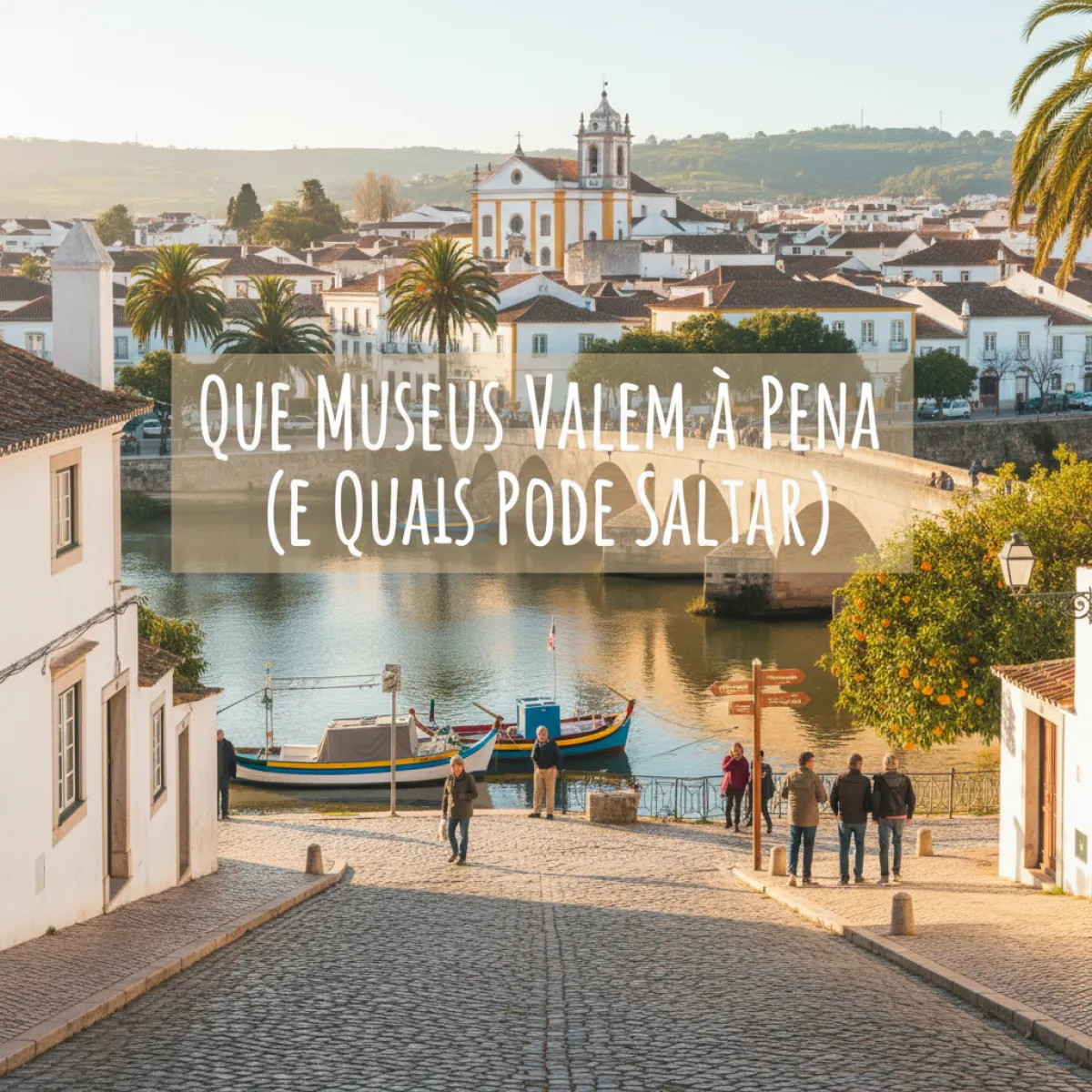
Tavira punches well above its weight when it comes to museums. For a small Algarve town, there are at least four proper museum spaces, a handful of church-museums and thematic exhibition centres scattered between the castle and the Gilão riverbanks. The trouble is that most visitors with a day or two try to see everything and end up appreciating nothing. My advice: be ruthless, spend your time in the right places, and dedicate the rest of the day to what Tavira does best, aimless walking, good food and watching the river.
What Actually Deserves Your Time
Palácio da Galeria, Tavira Municipal Museum
This is the one museum that justifies the visit. Housed in an 18th-century baroque palace on Calçada da Galeria, the Municipal Museum pairs serious archaeology with surprisingly strong contemporary art exhibitions. The building alone is worth the entry fee: the Renaissance arcade in the inner courtyard is among the finest in southern Portugal, and the contrast between old stone and contemporary pieces works effortlessly.
The most striking moment is on the ground floor: through glass panels, you can look down at excavated Phoenician structures, pits from the 6th-7th century BC that sat buried beneath your feet for millennia. These aren't reconstructions or replicas. They're the actual remains, right there, protected by glass. It's the kind of thing that stops people mid-sentence.
Open Tuesday to Saturday, 09:30–12:30 and 14:00–17:30 in winter (summer afternoons shift to 15:00–18:30). Entry is around €2, which is practically symbolic. Give it at least an hour, more if there's a good temporary exhibition, which there often is.
Núcleo Islâmico (Islamic Museum)
Small, modern and extremely well done. Opened in 2012, built around the remains of an Islamic-era structure, it displays artefacts found in excavations across the old town. The star piece is the Tavira Vase, an elaborate ceramic with human figures and animals around the rim, one of the most important Islamic-era finds in the Algarve.
The building incorporates sections of the original Muslim-era town walls, which gives the space a physical dimension that larger museums don't always manage. The upper floor has rotating exhibitions on local themes. You won't need more than 40 minutes, but they'll be 40 minutes well spent. It's right off Praça da República, stop in before or after a coffee on the square.
If the Islamic period of the Algarve interests you, and it should, given that nearly five centuries of Moorish rule shaped everything from architecture to agriculture, this museum gives you more real context than any information panel at a castle. For more on the authentic cultural side of the Algarve, our guide to local culture in Faro covers the region beyond the beach resorts.
Igreja e Casa Museu da Misericórdia (Church and Museum)
The Igreja da Misericórdia is, by general consensus, the finest Renaissance building in the entire Algarve. Built between 1541 and 1551, it was designed by André Pilarte, the same architect who worked on the Jerónimos Monastery in Lisbon. That alone should get you through the door.
The Renaissance portal is elegant without being showy, and the interior rewards close attention with its azulejos and carved woodwork. The adjacent Casa Museu, entered from Rua da Galeria, displays sacred art and historic rooms, including the Sala do Despacho where the brotherhood met to decide on charitable works. Entry is €3, open Tuesday to Saturday from 10:00 to 13:00 and 14:00 to 18:00. It's not a huge museum, but the church-plus-museum combination is worth half an hour.
What You Can Skip (Or Save for a Rainy Day)
Camera Obscura, Torre de Tavira
I'll be straight with you: the Camera Obscura is a pleasant experience but one you can live without. Installed in a former water tower, it projects a live 360-degree image of the city onto a horizontal surface using a system of mirrors and lenses. It's clever, it's different, and the 30-minute sessions are guided.
The problem is that Tavira is a city best experienced on foot, at eye level, with the smells and sounds. Watching a projection of rooftops when you could simply walk up to the castle and get the real view, wind in your face, the Gilão below, strikes me as a questionable use of time and money. Tickets cost between €5 and €8 per person, making it pricier than any other museum in town. If you're travelling with curious kids or if it's absolutely pouring, fair enough. Otherwise, go up to the castle, it's free, and it has the best view in Tavira without optical intermediaries.
Note that the Camera Obscura closes in winter for maintenance, so check locally if you're visiting outside peak season.
The Smaller Exhibition Centres
Tavira also has the Cachopo Museum Nucleus (dedicated to mountain culture and ethnography, in the village of Cachopo north of the municipality), the Hermitage of Santa Ana (sacred art) and an exhibition centre on water supply history. They're legitimate spaces maintained by the municipality, but far too niche for most visitors. If you have a particular interest in rural Algarvian ethnography, Cachopo is worth the drive. For everyone else, stick to the town.
My Recommended Route
With half a day, here's the sequence that works: start with the Islamic Museum in the morning (it's central, it's quick, opens at 9:30). Then walk up Calçada da Galeria to the Palácio da Galeria for the Municipal Museum, this is the main course. On your way down, stop at the Igreja da Misericórdia. Three museums, three hours maximum, under €10 total.
The rest of the day? Have lunch by the river, cross the Ponte Romana (which is actually medieval, but nobody seems to mind) and get lost on the south side of town. Or, for something unexpected, try the wine experience at Al-Lagar, which revives the region's winemaking traditions, a genuine surprise in an Algarve most people associate only with beaches.
Beyond the Museums
Tavira isn't a museum city in the classical sense. It's not Évora or Porto. Its real museum is the urban fabric itself: the 21 churches (yes, someone counted), the four-pitched scissor rooftops, a technique found only in the eastern Algarve, the ruins of the Moorish castle, the gardens along the Gilão. All of it free and open when the museums are closed.
If you're staying more than a day, and you should, consider Fazenda Nova Country House as a base, a rural property on the outskirts that lets you explore Tavira without the rush of having to get back to Faro by evening. Waking up in the countryside and reaching town before the tour buses completely changes the experience.
For those looking to extend their cultural Algarve itinerary, we've got guides on the neighbourhoods of Lagos and local culture in Albufeira, towns with very different personalities from Tavira, which is precisely the point.
Practical Information
Tavira is about 30 minutes from Faro by car, or you can take the regional train (the station is a 10-minute walk from the centre). From Lisbon, the most practical option is the Alfa Pendular train to Faro and then a regional connection, or the Rede Expressos bus directly to Tavira.
The municipal museums (Palácio da Galeria and Núcleo Islâmico) share the same ticketing system, ask about combined tickets, which sometimes exist. Everything closes on Sundays and Mondays. Plan your visit for Tuesday to Saturday. And if you arrive on a hot summer afternoon, do what the locals do: rest between 2pm and 4pm, and visit the museums in the morning or late afternoon, when the light enters the buildings differently and the whole experience shifts.