São Vicente Beyond the Coast: Inland Villages and Poios
Ninety minutes is not enough for São Vicente. Drive up the road to Rosário, drink the local cane-honey poncha, and discover the poios that carve Madeira's north coast like staircases for giants.
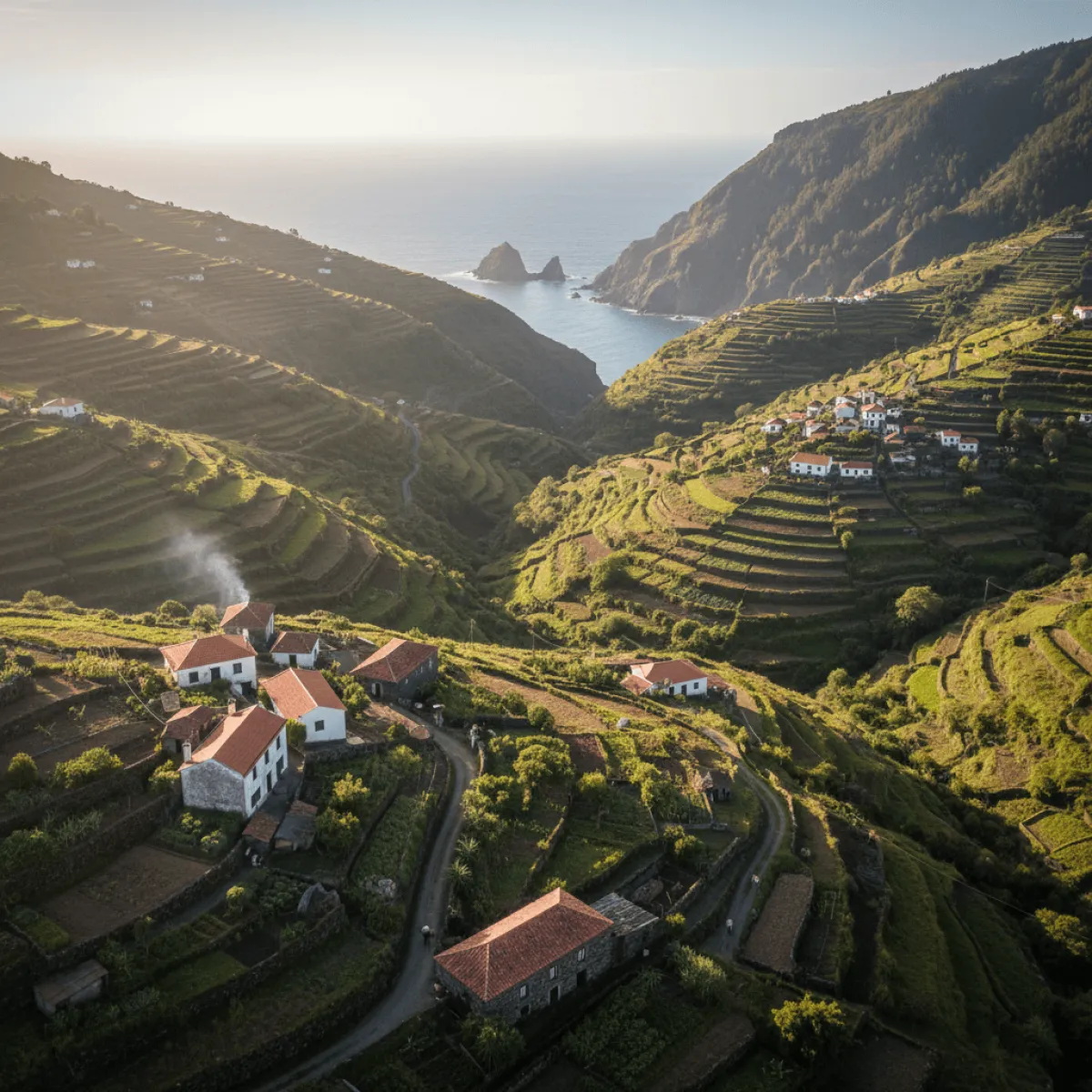
Most visitors to Madeira do the same thing in São Vicente. They park near the famous caves, photograph the white church wedged into the gorge, eat a quick espetada, and push on toward Porto Moniz. Total time on the ground: ninety minutes. That is a mistake. Not because the village center is dull, it is genuinely lovely, but because the real São Vicente begins when you turn your back on the sea and point the car uphill, into the snaking lanes that climb between the poios, those black basalt terraces that carve the slopes like staircases for giants.
This is a guide for the kind of traveller who wants more than ninety minutes. For the kind who has worked out that Madeira's north coast is not a drive-through, and that São Vicente in particular rewards anyone willing to leave the ER-101.
The quick briefing
São Vicente sits on Madeira's north coast, about 55 minutes from Funchal via the express roads (VR1 and VE4). With your own or a rented car, easy. Public transport runs (Rodoeste buses, Funchal to São Vicente around 5 to 6 euros), but services are infrequent, check schedules locally. Get a car. A small rental in shoulder season runs 25 to 35 euros a day. The freedom that gives you on these roads is the whole point.
Weather here is moody. The north coast catches more cloud and more rain than the south, that is the basic Madeira rule. Leave Funchal in 22 degrees of sun and you might roll into São Vicente at 16 with mist rolling down the hills. Bring a sweater and a windbreaker, even in July. And if it looks foggy on arrival, drive uphill anyway. The cloud ceiling often sits around 400 metres, and above it there is clean blue sky.
Starting point: the village center
The Igreja Matriz, with its whitewashed front and the bell tower built right against the rock face, is the standard postcard. Do the ritual: photograph, step inside, look up at the painted ceiling, then move along. The center has four or five decent cafés, all with passable pastel de nata and espresso for 80 cents. My pick for a low-key breakfast is any of the ones overlooking the river. Order a malassada on a Saturday morning. That is when they come out hottest.
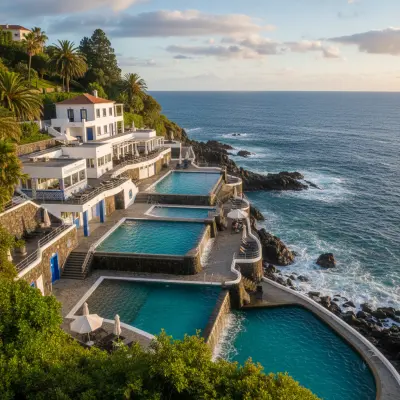
Before heading uphill, one detour is worth your time. The Complexo Balnear do Clube Naval de São Vicente is not a touristy palm-tree pool. It is a modest seafront complex tucked against the black rocks of Fajã da Areia, with a saltwater pool and direct sea access. In summer, this is where locals come instead of pretending to enjoy the south coast beaches. Bring a towel, sunglasses, and patience on August weekends.
Up to the poios: what they are and why they matter
The poios are Madeira's invisible masterpiece. Every cultivable square metre on this volcanic island was carved out of stone by hand, over centuries. In São Vicente, the terrace system runs from sea level up to nearly 800 metres of altitude. Drive the road toward Rosário, or the old back roads through Boaventura and Ponta Delgada, and you will see the geometric script of the terraces lining the slopes.
What grows on them? Vinha de americano and jaquet (the humble grape varieties that produce local table wine), sweet potato, yam, Portuguese cabbage, and in lower zones some of the noble vines that feed the proper Madeira wine producers. The levadas that water all this are a separate marvel, and if you want to start understanding that universe, our guide to Funchal's essential April levadas is a solid primer, even if it focuses on the Funchal area.
The road to Rosário
From the central roundabout in São Vicente, head up toward Igreja do Rosário (Sítio do Rosário). The road climbs fast in tight switchbacks. At around 400 metres, pull over wherever the shoulder allows. The views down the valley are the kind that justify renting a car even if you hate mountain driving.
Rosário itself is a tiny parish: a few village cafés, a white church, and the unmistakable sense that time moves more slowly here. It is the kind of place where, if you walk into a café and order a poncha, the man behind the counter will want to know where you are from, what you are doing here, and whether you have tried his version yet. Rosário poncha, made with sugarcane honey and local lemons, is the honest version of the cocktail that has been over-flavoured to death in Funchal. Five euros, full glass, careful: at altitude it goes to your head fast.
What to eat (and what to skip)
Let me be blunt. Food tourism in São Vicente clusters around half a dozen restaurants on the main street that serve passable espetada on bay-laurel skewers, industrial fried corn, and frozen bolo do caco. Not disasters, but not the reason you came here either.
What you want is a small casa de pasto, no English menu translation, where carne em vinha-d'alhos goes out on Sundays, wheat soup runs through the week, and the wine arrives in a jug. These places exist, change, open and close with the generations, and half the fun is finding them by talking to locals. Practical tip: ask at the café where you have your morning coffee where the construction crew eats lunch at half past noon. That tip never fails.
Dishes worth hunting for:
- Carne em vinha-d'alhos with bolo do caco on Sunday: garlic, wine, bay leaf, two-day marinade, fried in lard.
- Sopa de trigo, a winter wheat soup with courgette, pumpkin, beans and cabbage.
- Black scabbard fish fillet with banana and passionfruit. Yes, it sounds wrong. It works.
- Hand-cut bolo de mel, not the factory version.
- Nicolaus de funcho, fennel-laced Christmas biscuits, but some places make them year-round.
The arraial: when to come if you can pick
If you can choose your timing for São Vicente, choose August. Specifically, the weekend of Arraial dos Lameiros, the most authentic northern festa on the island. This is not a tourist-marketing festival, it is the party locals throw for themselves, and they welcome visitors who show up hungry and humble.
The arraial fills the Lameiros area with strung lights, brass bands, espetadas grilling on improvised open-air braziers, freshly fried milho frito (the difference between fresh and reheated is enormous), and poncha everywhere. Arrive in the afternoon, stay until the early hours, sleep in the car if you must, or book a guesthouse room six months ahead. By that weekend everything in the area is full.
Other dates worth marking
June in Madeira belongs largely to Funchal, with jazz, tuna celebrations, and the Festa da Sé. If you are on the island in June and want to pair the north coast with the south, our Funchal in June guide covers the calendar properly. In São Vicente, June is quieter, but it is an excellent walking month: long days, mild temperatures, less rain.
January gives you the wildest sea of the year. Watch the swells crash against the cobble beach at Fajã da Areia. Five minutes of that view is worth the drive, then duck into a café for poncha quente, hot poncha, a winter trick that hardly anyone outside the island knows about.
Pairing it with Santana
São Vicente and Santana sit 25 minutes apart by car, either via the slower scenic ER-101 or the faster VE2. If you are doing the north coast, pair them. Santana's traditional A-frame palheiros are the obvious icon, but there is much more to the municipality than the obligatory thatched-roof selfie. Our 24 hours in Santana guide lays out a full day done well.
Where to sleep
Skip big hotels. Those are concentrated in Funchal and around Porto Moniz. In São Vicente, the best beds are at rural quintas and restored village houses. Search for turismo de habitação or agroturismo in Rosário, Boaventura, and Ponta Delgada. Expect 70 to 120 euros a night in shoulder season, 100 to 180 in peak. Book early for August.
Some of these places still keep working poios: vines, old olive trees, and breakfast that includes house honey, the neighbour's goat cheese, and bread baked in a wood oven. It is the kind of stay that lodges in your memory long after any five-star resort in Câmara de Lobos has faded.
Final practical notes
- Fuel: fill up in Funchal or Santana before heading inland. There are few petrol stations in São Vicente, and they close early.
- GPS: trust but verify. Some roads marked as regular ways are in fact poio access lanes. If the road narrows below two metres wide, consider reversing.
- Clothing: layers. Always. A waterproof jacket is worth its weight even in summer.
- Walking: trail runners are fine for short walks. For longer levadas, proper boots and poles.
- Language: the local accent is heavy. Even continental Portuguese speakers sometimes have to ask for a repeat. Do it without embarrassment. It is part of the trip.
São Vicente is not a passport-stamp destination. There are no pyramids, no Gothic cathedrals, no three-Michelin-star tasting menus. What there is, is a parish where the landscape was hand-built over five hundred years, where you can eat well for little money if you know where to look, and where an afternoon driving between poios does more for the will to live than a week at a resort. Drive up the road. Stop wherever you feel like it. Drink the poncha. Come back later than you planned. That is how it is done.