Sacred Silence: The Modernist Architecture of Fátima's Lesser-Known Chapels
Beyond the crowds, Fátima hides an exceptional modernist heritage. From the raw concrete of the Hungarian Calvary to the glass lightness of the Chapel of the Apparitions, discover the aesthetic and minimalist side of Portugal's largest sanctuary.
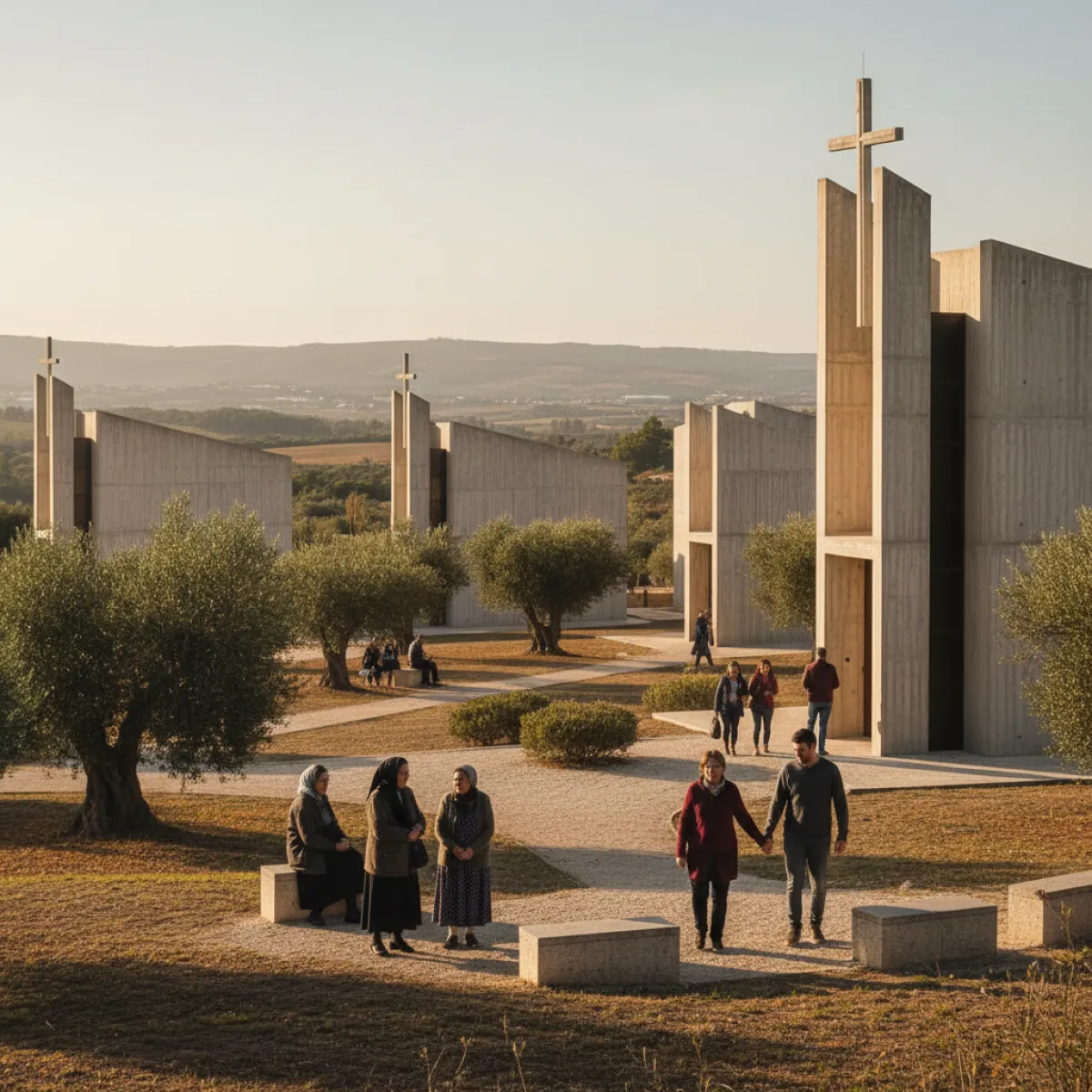
The Geometry of Faith in Cova da Iria
To the casual observer, Fátima appears as a phenomenon of mass gathering, a sea of candles and a plaza of monumental proportions that seems to defy human scale. However, for those who look beneath the surface of religious commerce and popular fervor, the city reveals itself as one of Portugal’s most fascinating repositories of 20th-century Modernist and Brutalist architecture. To step away from the central axis of the Basilica of Our Lady of the Rosary is to enter a realm of raw concrete, clean lines, and a management of light that transforms physical space into a metaphysical experience.
This less obvious Fátima doesn’t manifest in the neon signs of souvenir shops but in the silence of the small chapels and monuments that dot the pilgrim's path. It is an exercise in austerity that fits perfectly into a broader Portugal Itinerary: A Week in the Heart of the Country, where the transition from the limestone landscape of the Serra de Aire to human intervention is made with a stern elegance.
The Hungarian Calvary: Modernism as Refuge
Climbing the slope toward Valinhos, one finds what is perhaps the crown jewel of religious modernism in Portugal: the Hungarian Calvary. Designed by architect Ladislaus Marec and built between 1956 and 1964, this complex is a testament to post-war European history. Funded by Hungarian Catholic refugees following the Soviet invasion, the monument eschews Baroque sentimentalism in favor of rigorous geometry.
The Chapel of Saint Stephen, crowning the calvary, is a masterclass in how concrete can be used to create a sense of weightlessness. The interior is dominated by Robert Baumstark’s mosaics, which use a sober color palette to narrate the Christianization of Hungary. Here, light enters indirectly, washing the stone walls and creating an environment of introspection that rivals the solemnity found in Coimbra: The Grammar of Time in Portugal’s Intellectual Capital. While in Coimbra the stone tells the story of academia, in Fátima it narrates exile and hope through right angles and smooth surfaces.
The Way of the Cross and Landscape Integration
The path of the Way of the Cross leading to the calvary is not merely a devotional route; it is a lesson in land-art. The stations, designed by sculptor Maria Amélia Carvalheira, use local limestone to emerge from the earth organically. There is no opulence here. What we find is a conversation between the olive tree, the holm oak, and the dry-stone wall (the traditional "casulo"), an aesthetic that aligns with the geographic logic of The Measured Pace: A Seven-Day Passage from Lisbon to Porto via the Ria.
The Transparency of the Chapel of the Apparitions
It might seem contradictory to include the sanctuary's most visited site on this list, but the structure that today protects the Chapel of the Apparitions is a piece of contemporary architecture frequently ignored in its sophistication. The 1982 project by José Carlos Loureiro replaced the previous covering with a steel and glass structure that floats over the original site. The intention was clear: transparency and minimalism. Unlike the heavy naves of the old basilica, here the space is open to the elements, allowing the wind and the mountain light to participate in the liturgy. It is a lesson in how to intervene in a site of immense historical weight without suffocating it.
Concrete and Transcendence: The Holy Trinity Basilica
Though not a "lesser chapel" in size, the Holy Trinity Basilica, inaugurated in 2007 and designed by Greek architect Alexandros Tombazis, is the logical conclusion of modernism in Fátima. With its circular form and an impressive structural span, the building is a statement of engineering and aesthetics. The use of white concrete and the absence of superfluous ornament direct all focus toward the light and contemporary artworks, such as the gold panel by Marko Ivan Rupnik or the cross by Robert Schad.
Practicalities and Regional Flavors
To truly appreciate this side of Fátima, time is your most valuable resource. Avoid the dates of the major pilgrimages (May and October). The ideal time is November, when the morning mist envelops the concrete structures, lending them an almost cinematic aura.
- Where to Eat: The restaurant O Tia Alice is an institution that transcends the religious context. Order the Bacalhau com Natas (Cod with Cream) or the Duck Rice; the kitchen is as rigorous as the architecture you came to observe. Budget around €45 to €60 per person for a full meal with wine.
- Stay: Look for hotels that follow the city's aesthetic line, such as Luz Houses, which reinterprets traditional village architecture with a contemporary touch.
- Transport: The best way to arrive is by car, allowing you to explore the villages of Aljustrel and the trails of the Serra de Aire. Parking at the Sanctuary is ample and free, but prefer the peripheral lots to enter the rhythm of the place on foot.
A Verdict on Space
Fátima is often criticized for its peripheral aesthetics, but its architectural core is of admirable coherence. It is a place where modernism was not just a stylistic choice but a theological necessity to express the infinite through the finite. Walking between the Hungarian Calvary and the Holy Trinity, one realizes that the truly sacred often resides in the silence between forms.
