Renaissance Soul: A Detailed Guide to the Manueline Facades of Angra do Heroísmo
Discover the hidden symbolism and volcanic stonework mastery of Angra do Heroísmo’s Manueline facades, where the history of the Discoveries meets unique Azorean architecture.
The Geometry of Empire in the Mid-Atlantic
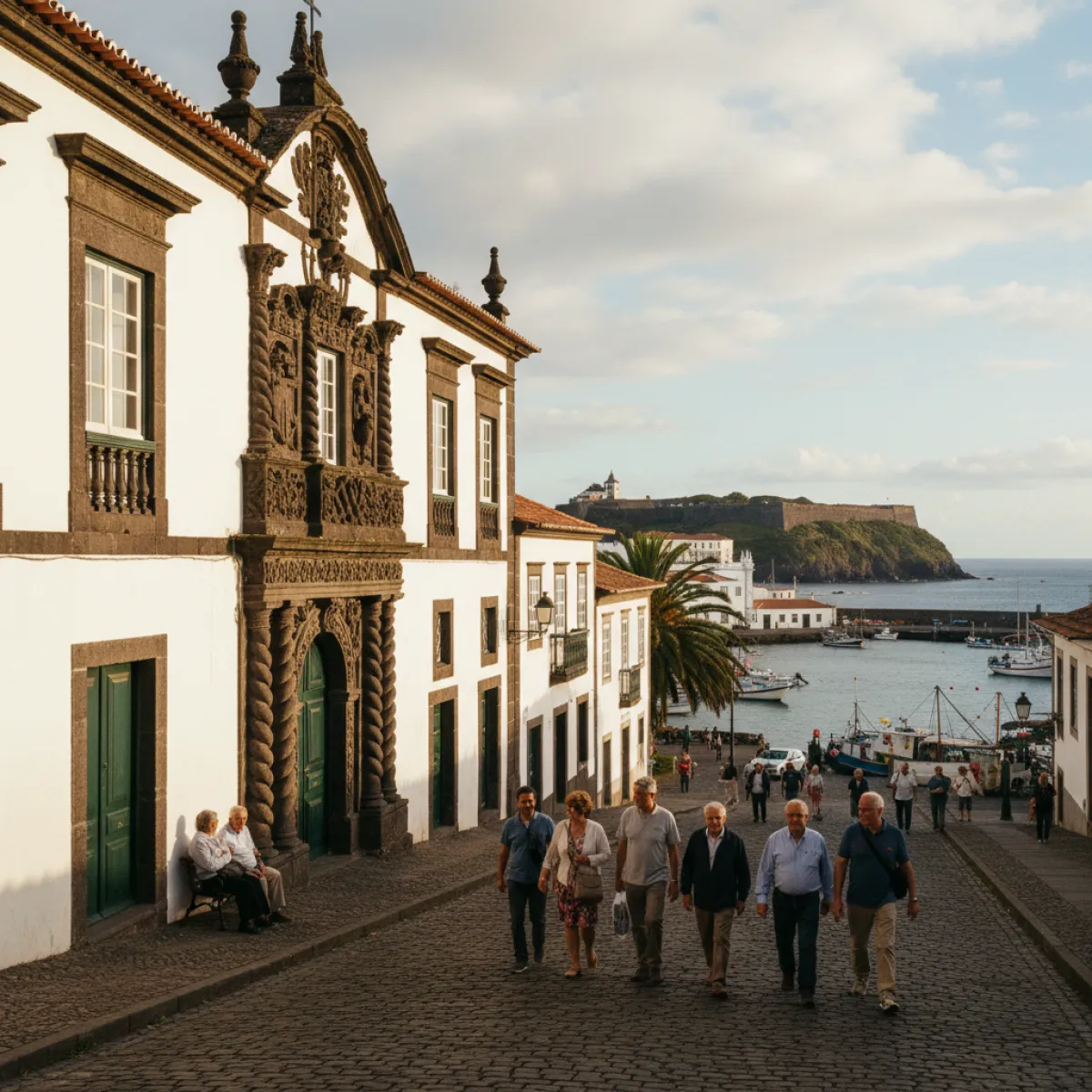
Angra do Heroísmo is not merely a city; it is a stone manifesto of Portuguese maritime ambition. Walking through its orthogonal streets, a rarity for the era in which it was laid out, one realizes that every corner holds a fragment of world history. But it is in the details of its Manueline facades that the soul of Terceira reveals its most complex form. The Manueline style, that exclusively Portuguese late Gothic, found in the island's black basalt and grey ignimbrite a rugged and imposing canvas, capable of withstanding centuries of salt air and the tectonic whims of the archipelago.
Observing these facades requires an eye attuned to symbolism. We are not looking at mere ornaments; every carved rope, every armillary sphere, and every Cross of Christ etched into a church portal or a manor house window narrates the epic of the Discoveries. In Angra, Manueline is not just an aesthetic; it is the testimony of an age when this bay was the mandatory stop for ships returning from the Indies and the Americas, laden with spices and gold. The city served as a harbor of refuge and an entrepôt, and this wealth manifested in the architecture that today, with full rigor, we attempt to decode.
The Church of São Sebastião: The Epicenter of Insular Manueline
If there is one place where Manueline reaches its peak on Terceira, it is the Church of São Sebastião. Located slightly away from the dense historical center, this 15th-century construction has survived with remarkable integrity. The main portal is a lesson in art history: its archivolts decorated with vegetable and maritime motifs transport us to a time when the sea was the center of European thought. However, it is in the side portal that we find the true delicacy of stone carving, where the small columns and naturalistic motifs seem to defy the hardness of the volcanic rock.
When visiting São Sebastião, it is recommended to do so during the early morning hours. The low Azorean sun highlights the textures of the sculptures, allowing one to appreciate the depth of the reliefs that, at other times of the day, might appear flat. It is an exercise in patience and observation. This temple is not just a religious monument; it is the starting point for understanding how the aesthetic of the mainland was adapted to the insular reality, where the scarcity of limestone forced master masons to master basalt with a skill that still surprises contemporary architects.
The Contrast Between Stone and Palate
The density of Angra’s architecture finds a direct parallel in its gastronomy. After a morning dedicated to the study of facades, understanding the local culture requires an immersion in the flavors that have sustained these people for centuries. Terceira’s alcatra is, perhaps, the ultimate expression of this cultural solidity. It is a dish slow-cooked in a clay pot, where the meat becomes so tender it almost falls apart, contrasting with the rigidity of the monuments we have just visited. For those who wish to go beyond passive tasting, participating in The Mastery of Alcatra: A Hands-on Traditional Cooking Class in Terceira allows one to understand the technique and time required to elevate a simple ingredient to the status of intangible heritage.
This dish, rich in spices, a direct legacy of the trade routes that Angra served, is the ideal fuel for continued urban exploration. The budget for a quality alcatra meal in a top-tier restaurant in Angra ranges from 25 to 35 euros per person, including a good wine from the Biscoitos region, whose vines grow in volcanic stone corals (currais), mirroring the city's architecture.
Windows to the World: Details on Rua da Sé
Back in the center, Rua da Sé and Rua Direita are open-air museums. Although the dominant architecture is Renaissance and Baroque, the result of the necessary reconstruction after the 1980 earthquake, Manueline vestiges remain in windows and thresholds that escape the less attentive tourist. Look for the decorated chamfers and the bases of the colonnettes. These micro-structures are the fingerprints of Angra's original builders.
The Cathedral (Sé), while predominantly Mannerist, holds within its interior and in certain exterior details the memory of older, previous structures. It is this architectural palimpsest that makes Angra fascinating. It is not a static city; it is a living organism that has incorporated styles upon styles while always maintaining its dignity. The scale of Angra is human, allowing these discoveries to be made on foot, with the time necessary for the eye to adjust to the alternation between the white of the lime and the dark grey of the stonework.
Nature as the Frame of Heritage
One cannot dissociate Angra’s architecture from its geographical context. The city was built based on its bay and the protection offered by Monte Brasil. This intimate relationship with the ocean and the volcanic land defines the experience of those who visit. For those seeking a contrast to the rigidity of the stone facades, the surrounding coastal areas offer a different perspective on island life. A foray for Birdwatching in Terceira: The Cabo da Praia Expedition with ComunicAir is a necessary counterpoint: here, the architecture is organic, shaped by erosion and wildlife, reminding us that Manueline is, in its essence, an attempt to mimic these natural forms in stone.
Cabo da Praia, located near Praia da Vitória, is one of the most important sites in Macaronesia for shorebird watching. It is an experience that requires binoculars and silence, offering a peace that complements the historical bustle of Angra's streets. The cost of these expeditions varies between 40 and 60 euros, depending on the duration and the specialization of the guide, and it is an investment that pays off through the depth of knowledge shared about the Azorean ecosystem.
The Regional Perspective: From Angra to the Horizon
Angra do Heroísmo is the focal point of a cultural triangle in the Atlantic, but its understanding is enhanced when compared with other port cities in the archipelago. Horta, on Faial, offers a distinct atmosphere, more cosmopolitan and focused on contemporary recreational sailing. If your itinerary allows, exploring 24 Hours in Horta: Cosmopolitan Soul in the Heart of the Atlantic reveals how the spirit of the Discoveries evolved into a culture of international yachting. While Angra is stone and history, Horta is color and movement, an essential dichotomy to capture the essence of the Azores.
This connection between islands is facilitated by regular SATA flights or ferries during the summer months. Budgeting for an inter-island trip requires a minimum of three weeks' notice to guarantee reasonable prices, which can range from 70 to 120 euros for a round-trip flight.
Practical Advice for the Architectural Traveler
- When to go: May, June, and September offer the best balance between photographic light and mild temperatures. Avoid the peak of August if you want to appreciate the monuments without the crowds of the Sanjoaninas festivals.
- Photography: Use wide-angle lenses to capture the grandeur of the churches, but don't forget a macro lens or a good zoom for the details of the Manueline portals.
- Clothing: Footwear must have good grip. Angra's pavements, while beautiful, can be slippery when damp, which happens frequently in the Azores.
- Logistics: Renting a car is essential for visiting São Sebastião and Cabo da Praia, but within Angra, a car is a hindrance. Park on the outskirts and walk.
In short, Angra do Heroísmo is not visited; it is studied. The Manueline facades are the paragraphs of a book written in volcanic stone awaiting attentive readers. It is a city that demands respect for its past and an intellectual curiosity that goes beyond the Instagrammable surface. As you walk these streets, remember that you are treading the ground that was, for centuries, the frontier of the known world, and that every detail carved into those facades was designed to impress those arriving from the sea, coming from far-off lands.
