Echoes of the Cross: Decoding the Manueline Symbolism in the Convent of Christ
Uncover the hidden secrets of the Convent of Christ in Tomar, from the mystical Templar Charola to the symbolic exuberance of the Chapter House Window. A deep guide to the monument that defines the Portuguese soul.
The Geometric Center of the Portuguese Soul
Tomar is not merely a city; it is a limestone palimpsest where Portugal’s history was written with the precision of knights and the exuberance of navigators. Perched atop a hill overlooking the Nabão River valley, the Convent of Christ stands as a complex that defies conventional chronology and aesthetics. For the traveler seeking to understand the Portuguese psyche, this is not just a monument to visit, but an enigma to be decoded. It serves as a spiritual anchor and an essential stop for anyone following a Portugal Itinerary: A Week in the Heart of the Country, grounding the journey before one ventures into the Ribatejo plains or the central mountains.
The Charola: The Mystical Circle
Stepping into the Charola, the 12th-century Templar rotunda, feels like exiting the temporal world. Modeled after the Church of the Holy Sepulchre in Jerusalem, this octagonal church is an assertion of faith and military might. The Knights Templar, the monk-warriors who established their headquarters here in 1160, designed this space so that knights could hear Mass while remaining on horseback. The verticality of the pillars, later adorned with Renaissance polychromy, creates an axis between the terrestrial and the divine that remains palpable.
The symbolism here is dense. The number eight, central to the structure, represents new beginnings and resurrection. Every detail, from the gilded wood carvings to the frescoes lining the walls, tells a story of transition. When the Order of the Temple was suppressed and replaced by the Order of Christ in Portugal, the building was not merely preserved; it became the aesthetic engine of the Age of Discovery. This evolution makes Tomar a mandatory waypoint for those exploring The Measured Pace: A Seven-Day Passage from Lisbon to Porto via the Ria, offering a monumental contrast to the riverine serenity found elsewhere.
The Chapter House Window: The Sea’s Cry in Stone
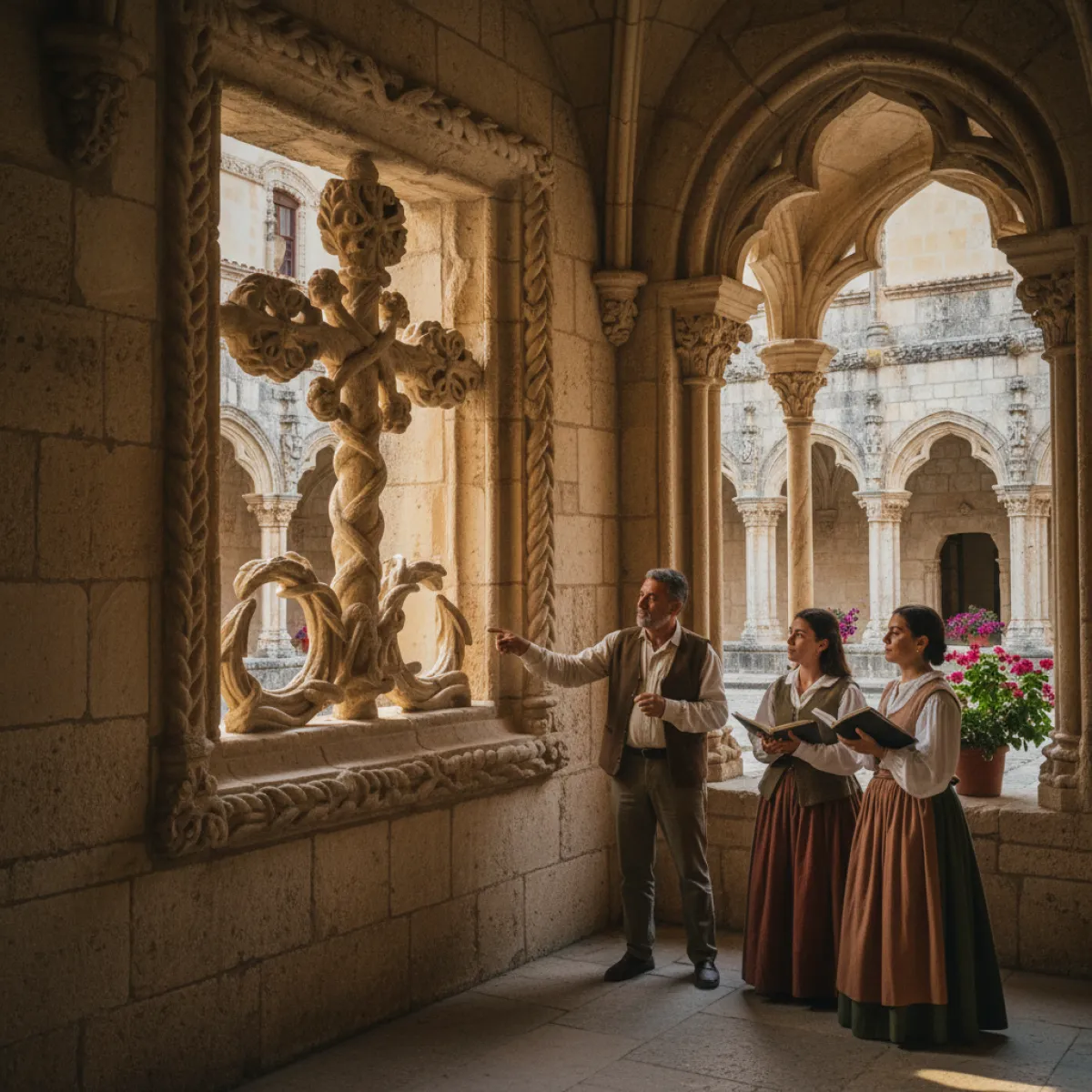
If the Charola is the spiritual heart, the Chapter House Window (Janela do Capítulo) is the political and artistic manifesto of King Manuel I. Here, the Manueline style reaches its zenith, transforming limestone into an organic narrative of ropes, algae, corals, and oak trunks. It is a piece that demands time. One must not just look; one must read the carved knots, symbolizing the unity and strength of a nation launching itself into the unknown.
At the base of the window, the figure of a bearded old man, often interpreted as the architect Diogo de Arruda or as a representation of knowledge itself, supports the weight of the structure. Above, the Cross of the Order of Christ and the Armillary Sphere, personal symbols of King Manuel, assert his vision of a universal empire under the sign of the cross. The window is a visual poem about expansion, nautical science, and divine providence. It serves as the perfect architectural counterpoint to the intellectual austerity found further north, detailed in Coimbra: The Grammar of Time in Portugal’s Intellectual Capital.
Architecture of Power: The Eight Cloisters
The Convent of Christ is a labyrinth of eight cloisters, each reflecting the needs and tastes of different eras. The Main Cloister (or King João III Cloister) is a masterpiece of the European Renaissance, its classical lines and perfect proportions contrasting sharply with the Manueline exuberance of the adjacent nave. It is a space of silence and light, where the play of shadows on the Ionic columns creates an atmosphere of intellectual contemplation.
Walking through the cloisters of Santa Bárbara, the Hospedaria, or the Corvos is to walk through the backstage of monastic and administrative life for an order that financed the caravels. It is here that one understands the convent was a city within a city, a center of logistics, spirituality, and study.
The Tomar Notebook
Logistics and Timing
Avoid weekends if you seek an introspective experience. The convent opens at 09:00, and it is during this first hour, when the morning light hits the Chapter House Window, that the symbolism truly seems to breathe. Allocate at least three hours for the complex and do not overlook the Mata dos Sete Montes, the former enclosed garden of the Templars, ideal for a contemplative walk after your visit.
Local Flavors
Do not leave Tomar without trying Fatias de Tomar. This conventual sweet, made solely from egg yolks and sugar, cooked in a water bath in a specialized pan, is a testament to local patience and tradition. For a substantial meal, seek out Casa das Ratas or Taberna Antiqua. The regional specialty is roasted kid (cabrito) or lamprey (in season), paired with Ribatejo wines that offer a robust yet elegant structure.
Budget and Access
Entry to the Convent of Christ costs €10 (base price in 2026), though combined tickets are available for those also visiting the monuments of Alcobaça and Batalha. Tomar is easily accessible by train from Lisbon (a journey of about two hours), making it a viable day trip, though the city deserves an overnight stay to truly feel the slow rhythm of the Nabão at dusk.
In decoding the Convent of Christ, the traveler discovers that Manueline was not just an architectural fashion, but an attempt to capture the infinite in stone. It is the echo of an age when Portugal believed the sea was not a boundary, but a bridge.
