Caldas da Rainha: The Irreverent Logic of Bordallo Pinheiro’s Ceramic City
Explore Caldas da Rainha, the city where thermal tradition meets the satirical genius of Bordallo Pinheiro. A deep dive into the Fruit Market, irreverent ceramics, and design that defies convention.
The Scent of Sulfur and the Aesthetics of Satire
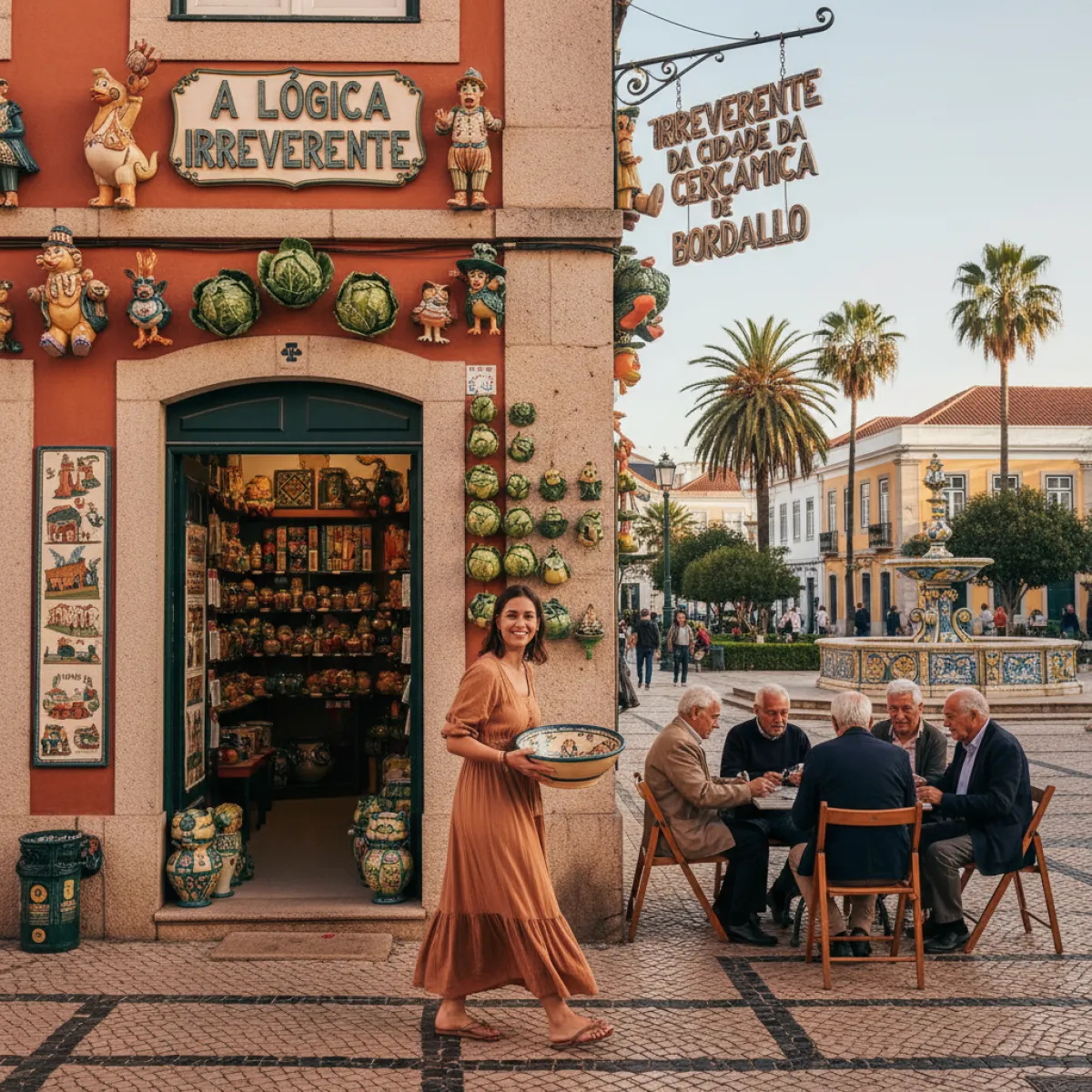
Caldas da Rainha does not ask for permission to exist. Unlike the manicured elegance of Cascais or the academic weight found in Coimbra: The Grammar of Time in Portugal’s Intellectual Capital, Caldas emerges as a necessary anomaly on the Portuguese map. It is a city built upon sulfuric thermal waters and the satirical genius of a man who decided that ceramics should be, above all, a form of social critique. To speak of Caldas is to speak of Rafael Bordallo Pinheiro, the artist who transformed clay into a political weapon and the humble cabbage leaf into a design icon that, decades later, still graces the most sophisticated tables from Paris to New York.
The city was born from a gesture of mercy by Queen D. Leonor, who in 1484, upon seeing the poor bathing in foul-smelling but curative waters, ordered the construction of a thermal hospital. It remains the oldest in the world in continuous operation. But if the foundation is royal and pious, the city’s spirit is profoundly republican and irreverent. Caldas da Rainha is perhaps the only place in Portugal where high culture and bawdy humor coexist without friction. It is here that one finds the famous phallic ceramics, a clay joke that became the country's most unlikely souvenir, just meters away from museums housing some of the most complex 19th-century earthenware pieces.
The Fruit Market: An Open-Air Gallery
One cannot understand Caldas without waking up early and heading to Praça da República, locally known as the Praça da Fruta (Fruit Market). While many tourist destinations have sanitized their markets for mass consumption, Caldas maintains Portugal’s only daily open-air market that refuses to become a caricature of itself. Under colorful umbrellas, regional farmers from the Oeste (West) bring the earth's bounty: Alcobaça apples, juicy Rocha pears, and, of course, the cabbages that inspired Bordallo. It is an exercise in pure chromatism.
For the visitor seeking substance, this market is the city’s barometer. The budget here is modest: 10 euros buys a week’s worth of fruit and a bag of Cavacas das Caldas, the local pastry made of flour, eggs, and a sugar glaze that challenges dental integrity but is mandatory. Seek them out at Pastelaria Machado, where tradition hasn't been diluted by modern haste. The Praça da Fruta is the heart of a system that fits naturally into a Portugal Itinerary: A Week in the Heart of the Country, offering a sensory and authentic pause between the stone monuments of neighboring towns.
Bordallo Pinheiro: Where Clay Becomes a Verb
The Fábrica de Faianças das Caldas da Rainha, founded in 1884, remains the creative epicenter. Visiting the factory shop and the adjacent museum is to enter the mind of a genius who was simultaneously a naturalist and a caricaturist. Bordallo Pinheiro did not merely copy nature; he exaggerated it to reveal human truths. Zé Povinho, his most famous creation, a bearded man in a hat performing the 'manguito' (a defiant 'take that' gesture), is the avatar of the Portuguese people's resistance against elite incompetence. It is a figure that, curiously, maintains a disconcerting relevance in contemporary Portugal.
Walking through the city also means following the Rota Bordaliana. Giant ceramic pieces have been installed at various strategic points: snarling cats, monkeys hanging from facades, and swallows that seem to watch the passersby. This urban intervention takes ceramics off the collector's shelf and returns them to the street, where they always belonged. The entry fee for the Ceramic Museum is negligible (about 3 euros), but the intellectual value of the collection, spanning from the Romantic period to modernist experiments, is incalculable.
Architecture and the D. Carlos I Park
If the Fruit Market is the body and Bordallo’s factory is the soul, the Parque D. Carlos I is the lungs of Caldas. This romantic garden, designed at the end of the 19th century, surrounds the old Thermal Hospital and the José Malhoa Museum. It is a rare example of urban planning that prioritizes contemplative leisure. The museum, dedicated to the master of Portuguese naturalism, holds the work "The Screamers" (Os Gritadores), a canvas that captures the essence of light and rural life in the region with a rawness that anticipates modernism.
The city's architecture is a catalog of Art Nouveau and bourgeois eclecticism. Tile-clad facades, many produced locally, serve not just to protect against Atlantic humidity; they are statements of status and taste. Observe the window details and the ironwork on the balconies along Rua das Montras. It is this balance between the glorious thermal past and the vitality of local commerce that defines the city's pace, a theme we also explore in The Measured Pace: A Seven-Day Passage from Lisbon to Porto via the Ria, where Caldas serves as an essential anchor in the West.
Practical Guide: Dining and Staying
For lunch, avoid the tourist menus and seek out Restaurante Solar dos Amigos in the nearby hamlet of Guisado. It is an institution. Portions are gargantuan, one serving of cod or meat easily feeds three people, and the environment, decorated with hundreds of rural artifacts, is the epitome of Portuguese hospitality. Book in advance, especially on weekends. Within Caldas, the restaurant Tacho is the right choice for those seeking a modern reinterpretation of market products, with an exquisite focus on fresh fish from the Óbidos Lagoon.
- When to go: Year-round, but the autumn light in the Fruit Market is unbeatable for photography.
- What to buy: A piece of Bordallo Pinheiro ceramics (the swallows are classic, but pieces from the 'Terrina' collection are true works of art) and, of course, the local sponge cake (pão de ló).
- Transportation: One hour from Lisbon by car via the A8. The bus (Rede Expressos) is efficient and drops you right in the center.
The Future is Clay
Today, Caldas does not live solely on nostalgia. The School of Arts and Design (ESAD.CR) has brought a new wave of creatives who are using traditional techniques to create new visual paradigms. Workshops like that of Vítor Reis or contemporary collaborations by the Bordallo factory with artists like Joana Vasconcelos or Paula Rego ensure that the city remains a living laboratory. Caldas da Rainha is not an open-air museum; it is a workshop that never closes, a place where mud is transformed into thought and irony is the official language. To visit Caldas is to accept that beauty can be strange, that satire is a form of affection, and that, at the end of the day, there is nothing more serious than knowing how to laugh at ourselves through clay.
