Albufeira on Foot: Trails Ranked by Difficulty and View
Five Albufeira trails, from the easy three-viewpoint loop downtown to the 18 km Salgados slog. With real bus numbers, prices, 80-cent espresso stops, and the honest opinions that save time on a one-week visit.
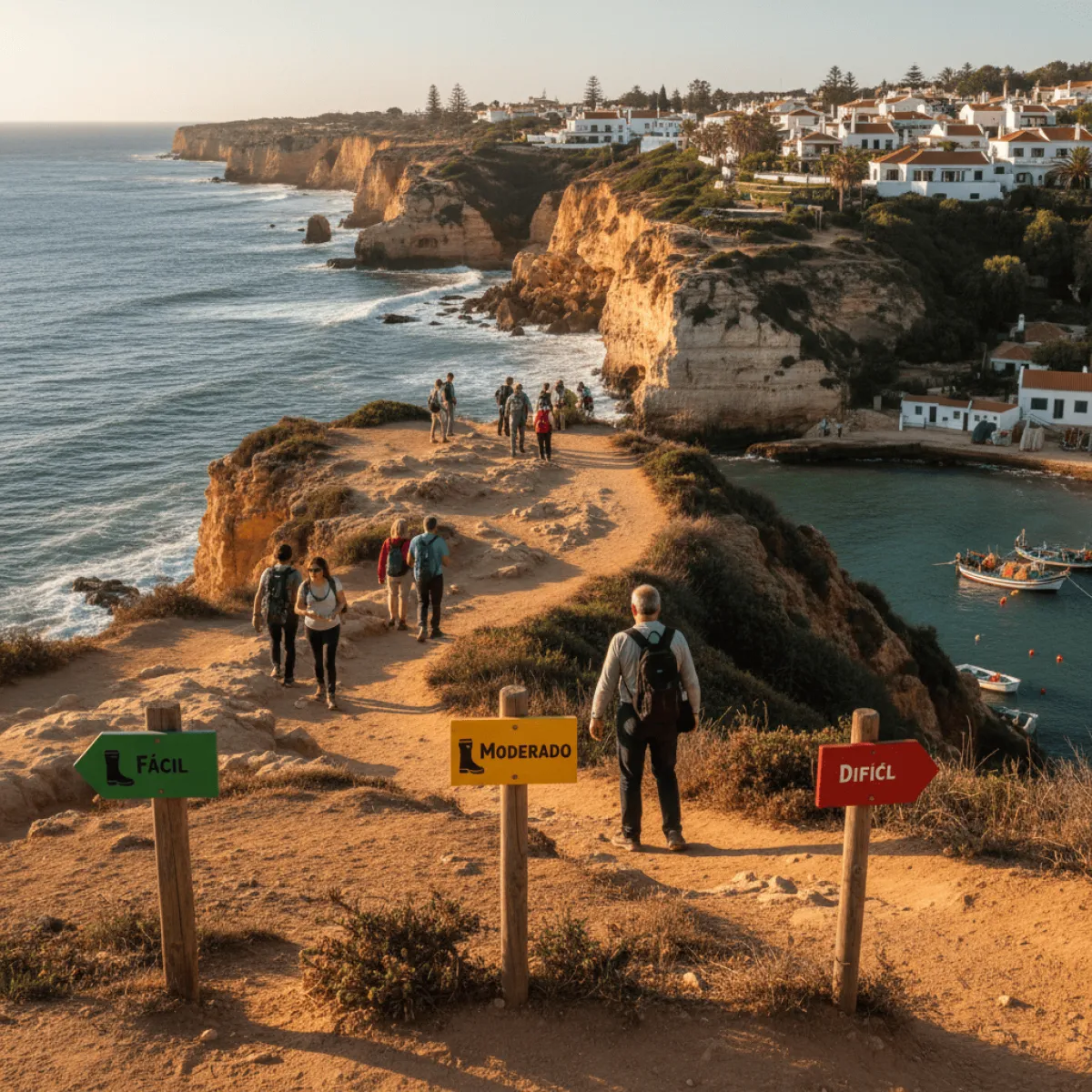
There's a version of Albufeira that exists in the minds of people who've never been here: karaoke bars on the Oura strip, all-inclusive wristbands, sangria at nine in the morning. It exists, yes. But it starts to fade the moment you step off the asphalt and point your boots toward the cliff trails. From October to April, and at dawn from May to September, there are kilometres of goat tracks that serve up better views than any paid rooftop sunset. This is my personal list, easiest to hardest, with the opinions that save time for anyone visiting for a week who wants to actually walk.
Before we start: carry real water (1.5 L per person in summer, even on short trails), wear closed shoes with grip (limestone steps get slick when damp), and slap on factor 50. The trails are free and almost none have ticket booths or set hours. The real risk isn't getting lost: it's the cliff erosion. Stay away from the edges and ignore those Instagram photos of people sitting on overhangs. People have fallen. Seriously.
Level 1 (Very Easy): The Old Town Viewpoints
Start with the obvious, because it's genuinely good and almost no one does it with method. Instead of bar-hopping along Rua Cândido dos Reis, do a one-hour loop linking the three downtown viewpoints, all paved, all accessible, all with benches to sit and watch the sea.
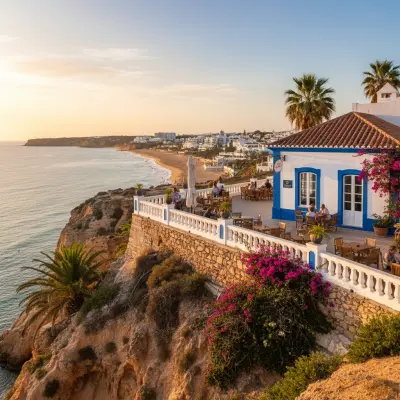
Begin at Miradouro do Pau da Bandeira, the classic Albufeira postcard. Go in the late afternoon, around 6:30pm in summer, and you'll see why 20th-century painters camped here: the golden light hits the Peneco cliff and turns the ochre into orange. A five-minute walk gets you to Miradouro Rossio, smaller, with Portuguese pavement mosaics and a view that hugs the Fishermen's Beach. Finish at Miradouro da Rua Latino Coelho, tucked between white houses, perfect for a crowd-free photo.
Total distance: about 1.2 km. Elevation gain: negligible. When to go: late afternoon. Cost: nothing. Who'll enjoy it: families with grandparents, couples who didn't pack boots, anyone wanting to warm up their legs for the serious trail tomorrow.
Level 2 (Easy): Praia do Peneco to Praia dos Alemães
This is the trail international guides most underrate. You exit the Praia do Peneco tunnel, climb the wooden staircase, and follow the compacted-sand boardwalk that snakes through the Oura cliffs. Two hours of slow walking gets you to Praia dos Alemães and back. The first 800 metres have railings, then it's packed-earth track with sections exposed to the wind.
What makes this special isn't the distance (about 5.5 km round trip), it's the rapid succession of scenery: pine groves, red cliffs, hidden coves, and two or three farmsteads with fig trees that survived the property boom. Stop at Praia do Inatel for a coffee at the kiosk (around 1.50 €, opens about 9am off-season) and push on. Avoid Sundays: packed.
Honest tip: if you've packed swimwear, Praia da Oura Leste, midway along, is where locals swim when tourists are on the main Oura beach. Coarser sand, bigger surf, but zero thumping music.
Level 3 (Moderate): Olhos de Água to Falésia, along the coast
This is where serious Albufeira hiking begins, the stuff that justifies blocking out days to walk. Catch Vibus bus 56 from the Guia roundabout (around 2.75 €, hourly off-season, check locally) to Olhos de Água. Start walking east toward Praia da Falésia along the wooden staircases that climb and dip between umbrella-pine dunes and red cliffs that look like a miniature Grand Canyon.
It's about 6 km one way, with constant elevation changes and stretches where the boardwalk has collapsed and been replaced by parallel earth paths. Plan three hours with photo stops. Pines provide near-continuous shade, which makes this trail doable even in July if you leave at 7am.
Midway, it's worth descending to Praia da Falésia on the Alfamar staircase for a swim. Sand is fine and pale, water turns green when sun hits it. Climb back up the same stairs (sorry, no honest shortcuts) and keep going to the lighthouse. On the way back, the bus also passes Falésia, sparing you the full 12 km on foot.
Where to refuel: no restaurants on the cliffs, bring sandwiches. But in Aldeia das Açoteias, about 400 metres off the trail, bakeries sell carrot muffins for 1.20 € that do the trick.
Level 4 (Moderate-Hard): Seven Hanging Valleys (from the eastern end)
Technically, the famous Seven Hanging Valleys Trail starts in Carvoeiro, not Albufeira. But for anyone staying in Albufeira, my strong advice is this: ignore the section that begins at Praia da Marinha (always packed, top of every TripAdvisor list) and start from the opposite end at Praia do Vale Centeanes. You'll be near-alone for the first hour.
Albufeira to Carvoeiro is about 25 minutes by car, or a roughly 30 € taxi. There's also the Vamus 28 bus, but it takes over an hour and the timetable is not walker-friendly. Linear trail of 5.7 km, plan three hours, with constant up-and-down. The Praia da Marinha view is what everyone photographs, but the best moment, for me, is Algar Seco seen from above: limestone carved by the sea looks like a sunken cathedral that pushed back up.
Reward at the end: O Castelo restaurant in Carvoeiro serves a fair-priced fish cataplana (around 22 € for two, check locally) and has a terrace overlooking the beach. If the wait is brutal, walk across to Boneca Bar, simpler, but the grilled octopus is good.
For anyone walking with older kids and wanting a full day of discovery, after the trail I'd push inland. I've actually written about this in our honest family guide to Silves, which pairs perfectly with this side of the Algarve: Carvoeiro in the morning, Silves in the afternoon.
Level 5 (Hard): Salgados, Pêra and the Salgados Lagoon
This is the trail that separates casual walkers from serious ones. Not because of technical difficulty (the surface is mostly flat) but because of total distance: 18 km round trip between Praia dos Salgados and Praia Grande de Pêra, with little shade and zero services along the way. Tourists have gotten heatstroke here in August. Don't attempt this between May and September unless you start before 7am.
The payoff? The Salgados Lagoon is the best birdwatching spot on the Algarve coast. Rise early, bring cheap binoculars (a 25 € pair from Decathlon does the job), and you'll see flamingos at 50 metres, herons, and in February even spoonbills. Walk the wooden boardwalk on the eastern side of the lagoon, then continue along the beach to Armação de Pêra. Brunch in the Armação town centre is worth it: old pastry shops where a galão costs 1.40 € and a chouriço roll runs 2.50 €.
I'll admit I do this trail twice every winter just to reset my head. No postcards. Just horizon.
When to swap your boots for wheels
If you've walked three days straight and your shins are begging for mercy, switch to an electric bike. The Bikesul e-bike tour covers in three hours what would take two days on foot: old town, cliffs, and three beaches. A good fix for anyone in Albufeira for just 48 hours who wants to see a lot without suffering.
What to eat after walking
I'll be blunt: most restaurants in the old town with menus in seven languages should be avoided. Step off the main drag. Look for the tasca with a formica table, menu in Portuguese only, owner in the kitchen. Eat sardines in summer (June to September are the good ones), pickled mackerel, fried cuttlefish, and in winter cataplana or xerém with cockles. Drink the house white, refuse the bottled offer, and you'll spend 15 € a head.
If you want to take these dishes home in your hands rather than your stomach, I recommend the Portuguese cooking class at MIMO Algarve. You'll learn cataplana and seafood açorda using market produce, and dinner is sorted. It's the best rainy-day plan in the Algarve, and runs three to four hours.
To stretch the radius: two day trips that pair well with Albufeira
If you're staying more than a week, do a day in Faro and another in Lagos. Faro for the local culture angle, markets, churches, the Ria Formosa lagoon; Lagos for the architecture and the less obvious neighbourhoods. I've covered both in detail in our Faro local culture guide and our Lagos neighbourhoods guide. Both are under an hour by car from central Albufeira.
The unvarnished conclusion
Albufeira deserves more than its reputation. Anyone who steps outside the Oura quadrilateral and onto the cliffs, even on the short three-viewpoint loop, finds a town that still has fishermen mending nets at 6am and cafés where espresso costs 80 cents. The trails are the fastest shortcut to that Albufeira. Put your boots on, get up early, and bring home better stories than a plastic wristband.