Albufeira Beaches: How to Escape the Crowds
Albufeira has dozens of beaches, and most tourists only know two of them. An honest guide to when to arrive, where to park, and how to have Praia dos Arrifes almost to yourself, even in mid-August.
Albufeira in August is exactly what everyone says it is: loud, sweaty, full of British stag parties staggering down Rua da Oura at three in the morning. If your idea of a holiday includes jugs of fluorescent sangria and DJs shouting the name of Birmingham, there are better articles to read. For the rest of you, here is an inconvenient truth: the chaos isn't Albufeira's fault. The fault belongs to anyone who looks at two kilometres of sand on either side of Praia dos Pescadores and assumes that's all there is.
The truth is that Albufeira has dozens of beaches. Some are ten minutes by car from the centre, hidden behind brick-coloured cliffs, and in July can have thirty people scattered across three hundred metres of sand. Not a secret, not a hidden discovery, nothing mythical. Just geography, plus the fact that most tourists don't walk more than 800 metres from their hotel. This guide is for those willing to walk.
The nine-in-the-morning rule (and why nobody follows it)
I'll spare you the theory. There is exactly one honest rule for escaping crowds in Albufeira in summer: have your towel on the sand by nine-thirty. Even Praia da Falésia, with its six-kilometre stretch that in August looks like a public square, is perfectly civilised at eight. The tour buses arrive around eleven. The resort guests at half past eleven. Arrive at ten, and you'll still find free parking and a front-row spot.
Locals know this. While you're finishing your hotel breakfast, they're already heading home for lunch. Flip the schedule and everything changes. Wake early, beach until twelve, lunch slowly, take a nap, return around five in the afternoon when the light goes amber and the tide starts pulling back. The British are by then on their first Aperol. You have the beach again.
Praia da Falésia: big, yes, but pick the right end
Praia da Falésia is the only enormous beach in the municipality, which makes it the best option when an east wind pushes everyone to the sheltered side. The classic mistake is entering at Olhos de Água or Pine Cliffs, where everyone else is. Drive instead to the Falésia access at Açoteias, the eastern tip. It costs three euros to park in August, there's a decent beach restaurant for lunch, and then walk a thousand metres east along the sand. The crowd evaporates.
The other secret is that low tide transforms Falésia. When the water pulls back, a wide strip of firm sand opens up, perfect for running, cycling, or simply walking two hours with your feet in the water all the way to Vilamoura without seeing anyone but fishermen. Check the tide tables before you go. It's the best free advice in this article.
The small ones: Praia do Castelo, Praia da Coelha, Praia dos Arrifes
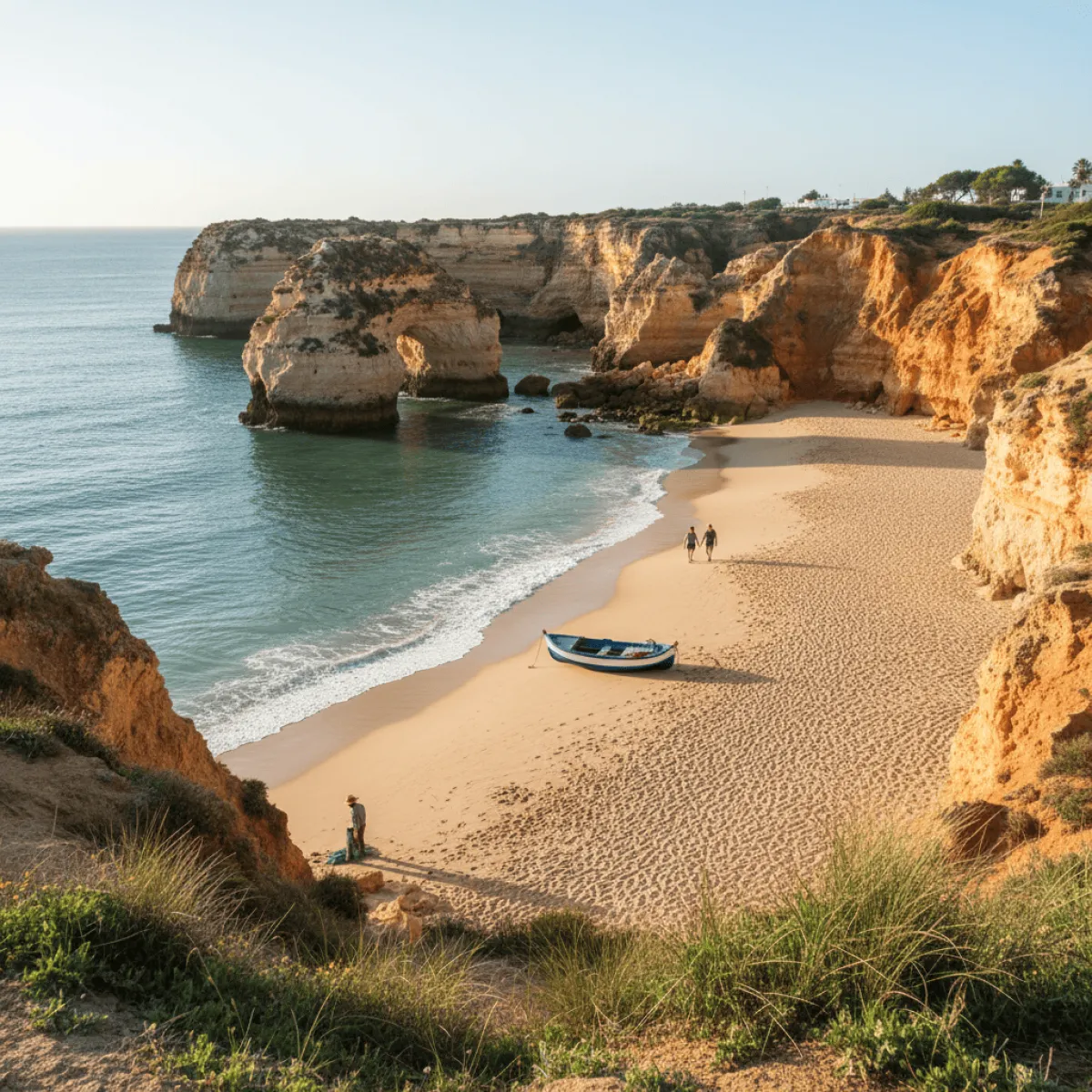
Leaving central Albufeira heading west, there's a sequence of small beaches, separated by cliffs, that receive a fraction of the visitors. There's nothing spiritual about them. They're just small, with limited parking, which keeps the buses away. Praia do Castelo has a steep staircase, golden sand, and two rock formations that look like shark fins. Praia da Coelha, next door, has more natural shade in the morning. Praia dos Arrifes, slightly further west, is my favourite: three coves separated by stone arches, transparent water, and a simple beach bar where the bifana sandwich costs what a bifana sandwich should cost.
Practical tip: park in Sesmarias, in the large lot at the entrance to the Vila Sésamo area, and walk down. It's five minutes. Trying to drive to the end of the dirt road is a bad idea in July and August.
Praia de São Rafael: the postcard, but get there early
Praia de São Rafael is the beach that appears in every photograph of Albufeira: rock arches, turquoise water, ochre cliffs. Which is precisely why you should never go between eleven and four. Arrive at eight-thirty. Have breakfast at the beach bar (the galão is honest, the buttered toast too). Leave at noon. Come back another day.
If Praia de São Rafael is impossible, Praia do Castelo (further west, near Galé, not the one mentioned above) and Praia da Galé Oeste offer the same kind of scenery with half the visitors. Galé Oeste is particularly generous with sand: kilometres and kilometres without anyone bothering you.
The tide secret: Praia do Peneco and Praia dos Pescadores
Here's a counterintuitive observation. Albufeira's two central beaches, Praia do Peneco and Praia dos Pescadores, are dismissed as touristy and best avoided. In August at noon, fair enough. But in May, June, September, and October, in the afternoon, at low tide, they offer one of the best experiences in town. Low tide exposes a strip of sand so wide that the crowds visually disappear. You can watch the fishermen working, hear seagulls instead of beach club music, and at sunset climb the cliffs to see everything from above.
Speaking of viewpoints, do yourselves a favour: after the beach, climb up to the Miradouro do Pau da Bandeira at the end of the afternoon. There's a covered staircase connecting Praia dos Pescadores to the top of the cliff, and the view across the bay with the colourful fishing boats more than earns the climb. For a different angle, the Miradouro Rossio offers the best framing of the historic centre, and the Miradouro Rua Latino Coelho has shaded benches. Bring a water bottle. Don't bring a plastic cup.
Getting there: the car problem
Let me be blunt: renting a car is the only decent solution for exploring Albufeira's beaches. Local buses exist but are slow and crowded. Ubers are expensive in high season. Cycling is a serious option, but the cliffs between beaches are punishing, and noon temperatures in July turn any climb into penance.
For those who want to combine mobility with views, I recommend the e-bike tour through cliffs and beaches with Bikesul. Electric motor turns brutal climbs into something civilised, and the guide knows shortcuts that even longtime residents don't. It's a good way to scout the territory on your first or second day, before deciding which beaches to return to.
When to come: the honest calendar
No mystery here. July and August are unbearable on any beach near the centre. June and September are nearly perfect: water above twenty degrees, reduced crowds, lower prices. May and October are excellent for coastal walks and beach lunches, though the water is fresh. From November to April, Albufeira empties out, many restaurants close, and the town carries an interesting melancholy. Could be a good moment to know it, if you're not coming purely to swim.
Eating between beaches
The big gastronomic mistake in Albufeira is to lunch at the restaurant closest to whichever beach you've been on. Beach prices, menus translated into seven languages, photos of the dishes: all warning signs. The rule is simple. Lunch lightly at a beach bar (mista sandwich, salad, fruit) and dine outside the tourist zone. There are decent taverns in Olhos de Água, in Ferreiras, in Paderne. Look for where work vans park at midday.
For anyone who wants to go deep into Algarve cooking (and go home knowing how to make a decent cataplana), the cooking class at MIMO Algarve, in the historic centre, is one of the best ways to spend a morning or afternoon off the beach. Not cheap, but you leave with real recipes, get a full meal out of it, and save yourself the expensive hotel dinner.
Families: what changes
With small children, the rules invert. Praia da Falésia in the late afternoon is hard for little ones because of the extension and the wind. The small beaches, with cliffs sheltering from wind and reduced swell, work much better. Praia da Coelha, Praia dos Arrifes, and particularly Praia da Galé Leste (with calmer waters) are my picks for families.
If you want a full day off the beach with kids, consider a trip to Silves, twenty minutes inland. The castle, the municipal market, and the river make for a balanced day, and temperatures are more civilised than by the sea. Our honest family guide to Silves has all the detail, including where to lunch without hearing the words "kids menu".
For those who want more than beach
There's a typical problem with people who stay in Albufeira: spending a whole week without ever seeing the rest of the Algarve. A mistake. Faro, forty minutes east, is a real city with real life, and deserves at least one day. Our guide to local culture in Faro points toward where to lunch and which traditions still function outside tourist season. Lagos, an hour west, is equally different, with more spectacular cliffs and a historic centre that still breathes. To understand the city neighborhood by neighborhood, see our Lagos neighborhood guide.
The summary, for those who only read the end
- Arrive at the beach before nine-thirty, or after five in the afternoon.
- For zero crowds: Praia dos Arrifes, Praia da Coelha, Galé Oeste.
- For the postcard without the chaos: Praia de São Rafael at sunrise.
- For the far-from-everything feeling: eastern tip of Praia da Falésia, at low tide.
- Rent a car or an electric bike. Buses won't do it.
- Avoid July and August if you can. June and September are the good window.
- Don't lunch at the first restaurant after the beach.
Albufeira isn't the problem. The problem is doing Albufeira like everyone else. Do it differently, and the town gives back an Algarve that still exists, underneath the noise.