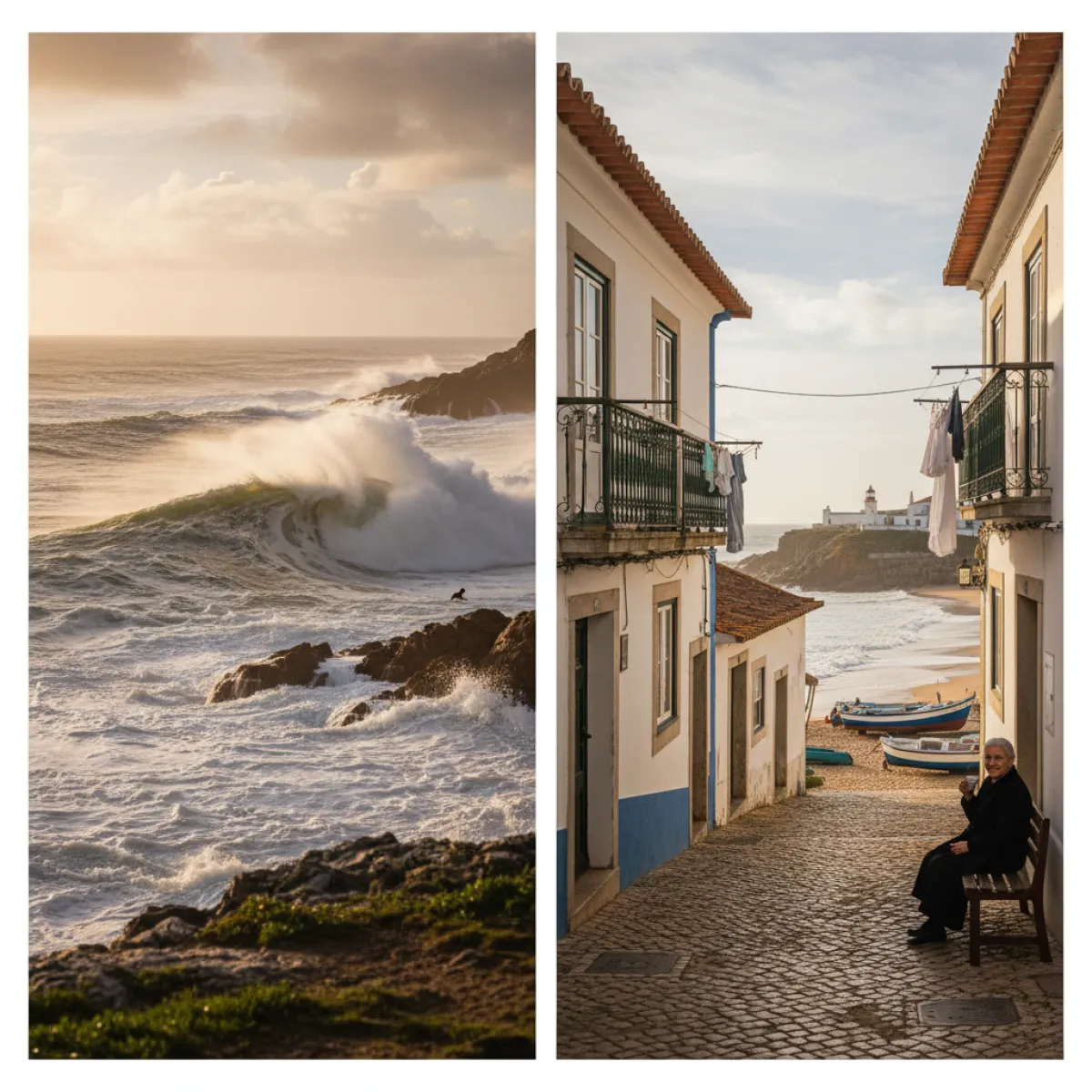
Nazaré: From Giant Waves to the Coast's Quiet Refuges
Forget the tourist menus and the crowded sands. To find the real Nazaré, you must climb to the Sítio via the old path and learn to read the rhythm of the women drying fish in the sun at low tide.
The Paradoxical Magnetism of Nazaré's Sands
At nine in the morning on Avenida da República, the air doesn't just smell of the sea; it smells of an aggressive mix of cheap sunscreen, bus exhaust, and the unmistakable scent of horse mackerel drying in the sun. Nazaré is perhaps Portugal's most honest village. It doesn't try to be elegant like Cascais or intellectual like Porto. It’s a place that lives on its knees before the Atlantic, whether praying for fish or fleeing a thirty-meter wall of water. For the casual visitor, Nazaré is a blur of colorful tents and ice cream that melts too fast. But if you know where to look, and more importantly, where to walk, the village reveals a logic of survival that is inherently fascinating.
Most tourists make the strategic error of planting themselves on the main Nazaré Beach, directly in front of the tourist-menu restaurants featuring faded photos of seafood rice. It’s an understandable mistake, but fatal for anyone seeking what remains of maritime dignity. The sand there is contested centimeter by centimeter. If you really want to understand the rhythm of this place without being trampled by a tour group, you have to get up early. At 7:30 AM, the only sound on Rua Adrião Batalha is the delivery vans unloading crates of Sagres beer and the rhythmic slap of brooms against stone steps. It is in this hour, before the first wave of buses arrives from Lisbon, that Nazaré belongs to the locals.
The Sítio Strategy: Looking Down from Above
To escape the crowd, go up. The Nazaré funicular, connecting the beach to the Sítio, costs about 4 euros round-trip, but the line at 11:00 AM is a test of human patience. If you have the legs for it, walk up the Ladeira do Sítio. It’s a fifteen-minute climb that pays off with a view that opens over the bay like a geological amphitheater. At the top, at the Miradouro do Suberco, the scale of the place becomes obvious. Here you realize that Nazaré isn't just a seaside resort; it's the edge of an underwater abyss known as the Nazaré Canyon. This fault in the continental shelf is why the waves here aren't just waves; they are hydraulic monsters.
In the Sítio, avoid the main square if you’re looking for silence. Walk toward the Lighthouse (Farol). Along the way, ignore the stalls selling caramelized almonds and focus on the Fort of São Miguel Arcanjo. Entry costs 2 euros and offers the best front-row seat to the spectacle of Praia do Norte. While the main beach to the south is packed with families and 'bolas de Berlim', Praia do Norte is the domain of the wild. Even in summer, when the waves are small by big-wave surfer standards, the current is treacherous and the sand is vast and empty. It’s the perfect place for a walk where the only noise is the constant roar of the north wind.
Fish, Salt, and Survival
Nazaré's gastronomy is an exercise in raw simplicity. If a restaurant has a tout at the door trying to convince you to enter, keep moving. Look for the tascas in the streets perpendicular to the beach, such as Rua do Elevador or Rua Adrião Batalha. The Caldeirada à Nazarena isn't a luxury dish; it’s what the fishermen made with what they couldn't sell. It consists of potatoes, onions, tomatoes, peppers, and a variety of fish the sea decided to deliver that day—ray, dogfish, conger eel. A fair price for a portion for two is around 30 to 40 euros. If they ask for much more, you’re paying for the view, not the fish.
One detail you cannot ignore is the 'secas' (fish drying racks). On the sand, you’ll see wooden frames with nets where horse mackerel, octopus, and rays stretch in the sun. It’s a thousand-year-old preservation technique that has survived the refrigerator. You can buy a bag of dried horse mackerel for about 5 euros. It’s an acquired taste—salty, fibrous, and with a deep ocean tang—but it is Nazaré distilled into a snack. For those who want to deepen this connection with local roots, it's worth seeking out Nazaré's Seven Skirts Tradition with Alma Nazaré Tours, which provides context for these practices without the tourist marketing veneer.
Escapes and Extended Itineraries
Nazaré works well as an anchor point for exploring Central Portugal, a region many rush through on the highway. If you are following a more structured plan, like the Portugal Itinerary: A Week in the Heart of the Country, you will realize that the distance between the beach chaos and the silence of the Alcobaça or Batalha monasteries is only a twenty-minute drive. This contrast makes the region interesting: in the morning you are fighting the wind at Praia do Norte, in the afternoon you are under the Gothic vaults of one of Christendom's greatest temples.
For those who prefer a more contemplative journey, the guide The Measured Pace: A Seven-Day Passage from Lisbon to Porto via the Ria offers an alternative that avoids the most obvious tourist traps, placing Nazaré in the perspective of a passage between the light of the Tagus and the power of the Douro. The village takes on another dimension when seen as part of a geographical whole rather than just an isolated sun-and-sea destination.
How to Avoid the Crowds: A Practical Guide
- Timing: Get to the beach by 8:30 AM. By 11:30 AM, when both temperature and noise levels rise, retreat for an early lunch or head up to the Sítio.
- Transport: Parking in Nazaré in August is impossible. If you’re coming from outside, use the parking lot at the entrance of the village and walk ten minutes. Better yet, take the Rede Expressos from Lisbon (Sete Rios); the trip takes 1h50 and costs about 12 euros.
- The Secret Beach: If Praia da Nazaré and Praia do Norte are too crowded for your taste, grab the car and drive ten minutes south to Praia de São Gião. There are no lifeguards and no bars, but there are kilometers of dunes and silence.
- The Market: The Nazaré Municipal Market on Avenida Vieira Guimarães is the place to buy real fruit and see the women of Nazaré negotiating the day's catch. It's loud, smells of the sea, and is absolutely authentic. It opens at 7:00 AM and by noon almost everything is gone.
At the end of the day, when the sun sets behind the promontory and the light turns the cliffs the color of bone, Nazaré calms down. The buses leave, the terrace menus are pulled in, and the village returns to the fishermen and those who had the patience to wait for the crowd to dissipate. It is in that hour, with a cold 'imperial' beer in hand and the sound of waves hitting the sea wall, that Nazaré justifies itself. It’s not an easy place, but easy places are rarely worth it.