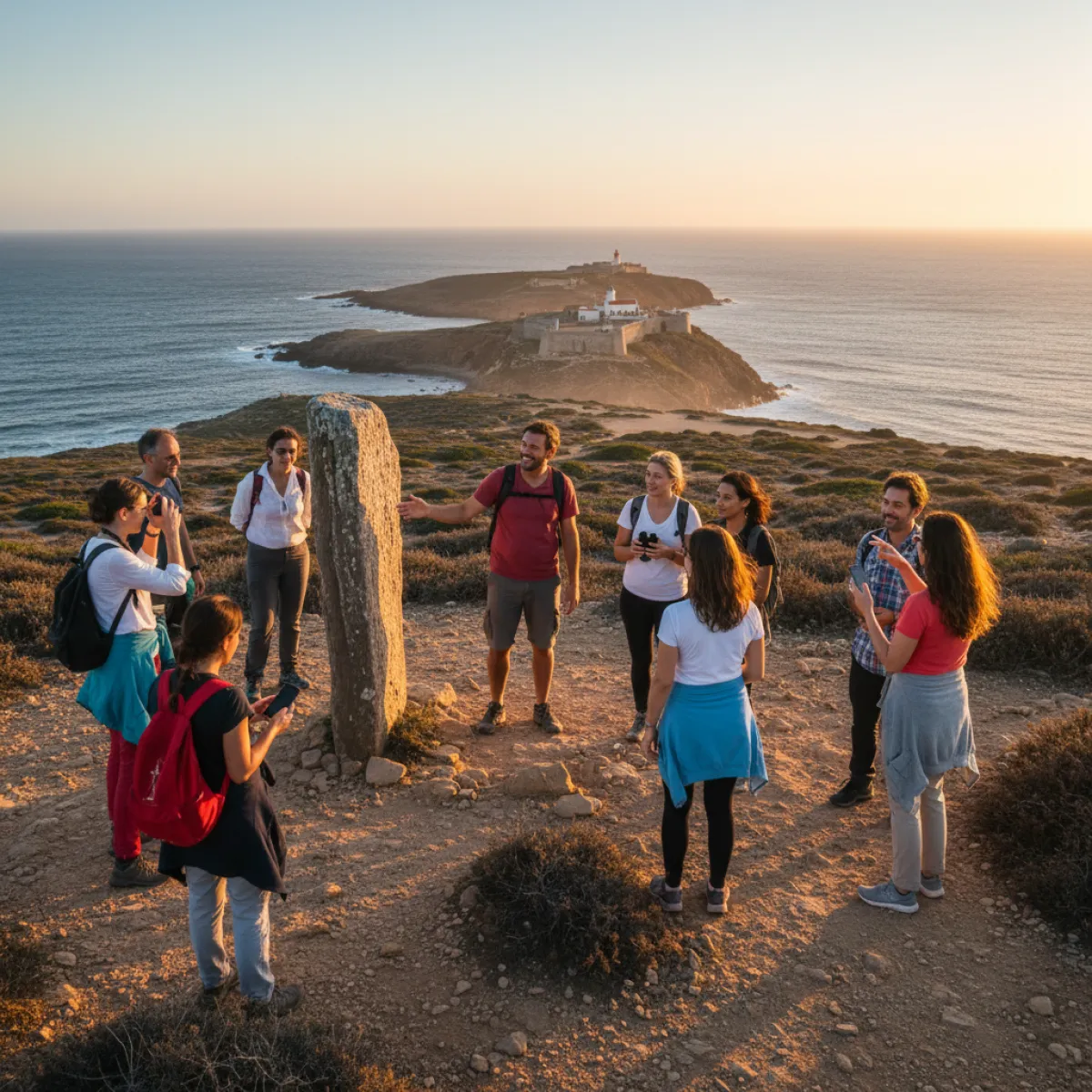
Walking Sagres: Megaliths and Fortress with a Local Guide
Walkin'Sagres guided walks take you through the Fortress, old pirate bays, and Neolithic megalithic sites most visitors never discover. Led by local guide Ana Carla Cabrita, they last around 3 hours and cover historical context from the Phoenician presence to Prince Henry the Navigator.
There is a significant difference between visiting Sagres Fortress on your own, reading the information panels and following the audio guide, and walking the same ground with someone who was born there and knows every stone by name. Ana Carla Cabrita founded Walkin'Sagres over 15 years ago, and her guided walks are probably the best way to understand the deep history of this corner of Europe.
What Walkin'Sagres Is
This is not a generic tour operator. Ana Carla is a Sagres native with training in flora, fauna, and environmental science. She built the company with a clear mission: to show the Southwest Alentejo and Vicentine Coast Natural Park to people who genuinely want to understand it. Walks are personalised, usually for small or private groups, which means the pace and content adjust to participants' interests.
Walks last around 3 hours and cover between 2 and 5 kilometres, depending on the route. The company holds Nature Tourism Permit No. 126/09 with mandatory insurance, so everything is above board.
The Routes with Archaeological Interest
Walkin'Sagres offers several itineraries, but two are particularly relevant for history and archaeology enthusiasts.
The Fortress and Sagres Harbour Circuit
This route takes you through the Sagres Fortress, the harbour, and the old pirate bays. The difference compared to a self-guided visit is context. Ana Carla does not just repeat that Prince Henry the Navigator founded his navigation school here. She places the site in a much longer timeline: the Phoenician presence, Roman remains, Islamic occupation, and then the Henrician transformation of the 15th century. The Rosa dos Ventos, that enormous 43-metre disc on the fortress floor, takes on a different dimension when someone explains the competing theories about its true function and age.
Fortress entry costs €3 per adult (€1.60 for children), which is not included in the walk price. It is worth it. Inside, the 1.5 km clifftop trail passes the Church of Nossa Senhora da Graça, built in 1579, and the cistern tower.
Night Excursions to Megalithic Sites
This is the lesser-known route and, in my view, the most compelling. The area around Sagres and Vila do Bispo is dotted with menhirs and Neolithic remains that most visitors have no idea exist. Walkin'Sagres organises night excursions to these sites, adding an atmospheric layer impossible to replicate during the day. Walking among megaliths with the sound of the Atlantic in the background and the Algarve sky free of light pollution is an experience that stays with you.
If you are in Sagres during spring, pair this walk with a visit to the Jardim de Sagres, where local vegetation is at its peak. Ana Carla, incidentally, is excellent at identifying the endemic flora you encounter along the way.
Practical Details
Price
Based on recent references, the price is around €35 per person. However, since walks are personalised, the cost may vary depending on group size and itinerary. Confirm directly with the provider.
What to Bring
- Comfortable walking shoes (coastal trails can have uneven sections)
- Sunscreen and a hat, even in cooler months
- Water (Ana Carla usually brings lemongrass tea and local pastries, but come prepared)
- For night excursions: warm clothing and a torch (the wind in Sagres at night is no joke)
When to Go
Spring, from mid-March to late May, is the best time. The wildflowers in Sagres during April are spectacular, and temperatures are perfect for walking. Summer works but the heat can be intense, particularly at midday. For the megalithic night walks, new moon nights are ideal for the best sky-watching conditions.
If you want to dive deeper into the botanical angle, our guide to spring botany in Sagres makes a good companion read.
How to Get There
Sagres is about 1 hour from Faro and 30 minutes from Lagos via the N125 and then the N268. There is no reliable public transport to the walk locations, so a car is essential. The meeting point is arranged directly with Ana Carla, usually in the centre of Sagres.
Contact and Booking
- Email: info@walkinsagres.com
- Phone: (+351) 925 545 515
- Website: walkinsagres.com
- Facebook: facebook.com/walkinsagres
Ana Carla replies quickly to emails. I recommend booking at least a week in advance, especially in spring and summer.
What Makes This Different
Sagres receives thousands of visitors who go to the fortress, take a photograph of the Rosa dos Ventos, and drive on to Cape St Vincent. There is nothing wrong with that, but it is like reading only the title of a book. A guided walk with Walkin'Sagres gives you every chapter: the geology of the cliffs, the reason certain plants exist only here, the history of shipwrecks, the purpose of the menhirs, the lives of the fishermen. It is Sagres for real, not the postcard version.
The best moment? It depends on the route. On the fortress walk, it is the point where you grasp the scale of the Rosa dos Ventos from ground level, not from an aerial photograph. On the night excursions, it is arriving at the first menhir, when the guide switches off the torch and leaves you alone with a stone that has been standing there for five thousand years.