Miróbriga at Sunset in Santiago do Cacém: Visitor Guide
There is no commercial sunset tour at Miróbriga, but from October to February the 5:30 PM closing time lines up almost exactly with sunset over the forum. Tickets are 3€ direct from Património Cultural.
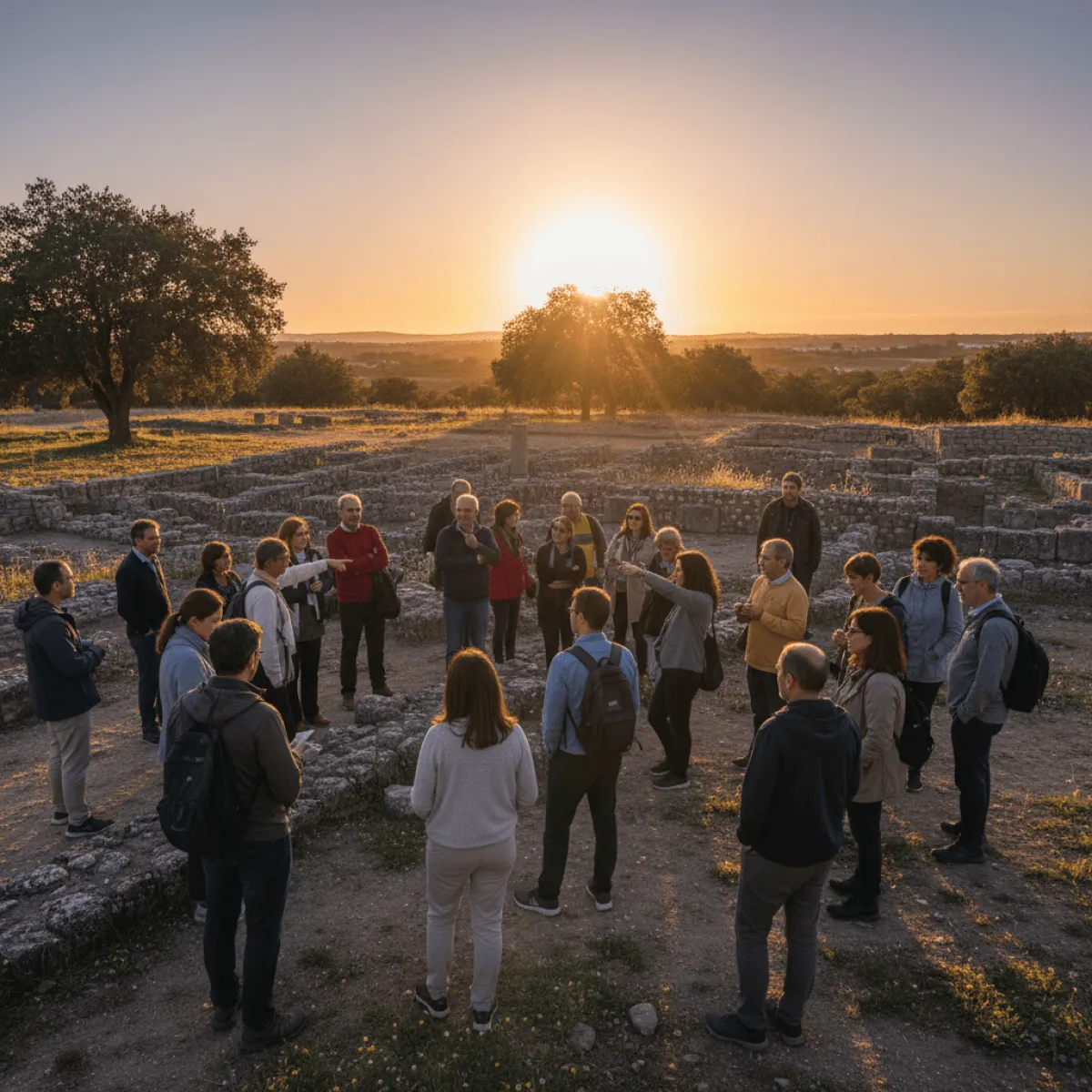
Let me get something out of the way first: as of this writing, there is no commercial operator running ticketed sunset tours of the Miróbriga Roman ruins. The site is run by Património Cultural, I.P. (the Portuguese state heritage body) and closes at 5:30 PM Tuesday through Sunday. The catch, and the reason this is worth your time, is that from mid October to February that 5:30 PM closing lines up almost exactly with sunset on the Alentejo coast. The honest version of this experience is a self guided visit in the final hour before closing, with the light dropping over the columns of the forum.
What Miróbriga actually is
Miróbriga is a Roman city built on top of an Iron Age settlement, sitting on Cerro do Castelo about 1 km northeast of Santiago do Cacém's town centre. You get a forum, a temple to the imperial cult, two bath complexes (one luxurious, one modest), houses with traces of wall paintings, Roman paving, a bridge, and, on a separate plot to the south, the foundations of a hippodrome, the only one known in Portugal. It is not Conímbriga in scale, but it is far more intimate and you will often have the place essentially to yourself.
The real provider and how to book
The operator is the Portuguese state, through Património Cultural, I.P. Tickets are 3€ (1,50€ for seniors 65+, students, Cartão Jovem; free for under 12s with an adult). Buy online at bilheteira.patrimoniocultural.gov.pt or at the Visitor Centre. No refunds. Last entry is 30 minutes before closing, so 5:00 PM (4:30 PM on Sundays). Direct contacts: mirobriga@patrimoniocultural.gov.pt and +351 269 818 460. Always confirm hours the same day, particularly on holidays.
What about a guide?
There are no scheduled guided tours sold as a product. The site does accept group bookings with your own guide and occasionally runs themed visits and educational sessions, announced on the official page and on the Sítio Arqueológico de Miróbriga Facebook page. For a certified private guide in English or Portuguese, contact the Santiago do Cacém tourism office or general Alentejo operators (Eco Tours Portugal and Visit Évora both cover the region on private circuits). Confirm directly with the provider before paying.
The visit, step by step
You enter through the Visitor Centre at Herdade dos Chãos Salgados. Spend the first ten minutes with the scale model and interpretation panels, especially if you have not read about the site: the buildings outside will then make sense on a different level.
- Forum and imperial cult temple: first stop up the path. The remaining columns are aligned to the west, which means that half an hour before sunset the light cuts across at a low angle and throws long shadows over the ground. This is where you slow down.
- Baths: walk the large complex first, with marble fragments and mosaic traces, then the smaller bath. Look for the hypocausts, the underfloor heating system. They are well preserved and rarely crowded.
- Houses, taberna and paved road: descending, you pass through the residential zone and over original Roman paving. Walking on the same stones people walked two thousand years ago is less of a cliché than it sounds.
- Bridge and hippodrome: the hippodrome sits about 600 m south, off the main loop. Most visitors skip it and that is a mistake. The foundations still read clearly on the ground and the walk back at dusk gives you a clean view over the plain.
The best part (and what to skip)
The best part, no contest, is the forum 20 minutes before closing in November or December. The light goes brick coloured, the school groups have long gone, and the crows that roost in the trees around the site start their evening racket. Put your phone away for five minutes and stand still. It is rare.
You can skip a long stop at the scale model if you already know what a Roman city looks like: spend the time outside instead. And do not try to see everything. Miróbriga rewards three or four slow stops more than twenty quick ones.
Practical tips
- When to go: October to February for the closing time sunset effect; April to June for long light and wildflowers across the site. August midday is too hot, go early morning instead.
- What to wear: closed shoes or trainers with grip, the ground is uneven and there is loose stone. An extra layer for the late afternoon even in warm months. The wind on the hill bites.
- What to bring: water, hat and sunscreen in summer. Year round, small binoculars help if you care about architectural detail, especially for reading the hippodrome from the main path.
- Accessibility: uneven terrain with gentle slopes but ancient paving; a wheelchair can reach the Visitor Centre and part of the route, but not the whole site.
- How long: 90 to 120 minutes is the sweet spot. More than that is for archaeologists.
Getting there and where to sleep
By car, Santiago do Cacém is 1h30 from Lisbon via A2 and A26. The site is signposted from the roundabout near the hypermarket on the south exit of the town. Free parking at the Visitor Centre. Without a car: train to Grândola, then Rede Expressos coach to Santiago do Cacém. From the town centre to Miróbriga is a 25 minute walk or a 5 minute taxi.
To stay over and stretch the end of the day out, I like Casas da Moagem - Turismo Rural, just outside the town, the kind of quiet that suits coming back from Miróbriga. For more around the area, see our day trips worth the detour guide, or, if you are watching the budget, Santiago do Cacém on a budget. Combine the afternoon at the ruins with a morning at the quiet local beaches nearby. And if the forum sunset leaves you wanting to stay out, there is decent music in town: see Santiago do Cacém after dark.
Is it worth it?
Yes, with one condition: calibrate your expectations. This is not a themed archaeology park, there are no costumed reenactors, no sound and light show. It is a near empty site, maintained with restraint, where the work is yours to do. In exchange you get a Roman forum with a fire coloured sky above it and nobody taking selfies in your shot. For me, that pays the 3€ twenty times over.