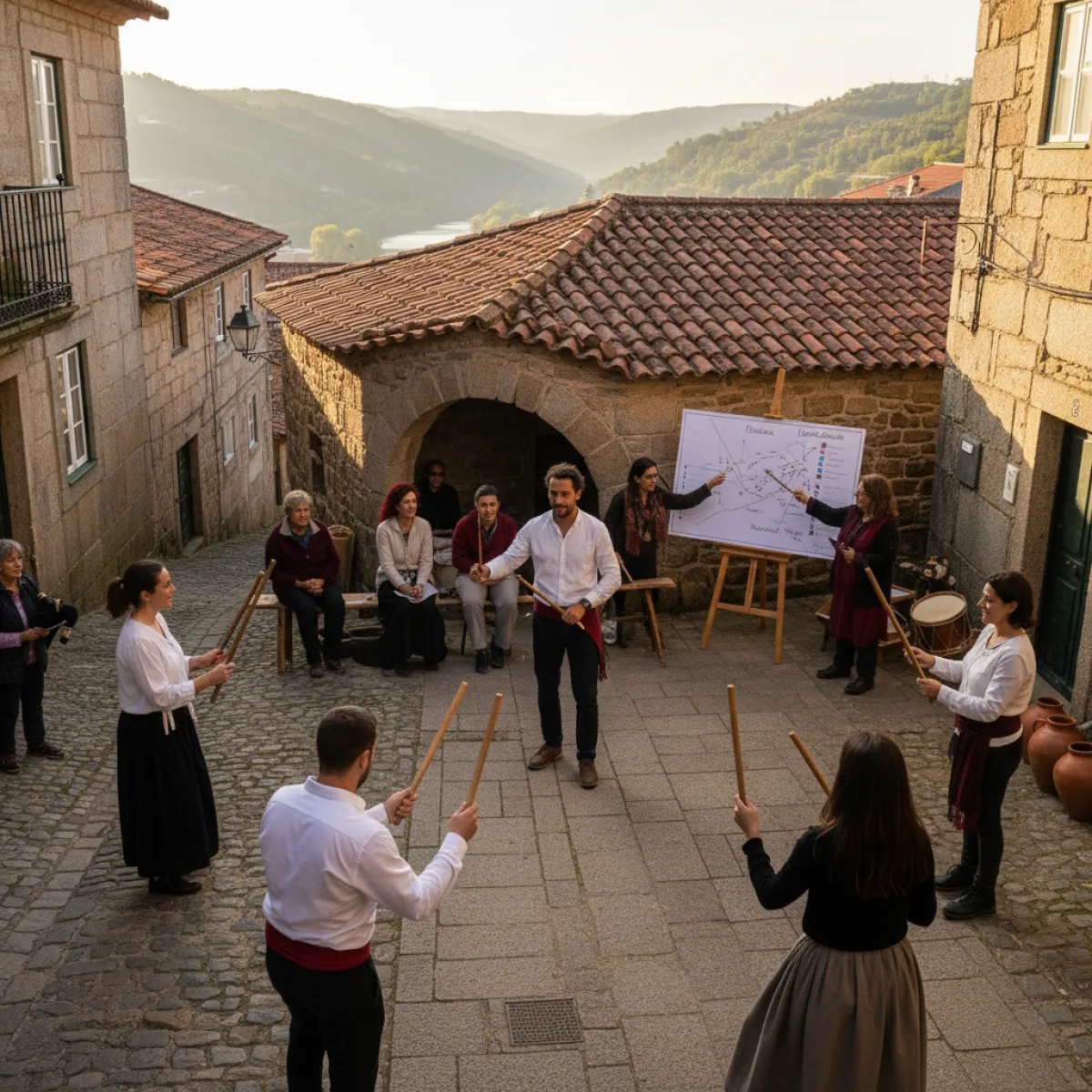
Mirandese Language and Pauliteiros Dance Workshop in Miranda do Douro
A hands-on dive into border culture with the Galandum Galundaina association. Between bagpipe tunes and stick-clashing, you'll discover that Mirandese is very much alive on the plateau.
The Mirandese Plateau: Where Culture Beats in the Pulse
Reaching Miranda do Douro requires a certain level of persistence. The journey across the Trás-os-Montes plateau, with its landscape stretching out in shades of brown and ochre, prepares your spirit for something different. This isn't just the end of the line in Portugal; it’s the beginning of a territory with an identity so potent you feel it the moment you park your car near the Cathedral. Here, culture isn't kept in glass cases; it’s alive, spoken, and danced. And the best way to understand it isn't through a tourist brochure, but by getting your hands dirty, or, in this case, tiring your arms, in a workshop on the Mirandese language and the Pauliteiros stick dance.
The operator that makes this possible is the Galandum Galundaina Cultural Association. If you’ve never heard of them, they are the ones responsible for dusting off traditional Mirandese music and bringing it to world stages without stripping away its character. They manage the L'Arribada cultural space and organize these hands-on sessions that put you at the center of the border's cultural whirlwind. As we previously explored in our guide on The Language of the Border: A Deep Dive into Mirandese Identity and the Pauliteiros Dance, these traditions are what define this region.
First Step: "Buonos Dies" and the Language of Resistance
The workshop usually begins with the word. Mirandese is the second official language of Portugal, but don't be mistaken: it's not an accent or a dialect of Portuguese. It has rules, grammar, and a sound that harkens back to medieval Astur-Leonese. During the first hour of the session, we sit down with one of the Galandum Galundaina instructors, often people who grew up hearing this language at home, to learn the basics.
The challenge starts immediately with the pronunciation of the "lh." Forget the sound of the Portuguese word "filho." In Mirandese, the "lh" at the beginning of words (like in lhéngua or lhuna) has a different, more frontal vibration. It’s a physical exercise for both the tongue and the ears. The instructor explains how the language survived isolated between the cliffs of the Douro and the high plateau, serving as a secret code for a population that always lived with its back to Lisbon and its face to the border. Learning to say "Como te bais?" (How are you?) or "Obrigado" (Obrigado or Gracyas depending on context) is the first step toward gaining the respect of the locals. When you leave the workshop and walk into a café on Rua da Costanilha, you'll see the older residents look at you differently if you venture one of these expressions.
Hands on the Sticks: The Rhythm of the Pauliteiros
After the theory comes the sweat. The second part of the workshop is dedicated to the Pauliteiros Dance. If you think it's just a folk dance of men in skirts hitting sticks together, you are sorely mistaken. It is a choreography of warfare, precision, and, above all, rhythm. The instructors hand us two oak sticks (the "paulitos"), heavy and dry, and explain the foundation: the rhythm of the Mirandese bagpipe (gaita de foles).
Learning the "lhaços" (the choreographies) requires coordination. We start with simple leg movements and gradually introduce the clashing of the sticks. The sound of the oak impact is dry and loud. There is a raw energy in this moment. It’s not meant to be graceful; it’s meant to be firm. The instructor guides us through the fundamental steps, explaining that each lhaço has a name and a story, often linked to agricultural tasks or historical episodes. The bagpipe, accompanied by the bass drum and snare, dictates the speed. When the group hits the rhythm and eight pairs of sticks clash in unison, the feeling of collective strength is impressive. It’s the highlight of the workshop, where you realize this dance isn’t just a show; it’s a ritual of belonging.
Insider Tips for the Experience
My recommendation is to try and book this workshop for late afternoon, when the sun starts to dip over the Douro Cliffs. The light becomes warmer, and the acoustics of the cultural space take on another dimension. Another important detail: wear comfortable shoes, preferably sneakers with good grip. You will be jumping, spinning, and you'll want your feet firmly planted on the ground. Don't worry if you miss a step, the patience of the Galandum Galundaina instructors is legendary, and the goal here is the experience, not technical perfection.
As for the best time to book, the Spring months (April to June) and early Autumn (September and October) are ideal. The heat on the Mirandese plateau can be merciless in July and August, making the physical part of the workshop quite taxing. However, if your visit coincides with the Sendim Interceltic Festival or the "L Burro i l Gueiteiro" traveling festival, you’ll have the chance to experience these workshops in a festive context with more people and excitement.
Where to Eat and What to Skip
After two hours of Mirandese and Pauliteiros, you will be hungry. Forget the diet. You are in the land of the Posta Mirandesa (steak). I recommend the restaurant O Mirandês or Taberna da Costanilha. Order the steak thick, grilled with coarse salt, and pair it with local wine. What should you skip? Those pre-packaged tourist menus that promise a "Pauliteiros show" with dinner included in soulless venues. Go to the source, go to the association, and live the workshop genuinely.
This workshop costs about 15€ per person in organized group sessions, though the price may vary for private sessions. It is mandatory to contact Galandum Galundaina in advance through their website or by email, as workshops do not happen every day without a booking. It is worth every cent and every drop of sweat.
In the end, what you take away from Miranda do Douro isn't photos of the cathedral or shopping in Spain, but the sound of clashing sticks and the discovery that, in a remote corner of Portugal, there is a language that refuses to be silenced. It’s a physical, sonic, and intellectual experience that shifts your perspective on what it means to be Portuguese.