The Giants’ Spring: Why March Marks the Start of the Best Whale Watching Season in Ponta Delgada
March signals the arrival of the great baleen whales in the Azores. Learn how Futurismo Azores Adventures facilitates ethical encounters with blue and fin whales in Ponta Delgada during this unique seasonal migration.
The Atlantic Awakening in March
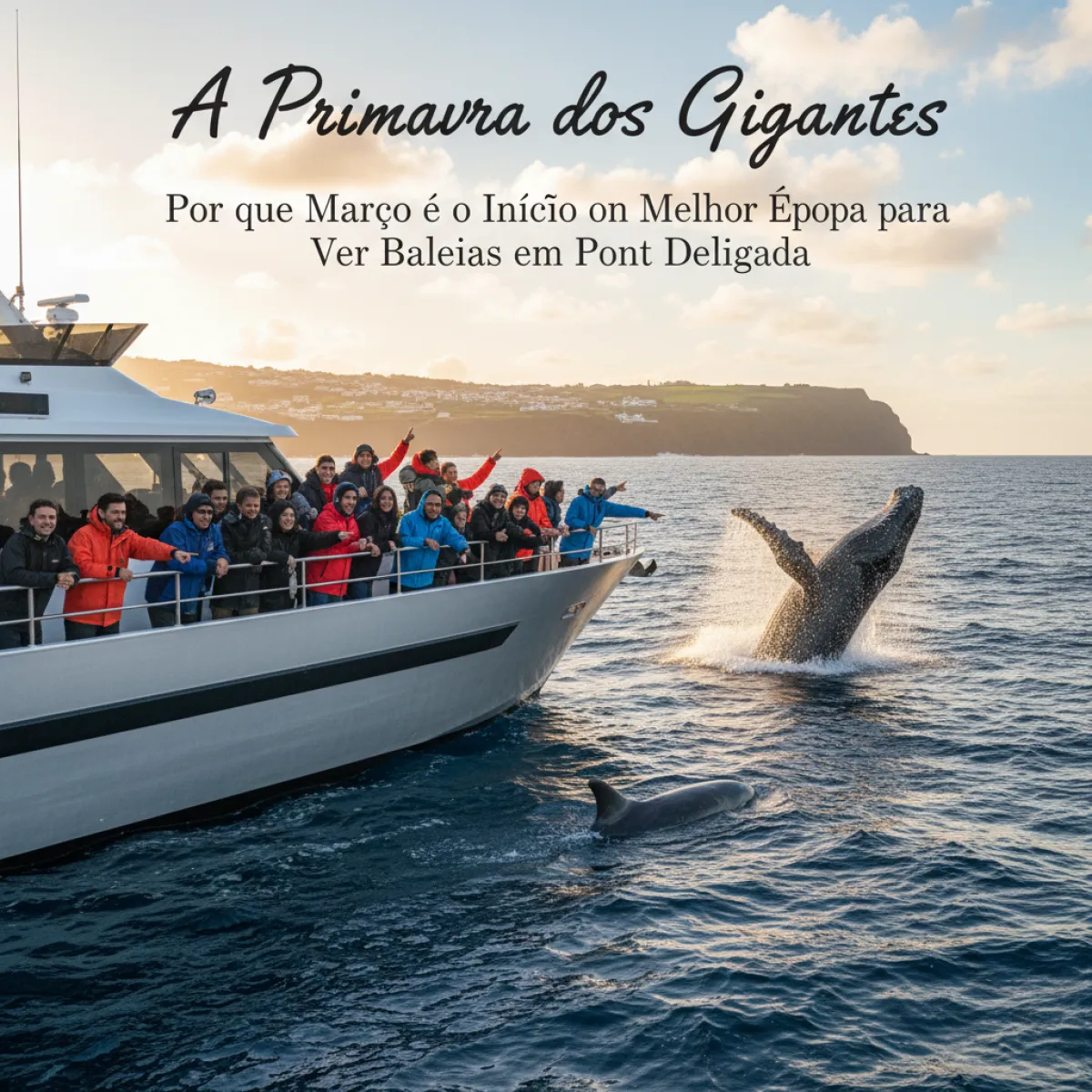
Ponta Delgada, the economic heartbeat of the Azores, serves as the premier gateway to one of the most significant biological events on the planet. While cetacean watching is a year-round activity in the archipelago, March represents a critical seasonal shift. It is during this window that the deep waters of the North Atlantic begin to surge with the migratory presence of the great baleen whales. While resident species like the iconic sperm whale remain steadfast off the coasts of São Miguel, March introduces the ocean-crossing giants to the scene.
This phenomenon is driven by the seasonal "spring bloom" of phytoplankton, triggered by increasing sunlight and the mixing of cold, nutrient-rich currents with the warming spring waters. This microscopic feast attracts massive swarms of krill, which in turn sustain the largest creatures to ever inhabit the Earth. For those seeking the definitive experience of observing a blue whale or a fin whale, March is undeniably the start of the golden season.
Futurismo Azores Adventures: A Legacy of Science and Discovery
To embark on this expedition with the necessary scientific rigor and safety standards, Futurismo Azores Adventures stands as the leading operator in Ponta Delgada. Established over three decades ago, the company has evolved from a small family operation into a global benchmark for regenerative tourism and whale watching. Operating out of Portas do Mar, Futurismo does not merely transport passengers to sea; their team integrates marine biologists and dedicated lookouts who monitor cetacean populations daily.
The success of a March excursion relies heavily on a central figure: the "Vigia de Terra" (land-based lookout). Utilizing high-powered binoculars from strategic points along the southern coast of São Miguel, these experts can detect a whale's blow from several miles away. This traditional technique, once used during the whaling era and now masterfully converted for conservation, ensures that boats head directly to confirmed sightings, significantly reducing search time and fuel consumption.
The Experience: A Step-by-Step Journey
The journey begins at the Ponta Delgada marina, specifically at the Futurismo headquarters in Portas do Mar. Following check-in, guests are led through a mandatory safety and educational briefing. This moment is vital for understanding the strict ethics of whale watching in the Azores: vessels maintain specific safety distances (usually 50 meters, or 100 meters if calves are present) and never approach animals from behind or intercept their path. Biologists explain the specific species expected during the season using migration maps and anatomical charts.
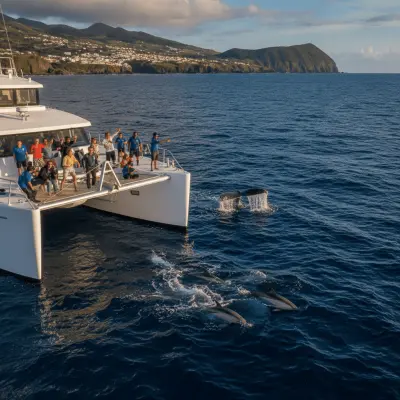
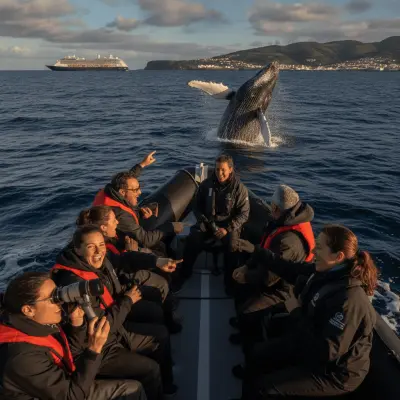
Boarding follows, with passengers choosing between the stability and comfort of a large catamaran or the agile, sea-level perspective of a rigid inflatable boat (RIB). In March, the Atlantic can be spirited, making the catamaran a popular choice for those seeking a higher photography platform and better protection from the crisp spring air. Once in open water, the radio communication between the land lookout and the captain dictates the expedition's pace.
The first sighting is often signaled by the blow, a column of mist that, in the case of a blue whale, can reach up to nine meters high. Witnessing the seemingly endless back of this creature break the surface is a transformative moment. In March, it is common to see lunge-feeding behaviors as whales filter tons of water for food. After a morning on the water, many travelers return to the marina seeking the flavors of the island, often following The Volcanic Plate: A Gastronomic Trek through Ponta Delgada to refuel with local delicacies.
The Species of the Spring Migration
What makes March unique is the sheer diversity of life. Beyond the resident sperm whales (Physeter macrocephalus), which can be identified by their distinctive 45-degree blow and massive tail flukes during deep dives, March is the month of the baleen giants. The blue whale (Balaenoptera musculus) is the undisputed star of this period. Reaching up to 30 meters in length, these magnificent animals pass through the Azores on their long-distance route to northern feeding grounds.
Traveling alongside them are fin whales (Balaenoptera physalus), noted for their incredible speed and asymmetrical jaw coloration, and sei whales (Balaenoptera borealis). Regarding dolphins, pods can number in the hundreds. While common dolphins and bottlenose dolphins are residents, March sees the arrival of striped dolphins and, occasionally, orcas, which follow the migratory paths of their larger prey.
Practical Tips for the High Seas
Preparing for a March sea excursion requires careful attention to detail. The Azorean weather is famously unpredictable, and the temperature at sea is invariably lower than on land. A layering system is essential: a thermal base, a fleece or wool mid-layer, and a high-quality waterproof windbreaker. Even if the sun is shining in Ponta Delgada, the wind chill and occasional spray can lead to rapid cooling.
For those prone to motion sickness, it is highly recommended to take a preventative medication (such as dimenhydrinate or natural ginger alternatives) roughly 30 minutes before boarding. A light breakfast is advised, avoiding heavy fats or excessive dairy. In terms of gear, personal binoculars are helpful, but a camera equipped with a zoom lens (at least 200mm or 300mm) is fundamental for capturing the detail of the animals while respecting the legal distance limits.
Provider Details and Booking
- Provider Name: Futurismo Azores Adventures
- Official Website: www.futurismo.pt
- Meeting Point: Marina de Ponta Delgada - Portas do Mar, Shop 26
- Pricing: From €65.00 per adult (Standard 3-hour tour)
- Contact: +351 296 283 288 | info@futurismo.pt
Advance booking of at least 48 hours is strongly recommended, particularly in March when nature photographers and wildlife enthusiasts converge on the islands. Morning departures (around 09:00 AM) often enjoy calmer sea conditions, though sightings are equally frequent during afternoon trips.