Stargazing in Monsaraz: The Dark Sky Alqueva Experience
The Monsaraz castle walls are free and open at night, but for telescopes and a guide book the Observatório do Lago Alqueva, inside the world's first Dark Sky reserve. From 15 euros you see thousands of stars where a city gives you thirty.
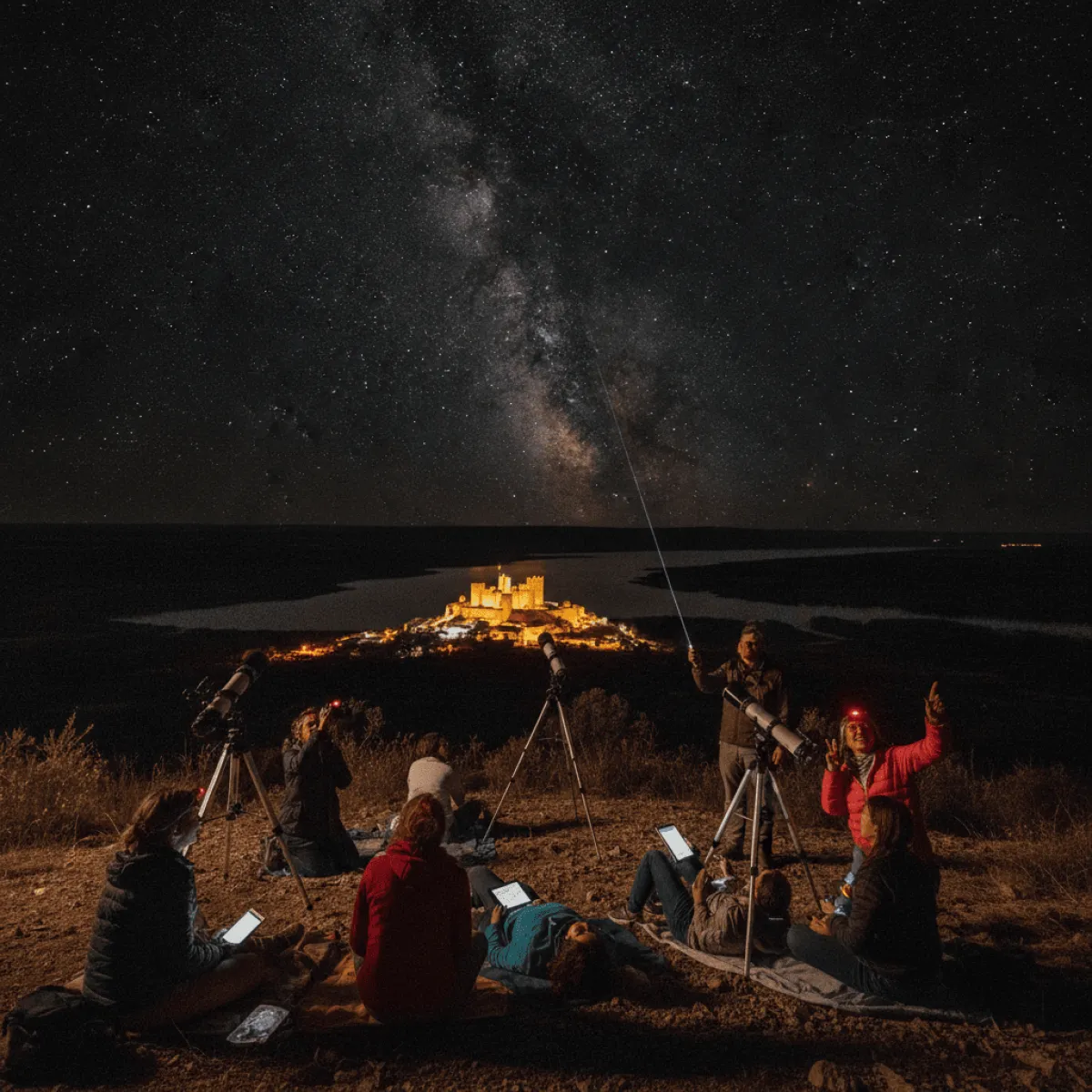
Here is the thing nobody warns you about when you climb up to Monsaraz at night: it is the silence that gets you first, not the stars. The village empties early, the tour buses have long gone down the hill, and when you tilt your head back on the castle walls the sky is so crowded with light that you struggle to find the constellations you thought you knew. You are standing inside the first certified Dark Sky reserve in the world, and it shows.
Where this actually happens, no fiction
Let me be straight with you, because the internet muddles this. There is no operator running paid telescope sessions on top of the Monsaraz castle walls. The walls are open and free: you can walk up on your own at dusk and stand there with the lake below and the sky darkening above. It is every bit as good as it sounds and it costs nothing.
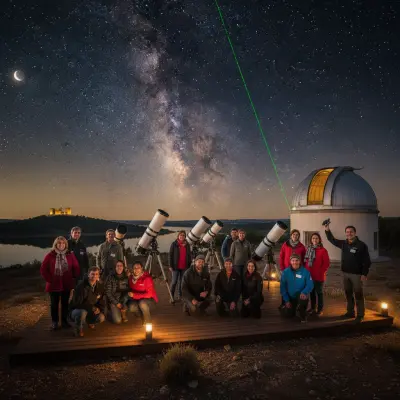
For a guided session, with proper telescopes and someone explaining what you are looking at, the right place is the Observatório do Lago Alqueva (OLA), right beside Monsaraz, with views of the castle and the water. It is the largest observatory in the reserve and its only purpose is astronomical observation. Book ahead, because spaces are limited and clear nights fill up fast.
- Provider: Observatório do Lago Alqueva (OLA)
- Website and booking: https://www.olagoalqueva.com
- Contact: geral@olagoalqueva.pt, +351 960 361 906
- Reference prices: adults from 15 euros, youth (10-17) 9 euros, family ticket 35 euros. Confirm directly with the provider before you go, as rates shift by season.
There is also the Official Dark Sky Alqueva Observatory, in the village of Cumeada (Reguengos de Monsaraz), about 20 minutes away by car. Sessions run around 1h15, roughly 25 to 30 euros per adult depending on the season, booking required at https://darkskyalqueva.com. Both are good; OLA is the one glued to Monsaraz itself.
What the session is like, step by step
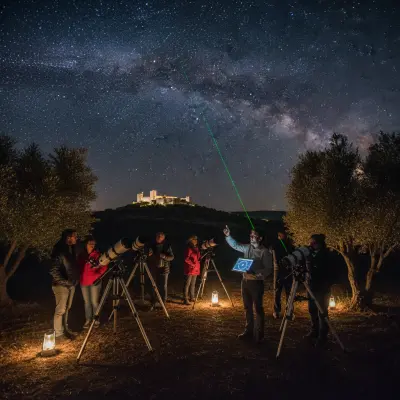
You arrive while there is still light. That is deliberate: as the sun drops over Alqueva, the guide starts orienting you, pointing to where the first planets will appear. Then comes the part that surprised me the first time, the naked-eye introduction. Before any telescope, someone with a laser pointer draws the constellations right over your head and tells you the stories behind them. This is where you realise how much you normally miss at home under city light pollution.
Only then do the telescopes come out. Depending on the time of year, they swing to Saturn and its rings, to Jupiter and the four Galilean moons, to nebulae, star clusters and distant galaxies. Every month brings a different sky, so no two nights are the same. If the weather turns and cloud rolls in, OLA replaces the observation with a real-time navigation session, and the Cumeada observatory runs an auditorium presentation instead. Ask about the policy before you book.
The best moment, and what to skip
If you ask me the best time to go, it is the new moon or the nights around it. A full moon is pretty but it washes everything else out, and the deep sky vanishes. Summer gives you warm, comfortable nights; winter gives you the crispest, clearest sky, at the cost of dressing seriously warm. The Milky Way shows best from late spring into early autumn.
What I would skip: do not try to shoot through the eyepiece with your phone. You will get frustrated and miss the session fiddling with the screen. Look with your eyes. If you want real astrophotography, that is a different activity with different gear.
What to bring and wear
- One more layer than you think you need. In the Alentejo the night cools fast, even in August.
- Closed shoes. The ground around the observatory is uneven and dark.
- A red-light torch, or set your phone to red, so you protect your night vision and everyone else's.
- Water and, if you head up to the castle on your own, a small blanket to sit on the stone.
Getting there and planning the night
Monsaraz has no practical public transport at night, so you will need a car. Park in the lots outside the walls (traffic inside the village is restricted) and walk up. If you are sleeping in the village, better still: eat early, do the session and stroll back.
Make stargazing the finish to a full day. By daylight it is worth understanding why this lake reshaped the whole region, which I get into in this guide to Monsaraz and Lake Alqueva. If you like sky and ancient stones, the Cromeleque do Xerez is an obvious stop before sunset, a megalithic alignment our ancestors raised looking at the very same sky. If you are building a whole weekend, the weekend guide to Monsaraz helps you slot it all together, and if you are watching the budget, the Monsaraz on a budget guide reminds you that the walls at night are still free.
Is it worth it?
It is, for one simple reason: most of us have never seen a truly dark sky. You live in a city, you see thirty stars on a good night, and here suddenly there are thousands. The best moment is not Saturn in the telescope, impressive as that is. It is the instant when the guide kills the light, your eye adjusts to the dark, and you realise the faint smear crossing the sky is our own galaxy. Book ahead, cross your fingers for clear skies, and bring a jacket. The rest takes care of itself.