Marble Quarry Tour in Estremoz: Into the Pits
With a helmet and vest on, you reach the edge of open-pit quarries where white rock drops up to 130 metres. The RMAE tour costs 25€ per adult and runs in Portuguese, English, Spanish or French.
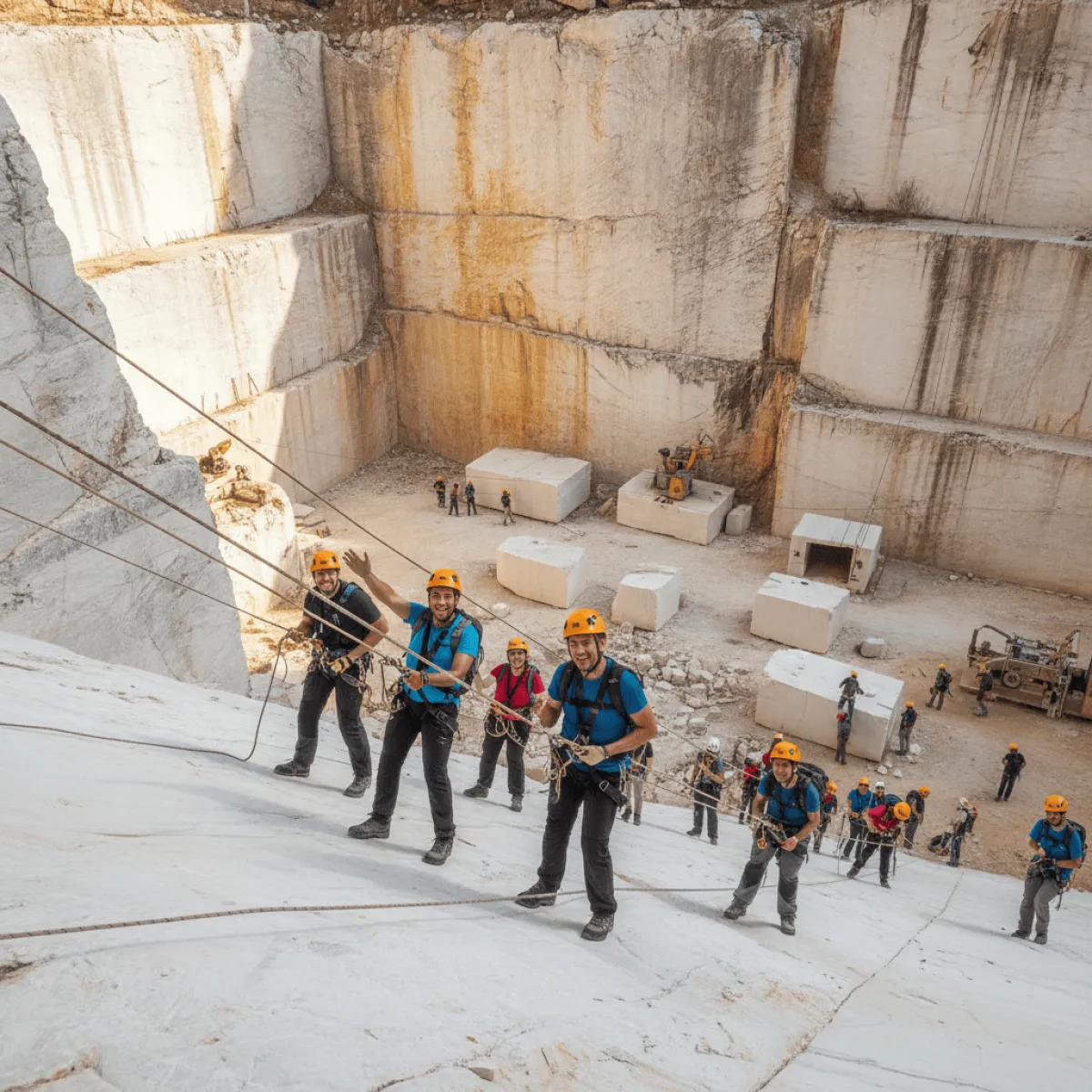
What this visit actually is
They call it the White Marble Triangle: Estremoz, Borba and Vila Viçosa, three municipalities sitting on top of one of the largest marble reserves in the world. The guided tour worth your time here is run by the Rota do Mármore do Anticlinal de Estremoz (RMAE), managed by CECHAP out of Vila Viçosa. This is not a museum walk with glass cases and captions. You put on a helmet and a vest and you go down to the edge of open-pit quarries where white rock drops tens of metres to a floor of green water. The deepest one on the visit, Pedreira Del Rei, runs about 130 metres down. Seeing that in person does something a photograph cannot.
An honest note on geography: although the route is named for Estremoz and includes the city's heritage, the quarries you actually descend into sit mostly around Vila Viçosa and Borba, the extractive heart of the anticline. It is the same geological vein that made Estremoz. If you want to understand where the marble in the region's streets and buildings comes from, this is the right visit.
How it starts and what you see
The meeting point is the Núcleo Documental do Mármore in Vila Viçosa. You begin here with a short talk on geography, geology and history: how the anticline formed, why this stone is so prized, what has been made from it since Roman times. It is the classroom part, and it is mercifully brief.
Then you get to the good stuff. The tour moves to a working quarry, where you see the extraction process up close: diamond wires slicing blocks the size of shipping containers, huge cranes, steps cut into the rock descending toward the bottom. The guides know the business from the inside, and it shows in the questions they answer without pausing: how much a block weighs, what it is worth, how much is lost in cutting, where it ends up.
Next comes a sawmill, where the raw block becomes slabs. This is the part nobody expects to enjoy and often ends up rating highest: realising that the polished white wall of a hotel lobby started as a mountain turned inside out in the middle of the Alentejo.
The best moment
The best moment of the visit is not technical, it is visual. It is the first time you reach the lip of a big quarry and look down. The white walls cut dead straight, the water pooled at the bottom in that impossible green, a scale that will not fit in a phone photo. Go in the morning if you can: the light hits the walls differently and there is less heat bouncing off the stone, which in an Alentejo summer turns the place into an oven.
Prices and booking
The themed quarry visit costs 25€ per adult, 20€ for over-65s, and children under 6 go free. Always confirm prices and availability directly with the provider before you go, since dates depend on group and season.
The themed programme usually runs on Saturdays between March and October, though groups can request visits year-round. Tours run in Portuguese, English, Spanish or French. You book through the RMAE website (with an online reservation system) or by contacting them directly.
- Provider: Rota do Mármore do Anticlinal de Estremoz (RMAE) / CECHAP
- Website: rotadomarmoreae.com
- Phone: (+351) 965 087 618 / 268 889 186
- Email: geral@rotadomarmoreae.com
- Meeting point: Núcleo Documental do Mármore, Avenida Duques de Bragança nº 4, Vila Viçosa
What to wear and bring
Helmet and vest are provided and mandatory, and you hand them back at the end. Everything else is on you: closed, sturdy shoes, because a quarry floor is uneven, dusty and littered with loose stone. No sandals, and no white trainers you care about. Bring water, a hat and sunscreen, especially between May and September, when the Alentejo does not forgive and the white stone throws the sun back at you like a mirror. Sunglasses help more than you would think, for the same reason.
Getting there
Vila Viçosa is about 50 minutes from Évora and two hours from Lisbon. Driving is by far the most practical option, and there is easy parking near the meeting point. If you are staying in Estremoz, it is roughly 20 minutes by car to Vila Viçosa. The visit involves moving between sites (documentation centre, quarry, sawmill), so have your own car or confirm with the provider how transport works on the day.
Fitting it into the trip
Estremoz deserves a day built around this visit. If you want to explore on your own before or after, our white gold trail through the marble quarries and workshops of Estremoz helps connect the dots, and for what to actually buy in town without falling for tourist traps there is the guide to Estremoz crafts, what to buy and what to skip. For the coffee stop, close to compulsory in the Alentejo, see the right cafés and what to order. And if the day is hot, which it probably will be, finish at the Azenhas d'El Rei river beach to wash the stone dust off.
Is it worth it?
It is, for a specific kind of traveller: anyone who likes understanding how things are made, who finds real industry interesting and not just churches and viewpoints. This is not a pretty visit in the postcard sense. It is impressive in the sense of scale and human labour. If you walk away looking at a kitchen countertop or a bench top differently, the tour did its job. Two to three hours well spent, and one of the few things in the Alentejo you cannot do anywhere else in Portugal.