Calvário Húngaro (Hungarian Calvary)
Far from the crowds of the Cova da Iria, the Hungarian Calvary offers a different Fátima: one of silence, stone, and olive groves. Discover the Via Crucis that winds through Valinhos and the story of exile behind its construction.
The Other Side of the Sanctuary
There are two Fátimas. The first is the one everyone knows: the vast concrete expanse of the Cova da Iria, where the human scale is lost between the old Basilica and the massive new church of the Holy Trinity. This is the Fátima of crowds, of melting wax, of promises paid on knees, and of a souvenir trade that, let's be honest, oscillates wildly between the devout and the kitsch. It is a place of intense energy, often chaotic, where silence is a rare commodity.
And then there is Valinhos. A few kilometers away from the confusion, the scenery changes drastically. Asphalt gives way to uneven stone, concrete hotels are replaced by centuries-old olive groves, and the roar of tour buses fades away. It is here, on this pedestrian path winding up the hill, that you find the Hungarian Calvary (Calvário Húngaro). If you are looking for a spiritual or architectural experience that doesn't involve elbowing your way through a crowd, this is where you should come. It isn't just an "alternative"; for many, it captures the true essence of the Fátima message, stripped of the tourist apparatus.
A Via Crucis in the Middle of Nowhere
The Hungarian Calvary isn't a recent invention designed to disperse tourists. Its construction began in the 1950s and it was inaugurated in 1964, at a time when Europe was divided and Hungary was suffering under a communist regime. The work was funded by exiled Hungarian Catholics, a sort of promise in stone for the liberation of their homeland. There is a historical weight here that you can feel in the sobriety of the stations.
The route begins at the Santa Teresa Roundabout (south roundabout) and follows the path that the little shepherds, Lúcia, Francisco, and Jacinta, habitually took between their homes in Aljustrel and the Cova da Iria. Unlike the open esplanade of the main sanctuary, here you walk between dry stone walls and low vegetation. The 14 stations of the Cross unfold along the path, small chapels designed with a simplicity that borders on the austere, but which fits perfectly into the arid landscape of the Serra de Aire.
What impresses is not the luxury of the materials, but the integration into the landscape. There is no gold, no gilded woodcarving. There are tiles, limestone, and the sound of the wind in the olive trees. It is a physical journey, you climb, and you feel the climb in your legs, which makes the experience more meditative than simply standing in a square.
The Chapel of St. Stephen
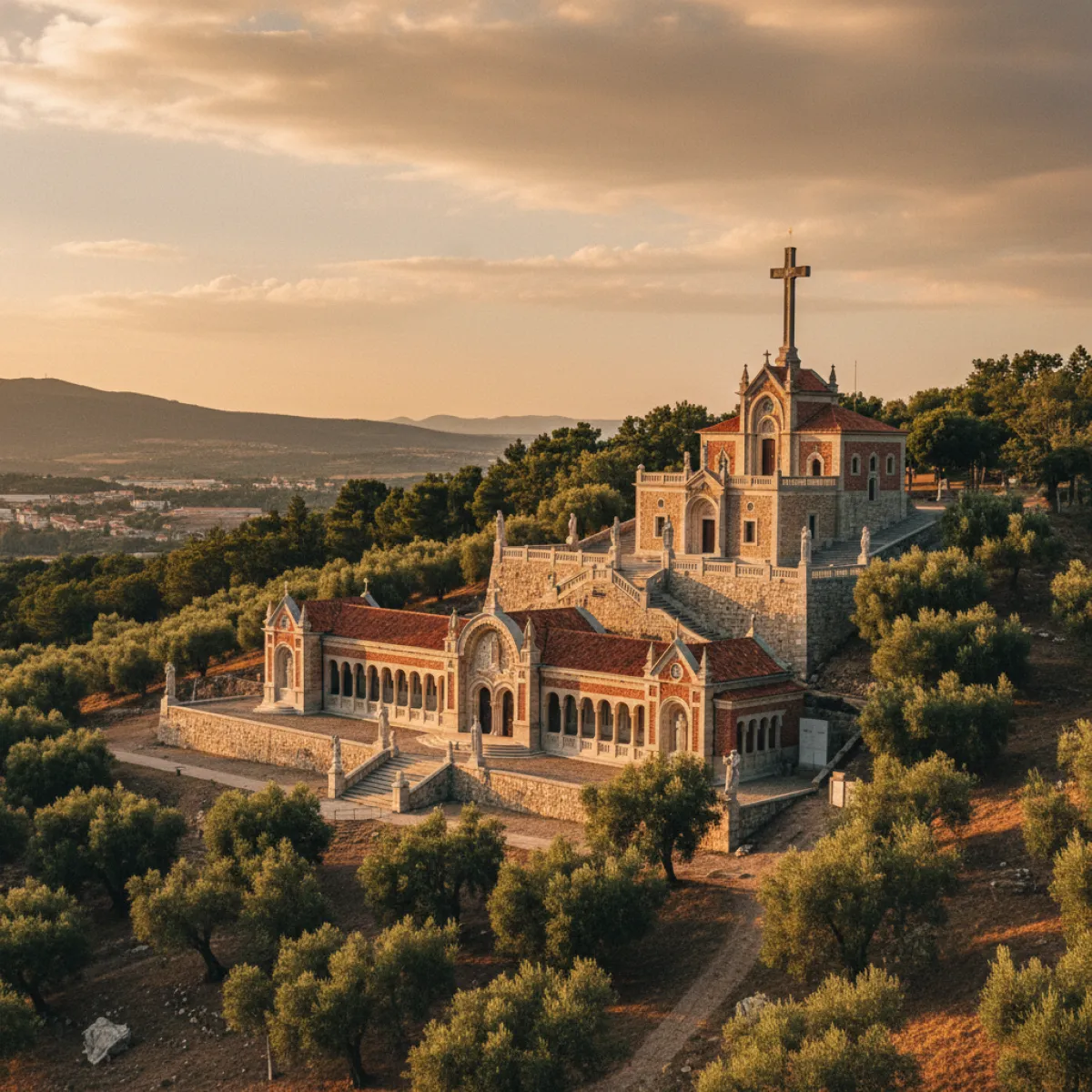
At the end of the climb, we are greeted by the Chapel of St. Stephen (Santo Estêvão, to whom the Hungarians are particularly devoted). It is the culmination of the calvary, literally and figuratively. The architecture here avoids the traditional Manueline or Baroque that dominates many Portuguese churches. It is more geometric, more contained, with mosaics that reflect a mid-20th-century aesthetic, something we explore in more detail in our guide on Sacred Silence: The Modernist Architecture of Fátima's Lesser-Known Chapels.
From the top, the panoramic view over the Cova da Iria and the Basilica of Our Lady of the Rosary is disarming. You see the human anthill down below, but you don't hear the noise. It is a privileged viewpoint that offers perspective, not just geographical, but mental. You can see the scale of the Fátima phenomenon without having to be in the middle of it.
It is also worth noting the presence of the "Loca do Anjo" near the 4th station, where the apparition of the Angel of Peace is believed to have occurred in 1916. The sculptures here are striking, almost brutalist, far from the usual sweetness of popular religious imagery. It is sacred art with edges.
Logistics and Practical Tips
Getting here requires some effort, but nothing superhuman. The Hungarian Calvary is located at Rua do Calvário Húngaro, Valinhos, 2495-301 Fátima. If you are at the sanctuary, you can walk (it's about 20-30 minutes to the start of the Via Crucis) or catch the tourist train that makes the connection. If you have a car, there is parking near the south roundabout, but the ideal way is to leave the car and walk the path.
There are no ticket offices, no turnstiles. Access is free and, surprisingly, there are no rigid hours for the outdoor space, although the chapel may be closed outside of main celebrations. For more specific information on masses or special events, you can call +351 249 539 600 or check the official website.
When to go? Avoid the peak heat hours in summer. The path has little shade, and the Fátima sun in August is unforgiving. Late afternoon, when the light turns golden and hits the white stone of the stations flat on, is the ideal time. The light here has a particular quality, dry and crisp, that photographers will appreciate.
Where to eat? Not here. The Calvary is a place of isolation. You won't find cafes or souvenir shops along the Via Crucis (thankfully). Bring water. If you want lunch afterwards, head back to the center of Fátima or, better yet, explore the more traditional restaurants in the neighboring villages of Aljustrel, where the food still tastes of the land rather than mass tourism.
In short, the Hungarian Calvary is not for those who want to tick a box on a tourist list. It is for those who want to understand what Fátima could have been if it had remained a village in the hills: silent, hard, and introspective. It is a place where architecture, faith, and nature converse without the need for megaphones.
