Vila Real de Santo António with Kids: An Honest Guide
No water parks, no costumed mascots hugging sweaty children. Just a Pombaline grid, a river with Spain on the other side, and flat beaches where kids sleep better. An honest guide for families who prefer holidays where the adults also get to breathe.
Let's be straight from the start: Vila Real de Santo António is not Albufeira, and that is a blessing. There are no giant water parks, no costumed mascots hugging sweaty children on the main strip, no neon chaos that makes serious parents question their life choices at three in the afternoon. What there is, instead, is a Pombaline town built on an impeccable grid, a river that separates Portugal from Andalusia, and a coastline of beaches so flat they look drawn by an architect obsessed with horizontal lines. For families, this translates into something very specific: a holiday where the adults also get to breathe.
I write this after several visits with kids ranging from four to eleven, and after many conversations with parents who came for a weekend and stayed a week. The question is not whether Vila Real works with kids. It does. The question is how to structure the days so that nobody collapses at lunch, and that is a science worth mastering.
Why here, and not somewhere louder
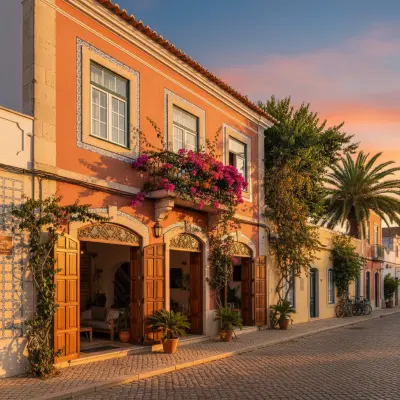
The eastern Algarve is, in many ways, the Algarve that survived itself. Tavira gets most of the travel-magazine love, Faro has the airport and administrative chaos, Olhão has the pretty market and the trendy restaurants. Vila Real sits at the end of the line, leaning into the Guadiana river, with a historic centre that fits inside a single quarter and was built in five months in the eighteenth century on orders from the Marquis of Pombal. It is, quite literally, a textbook town.
For children, that grid is a gift. The Praça Marquês de Pombal, with its sunburst cobblestone pattern and central obelisk, is a place where kids can run without much risk. Cars are mostly forbidden in the centre. There are café terraces on every side. Parents can drink a coffee and still keep eyes on their offspring, which, frankly, is the supreme luxury of family travel.
And then there is the light. This is the hard part to explain without sliding into bad poetry, so let me be concrete: the light in Vila Real, especially between October and May, has a quality that does not exist on the western coast. Warmer, lower, more golden. Children sleep better after a day in this sun. There is no published science on this, but any parent who has spent a week here will confirm.
Where to sleep without losing your patience
The first rule of family travel is not to pick a hotel filled with couples retreats and sunset DJs. The second rule is to choose somewhere within walking distance of everything, because hauling tired kids around in taxis is an exercise in financial masochism. The Sun Hostel solves both problems. Despite the name, it is not the typical backpacker bunk-bed setup: there are private family rooms, it is minutes on foot from the square and the river, and it has that easy informality that makes children feel at home. For two families travelling together, it is far more sensible than two separate apartments.
If you prefer something more conventional, there are aparthotels along Avenida da República. What matters is that you have some way to cook, even if it is just a microwave and a kettle. Hotel breakfasts with kids are almost always a bad idea: either the child eats in fifteen minutes and wants to leave, or refuses everything and you pay twenty euros for a slice of toast.
The day, hour by hour, no drama
Morning: the river before the heat
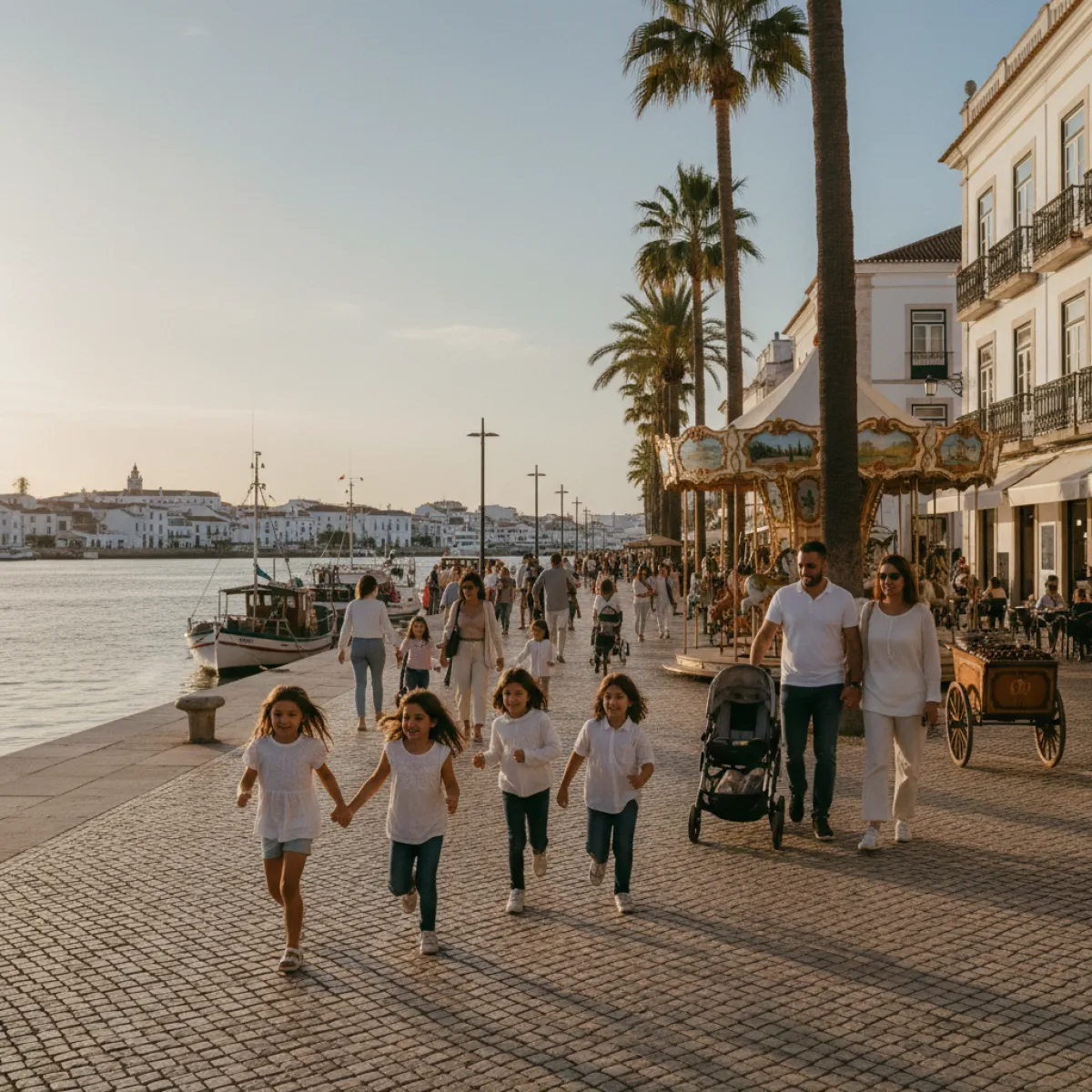
Start early. Not 7:30 early, but 9 early. Holiday children wake up at six and burn the next three hours bouncing on hotel beds, every parent knows this. Walk down to the Guadiana riverfront. The promenade in Vila Real is flat, wide, and across the water you can see Ayamonte, Spain, with its white rooftops and the ferry crossing every half hour.
Speaking of the ferry: this is the most underrated trick in town. The crossing to Ayamonte costs little more than a coffee (check locally, prices change) and takes about fifteen minutes. For a child, crossing a border by boat is mythic. For parents, it is an excuse to have tapas for lunch and come back in the afternoon. Bring documents: it is still a border crossing, even if nobody asks for them most of the time.
Lunch: where to eat without traumatising anyone
The centre has plenty of honest options. Avoid restaurants with photographs of the dishes outside, that is a universal travel rule. Look for places where local workers in suits and ties have lunch at one o'clock. Order a seafood rice to share, or a cataplana if your kid is old enough to appreciate it. For smaller children, there is always the fried egg with chips: no Portuguese restaurant refuses to make this, and it is always good.
After lunch, it is sacred: ice cream in the square. There are several gelaterias, and competition keeps quality high. Sit on one of the benches looking at the obelisk and let the kid melt the cone in peace.
Afternoon: beach or Cacela
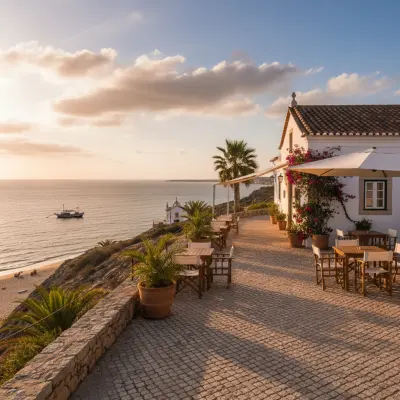
Monte Gordo beach is minutes away. It is enormous, with pale sand and almost no surf for most of the year, which makes it the ideal beach for kids still afraid of waves. There are concessions with sun loungers and a bar (Algarve prices, sadly). If you prefer something less touristy, head to Praia da Manta Rota or Praia Verde, both a short drive away.
But if there is a day when you want to show your kids that Portugal is more than towels and ice cream, go to the Miradouro de Cacela Velha. It is one of those places that keeps working even on low expectations. The hamlet has a church, a fort, three streets, and a view over the Ria Formosa that makes any child stop asking for the phone for at least two minutes. Bring water and closed shoes, because the descent to the beach is over soft sand and takes longer than it looks. At low tide, you can walk across to the sandbank opposite. It is a moment that sticks.
When kids want more than the beach
There is a moment, usually on the third or fourth day, when even the most beach-loyal child starts asking for something else. This is when many families panic and end up at an overcrowded water park near Quarteira. There are saner alternatives.
The sunset boat tour on the Guadiana is the first one. For kids from five or six upward, it is magical: heading up the river, watching both shores (Portugal on one side, Spain on the other), the sun dropping over the estuary. Tours usually run late afternoon and last one to two hours. Bring jackets: even in summer, the river cools off. And if your child is very small, think twice: boats with babies can be a parental endurance test.
The second alternative, for parents with older children (or for a day when grandparents are babysitting), is a quick escape to Castro Marim, just up the road. The town has a medieval castle that is a good walk for stretching legs, and it also has the Senescal Brewery, a craft beer maker that does guided tastings. Not an activity for small kids, but a great excuse for the adults to have an afternoon to themselves. The beers are honest, without that smug craft pretension that ruins certain cities.
Other options within reasonable range
- Sapal de Castro Marim Nature Reserve: ideal for kids who like birds and mud. There are flat trails, flamingo spotting at certain times of year, and an interpretation centre. Bring repellent.
- Cacela Velha village: mentioned above, but worth a visit on its own, without going to the beach. There is a fort, the views, and occasional cultural events.
- Vila Real municipal market: go in the morning, buy seasonal fruit, let the kid pick something they have never seen before. It is food education disguised as tourism.
Eating with kids without becoming a hostage to nuggets
The eastern Algarve still guards traditional restaurants serving grilled fish and cataplanas without the magazine-style theatrics. With children, the wisest strategy is to order a starter to share, usually a plate of cheese and cured meats, and let them nibble while the mains are on their way. The average child survives any Portuguese lunch as long as there is bread on the table, and the bread here is generally very good.
Order simple seafood: grilled gilthead bream, sea bass, squid. Avoid overly complex sauces with small children. And do not be afraid to ask for a half portion: in Portugal, this is not an insult, it is common practice, and it cuts down enormously on waste. If the child refuses fish, there is always roast chicken, and the roast chicken here is better than the roast chicken in Lisbon, I write this without irony.
Useful comparisons: other families, other guides
If this weekend goes well and you want to extend, it is worth considering a rotation through other Algarve towns with the same philosophy. Silves with kids has its own guide, written with the same honesty: castle, river, cataplana, no traps. Faro also has a genuine cultural side that is often overlooked by tourists who only pass through the airport. And if you want the western Algarve, Lagos has distinct neighbourhoods with very different personalities, which is interesting for older kids who are starting to ask questions about how cities work.
Typical mistakes to avoid
- Putting kids in the car at 11am to go see Tavira: Tavira is beautiful, but with a thirty-minute drive each way and a heavy lunch in between, it is a recipe for tears. Go in the morning, eat early, head back before three.
- Trying to do Seville in a day: yes, it is close. No, it is not a pleasant day with kids. Seville deserves three days, or none. The middle ground is suffering.
- Beach at noon in August: obvious, but it still happens. Go before 11am or after 4pm. Take a nap in the middle.
- Underestimating September heat: in Vila Real, September can be just as hot as August, sometimes more. Do not pack only transitional clothes.
What to pack that nobody tells you
Closed-toe trainers, even at the beach: the sand burns and there are occasional sea urchins in rockier zones. A waterproof bag for wet clothes. Strong mosquito repellent, especially if you visit the nature reserve or the river late in the day. Motion sickness pills, if your child is sensitive: the ferry to Ayamonte is short, but it can rock. And a deck of cards or a book for each child, for the dead moments at restaurants: holidays teach as much as any school, but only if there is enough dead time for boredom to do its work.
When to come, briefly
May, June, September, and the first half of October are the ideal months. July and August are hot but functional, with more tourists and higher prices. Winter is a positive surprise: days at fifteen to twenty degrees, sun, empty restaurants, and a town that feels almost yours. Children care less about sea water temperature than parents imagine. Bring a wetsuit if you come in cold months.
Vila Real de Santo António will not show up on lists of "unmissable family destinations". Good. Lists bring crowds, and crowds bring chain hotels with painted facades and plastic ice cream. People who come here usually come by accident or by recommendation. And those who come back, come back knowing. That is a compliment.