Vila Real de Santo António: Pombal's Grid City on the Border
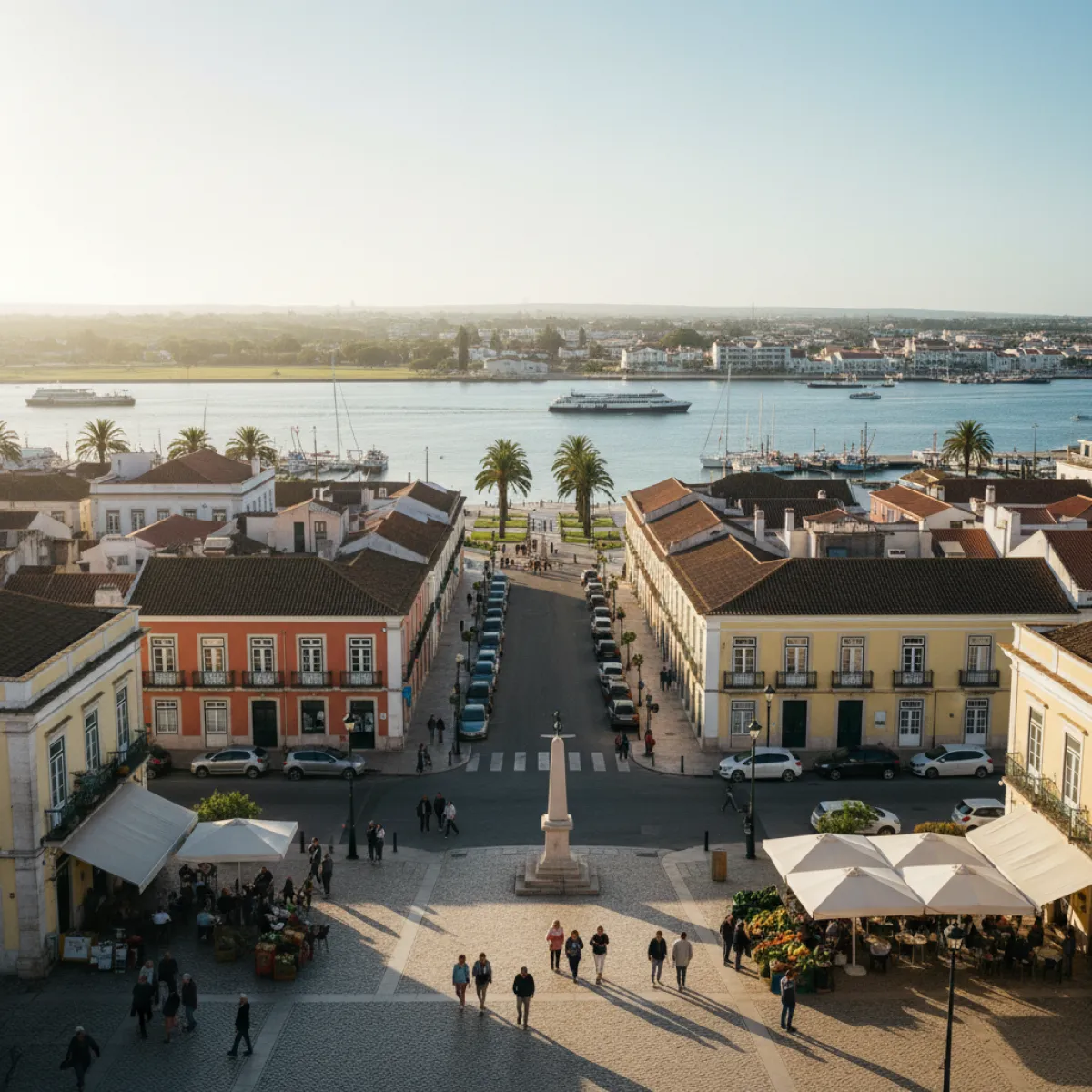
Built in under two years on the orders of the Marquis of Pombal, Vila Real de Santo António is the only Algarve city laid out on a perfect orthogonal grid. Praça Marquês de Pombal, with its 1776 obelisk and black-and-white cobblestones, is the starting point for exploring an Enlightenment urban plan still legible in every street.
Most Portuguese cities grew organically over centuries, with winding alleys that only make sense to locals and medieval streets that follow the logic of goats rather than architects. Vila Real de Santo António is the exception. This city was drawn on a desk in Lisbon, built in under two years, and inaugurated in 1774. It's an anomaly in the Algarve, and that's exactly what makes it worth the detour.
A City Built from Scratch
After the 1755 earthquake levelled Lisbon's centre, the Marquis of Pombal rebuilt the Baixa district with an orthogonal grid, uniform facades, and a central square concentrating political and religious power. When he needed to assert Portuguese sovereignty at the mouth of the Guadiana River, facing the Spanish town of Ayamonte, he used the same playbook. The result is a city that looks like it was stamped onto the sand in one go: rectangular and square blocks, streets crossing at right angles, two-storey buildings on the main square and single-storey everywhere else. Nothing here is accidental.
The project was led by Reinaldo Manuel dos Santos, the court's chief architect. The brief was simple: build a functional, sanitary, legible city. No medieval labyrinths, no surprises. A city that could be raised quickly and governed easily. This is Enlightenment urbanism in its purest form, and when you walk through Vila Real de Santo António today, that intention is still visible on every corner.
Praça Marquês de Pombal: Where Everything Starts
Start at Praça Marquês de Pombal, the geometric heart of the city. It's a perfect square, paved with black and white Portuguese cobblestones radiating from the central obelisk, erected in 1776. Orange trees line the perimeter. The buildings framing the square once housed all the instruments of power: the town hall, the guard house, the prison, and the parish church. Everything side by side, everything within sight.
The Igreja Matriz de Nossa Senhora da Encarnação, on the square's north face, follows the same Pombaline sobriety. Don't expect baroque exuberance or lavish gilded woodwork. It's a functional church, like everything else here. The square works best early in the morning, before 10am, when the low light picks out the straight lines of the buildings and the cafés start putting tables outside. Sit down, order a bica, and study the geometry. If you've been elsewhere in the Algarve, with its charming crooked streets, the contrast hits immediately.
Walking the Grid
You can cover the best of Vila Real de Santo António on foot in two hours. From the square, Rua Dr. Teófilo Braga leads down to the Guadiana riverfront. It's the main axis of the Pombaline grid and was designed as the commercial artery. You'll still find traditional shops at ground level, though tourist shops have crept in. Look up at the facades: many retain their original proportions, with sash windows and wrought-iron balconies. The Pombaline core was classified as a Protected Ensemble in 2011, which has helped prevent the worst interventions.
The streets perpendicular to Rua Teófilo Braga are quieter and more revealing. That's where you see the original single-storey system, with identical facades like pieces from a building set. Some houses have been altered over the centuries, but the rhythm of the openings (doors and windows at regular intervals) remains surprisingly intact. Some people find this uniformity dull. I disagree. There's an elegance in the repetition, a visual discipline that's become rare in Portuguese cities.
The Guadiana Waterfront
Avenida da República runs along the Guadiana River, and this is where Vila Real de Santo António gains another dimension. On one side, the Pombaline buildings. On the other, the wide, golden-brown river, with Ayamonte visible on the opposite bank. In the late afternoon, as the sun drops over Spain, the promenade fills with people. This is the ideal moment for a sunset boat tour on the Guadiana, which lets you see the city from the water and understand how the Pombaline grid relates to the river.
If you want to pop across to Ayamonte, the Transporte Fluvial del Guadiana ferry takes 15 minutes and costs €1.75 per person. Buy tickets at the terminal before boarding. You cannot buy them on board. The ferry runs every half hour in peak season, hourly in winter. It's an easy day trip: tapas in Spain, back to Portugal for dinner. Pedestrians and cyclists can't use the Guadiana International Bridge, so the ferry is your only option without a car.
Where to Eat Without Regret
The food in Vila Real de Santo António is river and sea, with a border influence. Cantarinha do Guadiana, on the riverbank, has been working with regional recipes since 2004. Eel stew is the signature dish, but the shark soup with coriander and the seafood rice are also strong. Restaurante da Associação Naval do Guadiana, south of the marina, has a broader menu with cataplanas, kebabs, and fish stew. The river views compensate for the no-frills decor. Caves do Guadiana is another solid riverside option for straightforward petiscos.
Grilled fish is king here. Sea bream, sea bass, and sole, straight from the market. Always ask for the fish of the day rather than choosing from the menu, and favour restaurants that grill over charcoal, not a flat-top. If you want a break from fish, black pork from the nearby Alentejo appears on many menus.
For something different outside town, it's worth the short drive to Castro Marim for a craft beer tasting at Senescal Brewery. It's under 10 minutes by car and a good way to break up the grilled-fish routine.
Beyond the Grid
Vila Real de Santo António makes an excellent base for exploring the eastern Algarve, the stretch that beach tourists usually skip. Miradouro de Cacela Velha, to the west, is an essential stop. The view over the Ria Formosa from the old fortress is one of the best in the Algarve, and the village itself is a cluster of whitewashed houses with bougainvillea that looks like a postcard. Go early morning or late afternoon to avoid the tour groups.
Castro Marim, 4 km north, has its own castle and salt flats producing flor de sal. The Sapal de Castro Marim Nature Reserve protects a wetland area where you can spot flamingos, especially in late summer. Monte Gordo, to the south, has the nearest beach, with golden sand and water warmer than anywhere else in the Algarve (the Mediterranean influence is already at work here).
If you want a deeper understanding of Algarve's local culture and traditions, it's worth exploring across the region. Every city has its own identity: from Lagos, with its distinct neighbourhoods and street life, to Albufeira, where local traditions and festivals endure despite mass tourism. Vila Real de Santo António is the rational counterpoint to all of that.
Practical Information
Vila Real de Santo António sits at the southeastern tip of the Algarve, about 60 km from Faro. By car, it's 45 minutes on the A22 motorway (tolled) or about an hour on the EN125. CP trains run from Faro on the Algarve line, stopping at Vila Real de Santo António. The journey takes between 1h and 1h15, depending on stops, and tickets cost a few euros. Check schedules on the CP website, as frequency varies.
The historic centre is completely flat, making it accessible for everyone. A couple of hours is enough to walk the Pombaline grid at a comfortable pace. Add the ferry to Ayamonte and a long lunch by the Guadiana, and you have a full day. If you can stay overnight, the empty square in the early morning, before the tourists arrive, is the city's best moment.
Vila Real de Santo António doesn't have the dramatic cliffs of Lagos or the nightlife of Albufeira. But it offers something no other Algarve city can: the geometric precision of an 18th-century idea, still readable, still functional, at the place where the river meets the sea and Portugal ends. Or begins, depending on where you're standing.