The Ephemeral Snow of the South and North: Chasing Almond Blossoms
Discover the most exclusive routes to witness the almond blossoms in the Algarve and Upper Douro. An aesthetic journey through whites and pinks, departing from Lisbon's south bank toward Portugal's authentic heart.
The South Bank Perspective: Starting the Journey
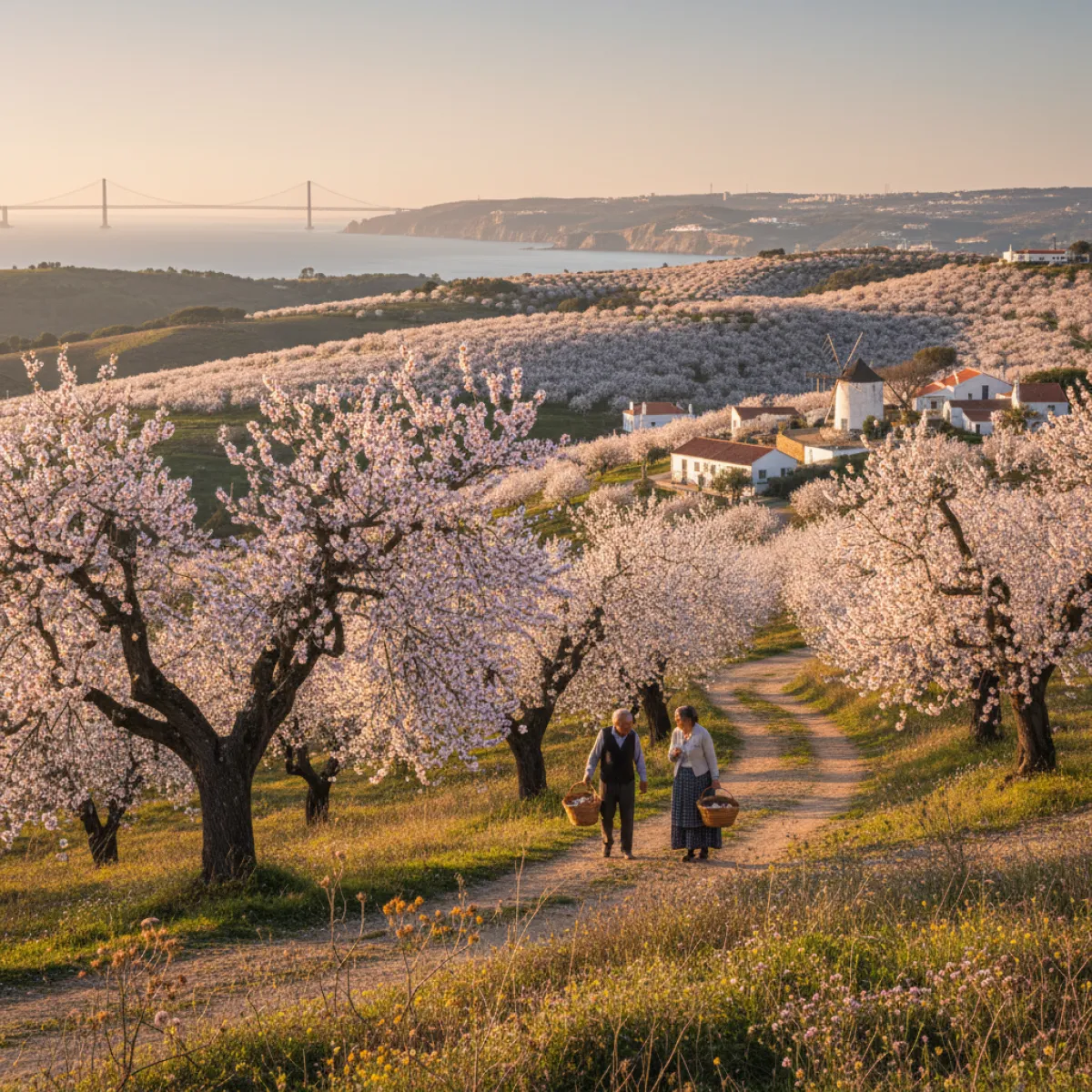
Gazing across the Tagus from the cliffs of Almada, with Lisbon’s silhouette etched against the horizon, is an exercise in urban contemplation. Yet, as February nears its end, the gaze of those living on the south bank begins to shift away from the concrete, searching for the first signs of a chromatic shift. This is the promise of the almond blossom, a phenomenon that transforms the Upper Douro and the Algarve’s Barrocal into a landscape that defies winter’s bite. This isn’t a journey for those seeking tourist frenzies; it is a pilgrimage for those who value the aesthetics of the ephemeral and the slow cadence of rural Portugal.
For the Lisboeta or anyone crossing the 25 de Abril Bridge from Almada, choosing between heading north or south is more than a matter of mileage; it is a choice of atmosphere. While Local Culture in Lisbon: Traditions, Neighborhoods and the City's Soul manifests in limestone and time-worn tiles, the almond routes offer a palette of whites and pinks that seem to float above the dry earth or harsh schist.
The Algarve Barrocal: Myth and Reality
Legend has it, worn by time but still steeped in poetry, that a Moorish king ordered almond trees to be planted so his Nordic princess could see "snow" every year. In the Algarve, the flowering begins early, often in late January. The ideal route avoids the saturated coastline and dives into the Barrocal. Between Loulé and Silves, secondary roads become corridors of petals.
Where to Pause and What to Savor
In Silves, the former capital of the Algarve kingdom, the almond is not just a visual ornament; it is the soul of local confectionery. Forget industrial pastries. Seek out the "doces finos," almond treats hand-molded into the shapes of fruits and animals, a direct heritage of the Moorish occupation that still defines the region’s palate. A budget for lunch at a local spot like Casa Velha should run around 30 to 40 euros per person, including a local wine, often underrated but surprising in its minerality.
Many travelers descending from Almada to the Algarve tend to ignore the intermediate stops, but taking regional detours reveals a Portugal that resists homogenization. If your journey begins by exploring the Best Day Trips from Cascais: Unmissable Destinations, you will find that the interior Algarve offers a scale of silence and space that the Cascais line, for all its charm, rarely permits.
The Upper Douro: Schist Rigor and Petal Softness
In the North, the experience is more dramatic. In Vila Nova de Foz Côa, the landscape is dominated by steep slopes and dark schist that absorbs the meager February sun. When the almond trees bloom here, the contrast is almost violent. It is an austere beauty, where the wind blowing through the Douro valley still carries the chill of the Iberian Meseta.
Driving Routes and Vantage Points
The road between Freixo de Espada à Cinta and Barca d’Alva is undoubtedly one of the most rewarding driving routes in Europe. Tight bends demand attention, but every stop at a viewpoint like Penedo Durão justifies the effort. Here, your budget should include a stay at one of the local quintas. Sleeping surrounded by almond trees and vineyards is a luxury that costs between 150 and 200 euros per night, but the experience of watching the sunrise over the Douro, with mist rising between the flowering trees, is priceless.
For those accustomed to the mystical fog that sometimes blankets the Sintra Neighborhood Guide: Discover Every Corner of the Enchanted Town, the Douro offers a different clarity. While in Sintra the vegetation is lush and humid, in the Upper Douro, nature is sparse, but every flower feels like a victory against the arid soil.
Logistics and Planning: Time Waits for No One
The traveler’s greatest mistake is assuming that the bloom follows a rigid calendar. It all depends on temperature and rainfall. Ideally, monitor local forecasts starting in mid-February. A weekly budget for two adults, including a mid-range car rental, fuel, and quality rural tourism accommodation, should range between 1,200 and 1,800 euros.
- Gear: Dress in layers. The February sun can be deceptive, and nights in the interior, both north and south, are considerably colder than on the Almada or Lisbon coast.
- Gastronomy: In the Douro, order the roasted kid goat and pair it with a full-bodied red from the sub-region. In the Algarve, look for maize porridge or "xarém" with clams.
- Photography: Morning light (until 10:00) and late afternoon (after 16:30) are the only times that capture the true texture of the petals without the harshness of the midday sun.
Conclusion: A Cycle of Renewal
Returning to Almada after one of these routes is to return with eyes full of a light that doesn't exist in the city. The almond blossom is an annual reminder that Portugal, despite its small scale, contains vast and distinct worlds within itself. Whether you choose the south of Moorish legends or the north of resilient schist, the key is to recognize that these moments are fleeting. Like any good editorial journey, the almond route is not measured by kilometers covered, but by the ability to look at the territory with a new and renewed curiosity.
