The Enlightenment Grid: Pombaline Urbanism at the Edge of the Guadiana
Discover Vila Real de Santo António, the jewel of the Algarvian Enlightenment. A city designed by the reason of the Marquis of Pombal, where the perfect grid of streets meets the serenity of the Guadiana river.
A Rationalist Manifesto: The Birth of Vila Real de Santo António
Arriving in Vila Real de Santo António offers a profound aesthetic shock to those accustomed to the organic, often chaotic sprawl of typical Algarve coastal towns. Here, there are no labyrinthine Moorish alleys or haphazard layers of historical accretion. Instead, one encounters the rigorous implementation of an Enlightenment ideal: a city designed with a ruler and square, born from the iron will of Sebastião José de Carvalho e Melo, the Marquis of Pombal. In 1774, Vila Real was erected in less than two years, not merely as a fishing port, but as a bold statement of Portuguese sovereignty facing Spain across the deep waters of the Guadiana.
The city's structure mirrors the grid plan applied to Lisbon’s Baixa after the 1755 earthquake, yet it achieves a purity that the riverine context of the Algarve only accentuates. Unlike the experience of exploring the Local Culture in Faro: Traditions and Experiences of the Authentic Algarve, where history reveals itself in sometimes confusing layers, Vila Real is a monolithic block of intention. Streets intersect at perfect right angles, creating wind corridors that pull the scent of salt and river silt into the heart of the urban fabric. This is urbanism as a tool of control, symmetry, and an austere elegance that has resisted the passage of time with remarkable stoicism.
The Praça Marquês de Pombal: A Centripetal Core
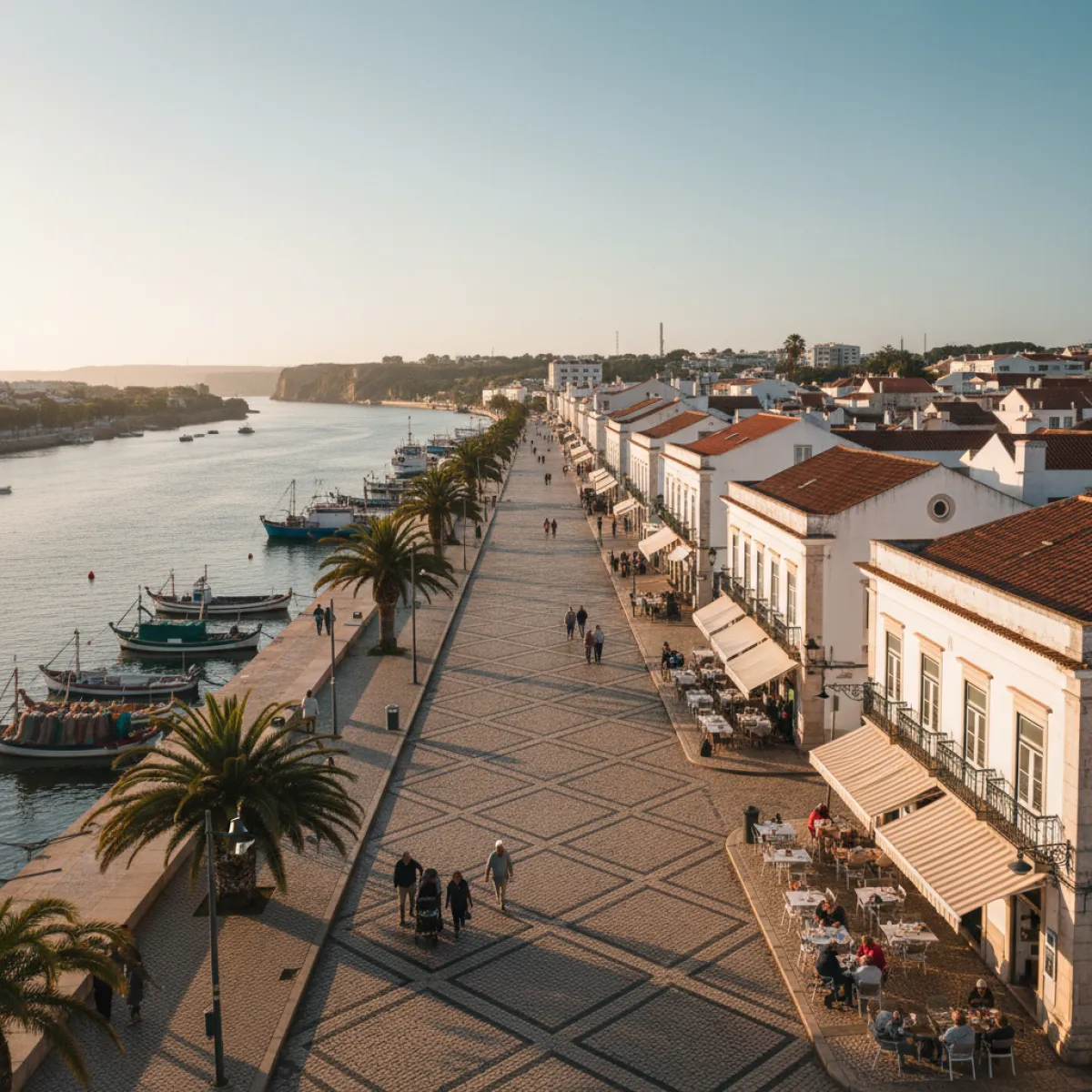
The gravitational center of this grid is the Praça Marquês de Pombal. Here, a central obelisk, raised in 1776, serves as a permanent reminder of royal authority. The square is flanked by uniform two-story buildings featuring wrought-iron balconies and hipped roofs, maintaining a visual consistency rarely found elsewhere. The pavement, a Portuguese calcada arranged in radiant patterns emanating from the obelisk, creates a visual dynamism that invites one to linger at one of the historic cafes.
For those who have consulted the Lagos Neighborhood Guide: Discover Every Corner of This Algarve Gem, the contrast is stark. While Lagos’s neighborhoods are defined by their relationship to medieval walls and rugged cliffs, in Vila Real, the neighborhood is the city itself. There is no historical periphery; there is only the original plan and its strictly controlled expansion. This architectural cohesion lends the town a cinematic dignity, particularly in the late afternoon when the golden light of the Sotavento strikes the white facades and limestone details.
Linens and the Commerce of Quality
Vila Real de Santo António is famous, perhaps unexpectedly for the uninitiated, for its textile industry and linen trade. For decades, Spaniards have crossed the river in search of high-quality towels, bedsheets, and embroidered goods. This tradition remains vibrant in shops that feel suspended in time. Do not expect generic luxury boutiques; what you find here is the luxury of raw materials and craftsmanship. Investing in a set of Portuguese linen bedsheets here is an exercise in durability and comfort, with prices ranging from €80 to €250 for more elaborate pieces.
This commerce coexists with a local life that, while less boisterous than the Local Culture in Albufeira: Traditions, Festivals and the Algarvian Soul, possesses an enviable depth. The connection to the river and the former canning industry has shaped the character of its inhabitants, people of few words but genuine, pragmatic hospitality.
Gastronomy: The Guadiana’s Bounty
Dining in Vila Real is an exploration of a fluid frontier. The most emblematic dish is undoubtedly Arroz de Lingueirão (Razor Clam Rice). These bivalves, harvested from the sands of the estuary, infuse the rice with a deep, briny flavor that no other seafood can replicate. Another essential specialty is Estopeta de Atumdried, salted tuna served with onions and peppers, a culinary ghost of the era when canning factories dominated the riverfront.
- Dining Recommendations: Seek out the small casas de pasto near the marina for perfectly grilled fish. For the best razor clam rice, head to the restaurants on the secondary streets away from the main square.
- Budgeting: A full lunch, including regional wine and dessert, typically costs between €30 and €50 per person at a reputable establishment.
- What to Order: Beyond the razor clam rice, try the Amêijoas à Bulhão Pato (clams in garlic and coriander) and, for dessert, the Dom Rodrigoa local sweet made of egg threads and almonds.
The River as Path and Border
The Guadiana is not merely a geographic barrier; it is the city's raison d'être. The riverside promenade, lined with palm trees and offering views of Ayamonte in Spain, is one of the most pleasant walks in the Algarve. The ferry crossing to Spain (approximately €2.50 per trip) provides a unique perspective of Vila Real’s Pombaline facade from the water. It is from this vantage point that one truly understands the scale of Pombal’s ambition: the riverfront was designed specifically to impress those arriving by sea.
Practical Information for the Discerning Traveler
The ideal time to visit Vila Real de Santo António is during the spring or early autumn. The summer can be punishing due to the dry heat, and the straight streets provide little natural shade during the midday hours. Access is easy via the Algarve railway line or the A22 motorway, but the most dramatic arrival is crossing the Guadiana International Bridge or arriving by boat.
For those seeking an Algarve far removed from mass-market clichés, Vila Real offers an experience of order, silence, and living history. It is a city that demands to be walked with an eye for detail, the tiles on the facades, the ironwork on the balconies, and the constant, reflecting light from the river. It is, in essence, the triumph of reason over landscape, a monument to the Enlightenment that still teaches us about the beauty of proportion and clarity.
