The Convent Route: Hidden Monastic Architecture in Santarém
Santarém holds one of the most remarkable collections of monastic architecture on the Iberian Peninsula, from the Church of Santa Clara to the spectacular ruin of the Convent of São Francisco. A walking route through Gothic convents that mass tourism has yet to discover.
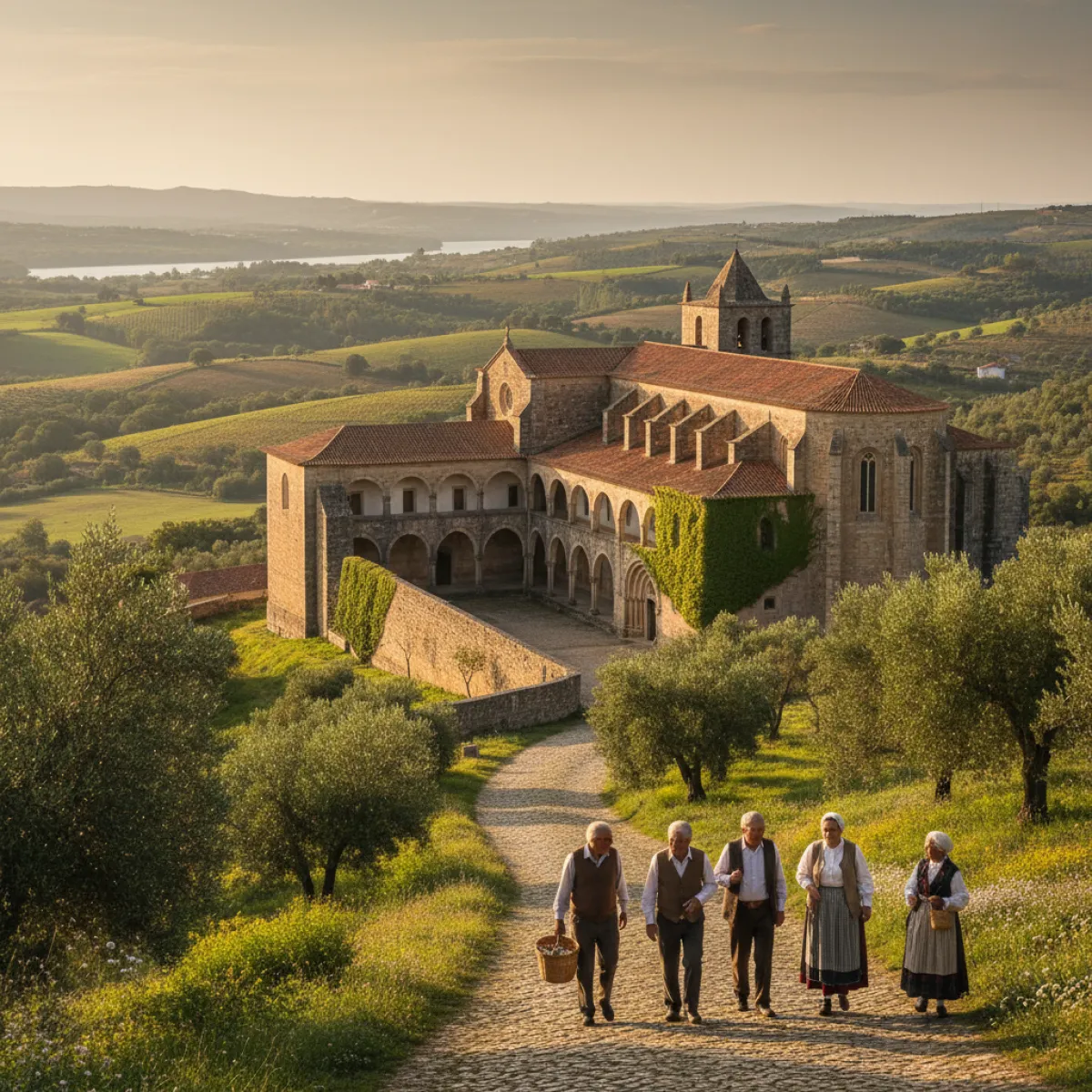
Santarém does not compete with Lisbon for the traveler's attention. It lacks Sintra's theatrical landscape and the cosmopolitan sheen of the Chiado. What it possesses, and this is stated with the conviction of someone who has walked its streets in fog-bound mornings and afternoons of suffocating heat, is one of the most extraordinary concentrations of monastic architecture on the Iberian Peninsula. And almost nobody talks about it.
The capital of Portuguese Gothic, as art historians call it with some justification, accumulated over centuries a collection of convents, churches, and monasteries that would rival any European city of comparable size. But Santarém never bothered to market itself. The convents are there, silent, wedged between apartment buildings and neighborhood grocery shops, waiting for those who seek them out.
The Starting Point: Church of Santa Clara
Any serious itinerary through Santarém's convents begins at the Church of Santa Clara, on the southwestern edge of the old town. Founded in the thirteenth century by King Afonso III, this single-nave Gothic church is an exercise in Franciscan austerity that, paradoxically, produces a disarming beauty. The bare limestone walls, the original rose window, and the tomb of Queen Leonor, with its stone angels worn smooth by time, compose a scene that needs no Baroque ornamentation to impress.
Admission to the Church of Santa Clara is free, but hours are irregular. The safest bet is to visit between 10am and 12:30pm on weekdays. On Saturdays, the church opens only in the morning and closes at noon sharp. Bring your phone's flashlight, the far corners of the nave are genuinely dark, and that is precisely where the most interesting sculptural details hide.
Church of Graça: Gothic at Its Most Ambitious
A five-minute walk uphill along Rua Serpa Pinto brings you to the Church of Graça, perhaps the most impressive building in Santarém and yet one of the least visited in the entire Ribatejo region. The main façade, with its tracery window carved in stone, a fourteenth-century technical marvel that defies both gravity and common sense, is frequently compared to the Batalha Monastery. The comparison is fair: the same master stonemasons worked on both buildings.
Inside, the tomb of Pedro Álvares Cabral occupies a discreet position in the chancel. This comes as a surprise to many visitors: the man who officially discovered Brazil is buried in Santarém, not in Lisbon. The tomb is simple, almost modest, with a marble slab and little ceremony. Cabral died here, far from the sea that made him famous, and Santarém kept him without fanfare.
Admission is €2 and includes access to the small adjoining museum, which holds a notable collection of sixteenth- and seventeenth-century azulejos. The museum is closed on Mondays.
A Detail Worth Noting
On the left lateral wall of the nave, about two meters up, there is a set of mason's marks, the symbols that medieval stonemasons carved into the stone as signatures. There are at least twelve different marks, suggesting a large and diverse team. If you have an interest in medieval epigraphy, this is one of the finest examples in Portugal.
Convent of São Francisco: Ruin as Spectacle
The Convent of São Francisco is, in a sense, the opposite of the Church of Graça. Where the latter remained intact, the former embraced ruin with a dignity that lends it a particular charm. Founded in the thirteenth century, the convent was partially destroyed by fire in the nineteenth century and was never fully restored. The result is a hybrid structure: part functional building (it now houses a cultural center), part romantic ruin with ogival arches open to the sky.
The cloister, or what remains of it, is particularly photogenic in the late afternoon, when the golden light of the Ribatejo enters through the arches and casts long shadows on the packed-earth floor. The cultural center hosts temporary exhibitions and occasional concerts, check the Santarém municipality's program before visiting.
Admission is free. Opening hours are 9am to 5:30pm, Tuesday through Sunday.
The Patriarchal Seminary and the Jesuit Legacy
Stepping outside the strictly medieval circuit, the former Jesuit College, now the Patriarchal Seminary, deserves a detour. The building, constructed in the seventeenth century, is a sober example of Jesuit architecture, with its austere façade and the adjoining hall-plan church. The church interior, however, contradicts the exterior sobriety: the gilded woodwork of the main altarpiece and the blue-and-white azulejo panels are of a richness that surprises.
The Seminary is not a tourist attraction in the conventional sense. It operates as an active religious institution, and visits depend on the goodwill of those who work there. The best strategy is to arrive on a weekday morning, between 10am and noon, and politely ask to see the church. In the vast majority of cases, the answer is yes.
The Practicalities: How to Organize the Day
The Santarém convent route is comfortably walkable in a full day, or in half a day at a brisker pace. The old town is compact and flat along its main axis, with some moderate climbs on the side streets. Comfortable shoes are essential; heels are an impossibility on the uneven cobblestones.
Where to Eat
Santarém is, above all, the capital of Ribatejo gastronomy. Between convents, lunch presents itself as an obligatory stop, and not merely a functional one. Taberna Ó Balcão, on Rua Capelo e Ivens, serves a sopa da pedra (stone soup) that is a regional benchmark, thick with sausages and beans, served in a clay bowl. It costs €4.50 and constitutes a meal in itself. For something more substantial, the Ribatejo-style veal meatballs (around €12) are prepared according to a recipe the owner swears belonged to his grandmother.
For a mid-morning coffee, Pastelaria Bijou on Rua Serpa Pinto has remained faithful to a tradition of decades. The pastéis de Santarém, a local variation with cinnamon and egg yolk, cost €1.20 each and pair well with a short espresso at €0.70. The terrace overlooks Praça Sá da Bandeira and serves as a fine observation point for the city's daily life.
Getting There
From Lisbon, the Intercidades train takes approximately one hour to Santarém station (one-way ticket: €10–14, depending on how far in advance you book). The station sits in the lower part of town, beside the Tagus River. From there, you need to climb to the old town, which can be done on foot (a steep 15-minute walk) or by taxi (around €5). Those driving from Lisbon via the A1 motorway will arrive in about 50 minutes; parking in the old town is difficult but not impossible, especially early in the morning.
For those based in Cascais, Santarém works perfectly as a day trip from Cascais, departing early in the morning and returning by late afternoon. The drive takes roughly one hour and fifteen minutes via the A5 and A1 motorways.
When to Go
The ideal months are March, April, October, and November. The Ribatejo summer is brutal, temperatures above 38°C are common in July and August, and touring stone churches without air conditioning becomes an exercise in endurance rather than aesthetic pleasure. Winter is feasible, though short days limit available time. Spring, with its cool mornings and mild afternoons, is the perfect season.
Avoid the week of the National Agriculture Fair (usually in June): the city fills up, prices rise, and collective attention shifts from convents to bullfights and fairground taverns.
The Broader Context
Santarém belongs to a tradition of Portuguese cities that accumulated religious heritage disproportionate to their size. Évora, Tomar, and Coimbra are the better-known examples; Santarém is the least publicized case, but not the least deserving.
Those interested in this layering of historical periods will find in Lisbon a fascinating counterpoint. The local culture of Lisbon, with its traditions and historic neighborhoods, offers a complementary panorama, more urban, more cosmopolitan, but equally stratified. And for those who wish to explore a different kind of monumental architecture, the guide to Sintra's neighborhoods reveals palaces and estates that engage with the conventual tradition in a different language, more secular, more exuberant, but born of the same constructive impulse.
A Final Note on Silence
What truly distinguishes Santarém's convents from Portugal's great religious monuments is the silence. Not the programmatic silence of museums, but the genuine silence of spaces that have ceased to serve an active function and now exist in a kind of temporal suspension. At the Church of Santa Clara, on a weekday outside peak season, it is perfectly possible to stand alone for half an hour. At the Church of Graça, footsteps echo through the empty nave with an acoustic clarity that the medieval architects certainly did not plan for but which, centuries later, has revealed itself as one of their greatest attractions.
Santarém does not need to be rescued from obscurity or promoted as the next great discovery. It needs only visitors who know to look up, at the ribbed vaults, at the carved capitals, at the rose windows that filter the Ribatejo light, and who understand that the most valuable heritage is not always the most accessible. Sometimes, it sits in a city one hour by train from Lisbon, between a pastry shop and a grocery store, waiting for someone to push open a heavy oak door and step inside.
